Why do animals, especially males, have so many different colors?
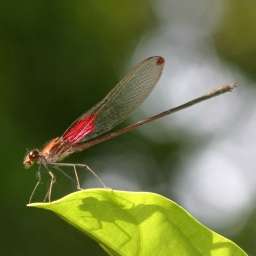
(PhysOrg.com) -- In new research, UCLA scientists claim that "secondary sexual traits" like coloring may let animals know which species to avoid fighting.
Why do so many animal species — including fish, birds and insects — display such rich diversity in coloration and other traits? In new research, Gregory Grether, UCLA professor of ecology and evolutionary biology, and Christopher Anderson, who recently earned his doctorate in Grether's laboratory, offer an answer.
At least since Charles Darwin, biologists have noticed that species differ in "secondary sexual traits," such as bright coloring or elaborate horns, Grether said. Darwin attributed this diversity to sexual selection, meaning the traits increased an animal's ability to attract mates.
But Grether and Anderson, writing in the Oct. 28 issue of the journal Proceedings of the Royal Society B: Biological Sciences, emphasize another evolutionary factor.
"The cost of attacking the wrong type of male and of being attacked by the wrong type of male favors the rich diversity of coloration and of birdsong and chemical cues, such as odors, to identify rivals," Grether said.
Grether and Anderson studied several species of the Hetaerina damselfly (closely related to dragonflies) and found that differences in coloration served to help damselflies distinguish males of their own species, who are rivals, from those of other species, who are not.
"We found that male Hetaerina damselflies use species differences in wing coloration to distinguish between intruders of their own species and intruders of other damselfly species, but only at sites where the two species naturally occur together," he said. "This provides one of the clearest demonstrations yet of an evolutionary process that is probably very prevalent in nature but which has largely been overlooked. We tested for shifts in what animals recognize as competitors."
Nobel Prize-winning Austrian ethologist and zoologist Konrad Lorenz suggested in 1962 that the spectacularly diverse coloration of coral reef fish was likely due to selection against fighting with the wrong species.
"Just as there could be selection against mating with the wrong species, there can also be selection against fighting with the wrong species," Grether said. "Lorenz said there was no advantage to coral reef fish attacking species that are close in proximity but are not competitors. The idea never really reached the level of attention in evolutionary biology that it deserved."
Lorenz's idea may not accurately explain the color diversity of coral reef fish, Grether said, but it may explain the diversity of coloration of other animal groups.
"When species are found in the same location, they do a better job of telling apart males of their own species from males of the other species than they do in places where they do not occur together," Grether said.
At sites where only one damselfly species occurs naturally, the researchers tested their theory by using members of that species whose wings had been artificially colored to resemble males of another damselfly species.
"We can test their responses at both kinds of sites, and we found they show greater discrimination between males of their own species and of other species at places where they actually have to contend with the other species than at places where they don't. They differentiate based on color," Grether said. "That this ability has evolved as a result of selection against fighting with other species is suggested quite strongly by the fact that in places where the other species do not occur, they do not make that distinction.
"If there is no reason for two species to interact aggressively with each other — as Lorenz argued with coral reef fish — then you would expect evolution to favor the ability for them to tell the difference by, for example, an exaggeration in the initial difference in color between them," Grether said. "Differences in color might enable females to more readily tell their own males apart from males of other species. Selection against interspecies aggression could favor the evolution of increased differences between species in color."
Some damselflies species also differ more in coloration where they occur together than where they occur alone, but "this finding can be explained either by selection against mating with the wrong species or selection against fighting with the wrong species," Grether said.
In future research, Grether hopes to learn what proportion of species can tell the difference between members of their own species and members of other species and whether they respond more strongly to their own species in a competitive context. Interspecies aggression and the evolutionary effect it has are understudied scientific questions, Grether said.
In addition to studying several species of damselflies in Mexico and Texas, Grether and Anderson collaborated with modeler Kenichi Okamoto to construct a mathematical model of what happens when species with similar secondary sexual traits come into contact. The model, published in the November 2009 issue of the journal Biological Reviews, predicts rapid evolutionary shifts in secondary sexual traits and also in what the animals recognize as competitors.
"My reading of the evidence," Grether said, "is that these evolutionary processes are important."
Provided by University of California Los Angeles (news : web)


