Wolves, moose and biodiversity: An unexpected connection
November 2, 2009 Wolves, moose and biodiversity: An unexpected connection

Enlarge

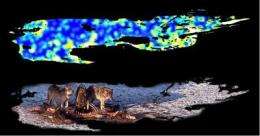
The coastline of Isle Royale National Park is represented in two maps. Moose carcasses, like the ones on which wolves are feeding in lower map, produce pulses of nutrients that affect soil fertility, decomposition and the nutrition of nearby plants. Clustered hotspots of biogeochemical activity are seen in the yellow to white zones in upper map. Credit: Michigan Technological University

Moose eat plants; wolves kill moose. What difference does this classic predator-prey interaction make to biodiversity?

A large and unexpected one, say wildlife biologists from Michigan Technological University. Joseph Bump, Rolf Peterson and John Vucetich report in the November 2009 issue of the journal Ecology that the carcasses of moose killed by wolves at Isle Royale National Park enrich the soil in "hot spots" of forest fertility around the kills, causing rapid microbial and fungal growth that provide increased nutrients for plants in the area.

"This study demonstrates an unforeseen link between the hunting behavior of a top predator—the wolf—and biochemical hot spots on the landscape," said Bump, an assistant professor in Michigan Tech's School of Forest Resources and Environmental Science and first author of the research paper. "It's important because it illuminates another contribution large predators make to the ecosystem they live in and illustrates what can be protected or lost when predators are preserved or exterminated."

Bump and his colleagues studied a 50-year record of more than 3,600 moose carcasses at Isle Royale. They measured the nitrogen, phosphorus and potassium levels in the soil at paired sites of wolf-killed moose carcasses and controls. They also analyzed the microbes and fungi in the soil and the leaf tissue of large-leaf aster, a common native plant eaten by moose in eastern and central North America.

They found that soils at carcass sites had 100 to 600 percent more inorganic nitrogen, phosphorus and potassium than soil from surrounding control sites. Carcass sites also had an average of 38 percent more bacterial and fungal , evidence of increased growth of bacteria and fungi.

The nitrogen levels in plants growing on the carcass sites was from 25 to 47 percent higher than the levels at the control sites. Since large herbivores, like moose, are attracted to nitrogen-rich plants, the carcass sites become foraging sites, further supplementing soil nutrients from the urine and feces of the animals eating there.

"I was initially skeptical that it would be possible to detect something as diffuse in the forest floor as nutrients from dead animals," said Peterson, who has been studying the wolves and moose of Isle Royale for decades. "It was gratifying to see Joseph succeed in following animal-derived nutrients back into plants to enrich them in protein, ready to be eaten again."

Even moose killed in winter and mostly consumed produce substantial nutrient hot spots, Bump reports. "At the landscape scale, long-term carcass deposition patterns could influence forest dynamics by shifting competitive relationships among tree seedlings through changes in the nutrient concentrations in their growth environment," he writes.

Bump has observed similar effects on the soil and plant life at elk carcass sites in Yellowstone National Park, another place where wolves are predators and large herbivores are their prey. And he adds that on the Arctic tundra, where soil nutrients are limited, others have found that the impact of a muskox carcass on surrounding vegetation is dramatic even after 10 years.

"Predation and nutrient cycling are two of the most important of all ecological processes, but they seem just about completely unrelated to one another," observes Vucetich. Also on the faculty of Michigan Tech's School of Forest Resources and Environmental Science, Vucetich conducts an annual winter study of the wolves and moose of Isle Royale. "Bump has led us to understand how these two seemingly disparate processes—predation and nutrient cycling—are in fact connected and connected in a most interesting way."

The strong and unexpected connections between wolves, and the biogeochemistry of their ecosystem are important to policy makers involved in predator management and to a public increasingly concerned about conservation, Bump suggests.

Source: Michigan Technological University (news : web)


print this article email this article download pdf blog this article bookmark this article     Stumble it Digg this share on Facebook retweet share on Reddit add to delicious
Rate this story - 4.9 /5 (7 votes)

Rank Filter

Move the slider to adjust rank threshold, so that you can hide some of the comments.


Display comments: newest first

  • vit - Nov 02, 2009
    • Rank: not rated yet
    The thing is the moose will die and create the hotspots regardless of whether wolves kill them.
  • david_42 - Nov 02, 2009
    • Rank: not rated yet
    A moose dying in a random location does not produce much of a hot spot. The article is addressing areas where frequent kills occur. Since wolves are territorial, the nutrients are concentrated in relatively small areas. I see this in my neighbor's field. Hunters drag their deer and elk into an open area where they left their trucks (at the top of the hill), then dress them. The coyotes clean up the remains, but you can see where the work was done for years.
  • jimbo92107 - Nov 02, 2009
    • Rank: not rated yet
    Wolves chase moose to clearings, where the prey cannot maneuver, and where they can see approaching threats after the kill. The resulting pulse of nutrients feeds plants in a spot with plenty of sunlight, providing food for more moose...
    Without the wolves, the moose would still die, but they'd die in the woods, not in a clearing. Over time, the clearings, lacking added nutrients, would get more and more barren.
  • Jayofalltrades - Nov 02, 2009
    • Rank: not rated yet
    This all seems pretty common sense. I'm guessing that no one has proven it until now, which is why it is news worthy.

November 2, 2009 all stories

Comments: 4

4.9 /5 (7 votes)
  • Stumble this up

  • Digg this

  • share this

  • hide
  • Related Stories

  • Bone Deformities Linked to Inbreeding in Wolves of Isle Royale
    created Apr 02, 2009 | popularity not rated yet | comments 0
  • Moose multiplying in Scandinavia
    created Apr 20, 2008 | popularity not rated yet | comments 0
  • Prey not hard-wired to fear predators
    created Jun 20, 2007 | popularity not rated yet | comments 0
  • Inbreeding taking toll on Michigan wolves
    created Apr 04, 2009 | popularity not rated yet | comments 0
  • Warmer weather threatens moose in Minnesota
    created Sep 28, 2009 | popularity not rated yet | comments 0


  • hide
  • Relevant PhysicsForums posts

  • Glucose effectiveness and insulin sensitivity
    created Dec 02, 2009
  • Conflict about classifying Protist?
    created Dec 01, 2009
  • snake gourd vs an egg
    created Nov 30, 2009
  • burns
    created Nov 30, 2009
  • What type of adhesive to use with Aspergillus Niger experiments?
    created Nov 30, 2009
  • Is it true that
    created Nov 27, 2009
  • More from Physics Forums - Biology

Other News

Chicken of the sea? Tuna farming getting a boost (AP)

Chicken of the sea? Tuna farming getting a boost

Biology / Ecology

created 25 minutes ago | popularity not rated yet | comments 0

(AP) -- Thousands of tuna, their silver bellies bloated with fat, swim frantically around in netted areas of a small bay, stuffing themselves until they grow twice as heavy as in the wild. Is this sushi's ...


meat

Pork meat grown in the laboratory

Biology / Biotechnology

created Dec 01, 2009 | popularity 4.7 / 5 (32) | comments 29

(PhysOrg.com) -- Scientists from Eindhoven University in The Netherlands have for the first time grown pork meat in the laboratory by extracting cells from a live pig and growing them in a petri dish.


A farmer droving his sheep, northwest of Melbourne

Australian scientists aim to reduce sheep burps

Biology / Biotechnology

created Nov 29, 2009 | popularity 2.2 / 5 (6) | comments 9

Australian scientists are working to breed a sheep that belches less, as they look for ways to reduce harmful methane emissions from the country's woolly flocks, a researcher said Sunday.


Sylvia atricapilla (Blackcap)

By feeding the birds, you could change their evolutionary fate

Biology / Plants & Animals

created Dec 03, 2009 | popularity 4 / 5 (5) | comments 6

Feeding birds in winter is a most innocent human activity, but it can nonetheless have profound effects on the evolutionary future of a species, and those changes can be seen in the very near term. That's ...


Research shows some plants can remove indoor pollutants

Research shows some plants can remove indoor pollutants

Biology / Plants & Animals

created Dec 02, 2009 | popularity 4.7 / 5 (15) | comments 2

(PhysOrg.com) -- Some plants have the ability to drastically reduce levels of indoor pollutants, according to new research at the University of Georgia. Researchers showed that certain species can effectively ...