Robot fish could monitor water quality
November 2, 2009 Robot fish could monitor water quality

Enlarge

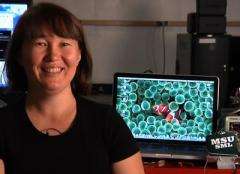
This is Michigan State University assistant professor of zoology Elena Litchman. Credit: G.L. Kohuth, Michigan State University

Nature inspires technology for an engineer and an ecologist teamed up at Michigan State University. They're developing robots that use advanced materials to swim like fish to probe underwater environments.

"Fish are very efficient," explained Xiaobo Tan, an assistant professor of electrical and computer engineering. "They can perform very efficient locomotion and maneuvering in the water."

Robotic fish - perhaps schools of them operating autonomously for months - could give researchers far more precise data on aquatic conditions, deepening our knowledge of critical water supplies and habitats.

Tan and Elena Litchman, an assistant professor of zoology based at MSU's Kellogg Biological Station on Gull Lake in Kalamazoo County, recently won funding from the National Science Foundation to integrate their research.

"The robotic fish will be providing a consistent level of data that hasn't been possible before," Litchman explained. "With these patrolling fish we will be able to obtain information at an unprecedentedly high spatial and temporal resolution. Such data are essential for researchers to have a more complete picture of what is happening under the surface as and other outside forces disrupt the freshwater . It will bring to a whole new level."

The robotic fish will carry sensors recording such things as temperature, dissolved oxygen, pollutants and harmful algae. Tan also is developing electronics so the devices can navigate and communicate in their watery environment.

"This project will greatly advance bio-robotic technology," Tan said. "The project is very practical and we are designing the fish to be inexpensive so they can be used in various applications like sampling lakes, monitoring aquafarms and safeguarding water reservoirs."

The robotic fish might detect toxic algal blooms, for example.

"As air temperature increases, the lakes and reservoirs also heat up," Litchman said. "Increasing water temperature creates strong stratification within the various layers of the water and this may lead to increased growth of harmful algae. Some of these algal blooms create poor conditions for fish and exude toxins that also endanger people."

To mimic how fish swim and maneuver, Tan builds "fins" for robotic fish with electro-active polymers that use electricity to change shape. Similar to real muscle tissue, ion movements twist and bend the polymer when voltage is applied. The effect works in reverse, too - slender "feelers" could signal maneuvering circuits in a sort of electro-active central nervous system. Infrared sensors also could be used for "eyes" to avoid obstacles.

The robots will communicate wirelessly with a docking station after surfacing at programmed intervals and could similarly be linked to other robotic fish for coordinated maneuvers or signal relay. Global positioning system technology and inertial measurement units will allow precise navigation.

It's not big, but it's a keeper: A 9-inch prototype now swimming in Tan's laboratory tank is modeled on the yellow perch by John Thon, a member of the research team who teaches art at nearby Holt Junior High School. The device isn't strong enough to resist stiff currents, so for now must be confined to relatively still waters. Future versions will incorporate the ability to change buoyancy to assist locomotion and maneuver.

Source: Michigan State University (news : web)


print this article email this article download pdf blog this article bookmark this article     Stumble it Digg this share on Facebook retweet share on Reddit add to delicious
Rate this story - 4 /5 (1 vote)

Rank Filter

Move the slider to adjust rank threshold, so that you can hide some of the comments.


Display comments: newest first

  • DGBEACH - Nov 02, 2009
    • Rank: not rated yet
    t's not big, but it's a keeper: A 9-inch prototype now swimming in Tan's laboratory tank is modeled on the yellow perch by John Thon, a member of the research team who teaches art at nearby Holt Junior High School. The device isn't strong enough to resist stiff currents, so for now must be confined to relatively still waters. Future versions will incorporate the ability to change buoyancy to assist locomotion and maneuver.

    At only nine inches this thing would end up as fish food...maybe they should give it some armaments...like electric shocks (like an eel), or maybe an inflatable spiked membrane around it so it could "blow up" like a blow fish.
  • nuge - Nov 02, 2009
    • Rank: not rated yet
    At only nine inches this thing would end up as fish food...maybe they should give it some armaments...like electric shocks (like an eel), or maybe an inflatable spiked membrane around it so it could "blow up" like a blow fish.


    Congratulations, I think you just invented Robot Wars 2.0

November 2, 2009 all stories

Comments: 2

4 /5 (1 vote)
  • Stumble this up

  • Digg this

  • share this

  • hide
  • Related Stories

  • Fish-shaped robot for underwater research
    created Dec 16, 2004 | popularity not rated yet | comments 0
  • Robotic fish in action at London Aquarium
    created Oct 06, 2005 | popularity not rated yet | comments 0
  • School of Robofish provides basis for underwater robot teams
    created Jun 06, 2008 | popularity not rated yet | comments 0
  • New robots mimic fish's swimming (w/ Video)
    created Aug 24, 2009 | popularity not rated yet | comments 0
  • British-built robotic fish to detect pollution
    created Mar 19, 2009 | popularity not rated yet | comments 0


  • hide
  • Relevant PhysicsForums posts

  • Aspiring Engineering major looking for general answers
    created 18 hours ago
  • Calculating max load of square tube (steel)
    created Nov 19, 2009
  • Passive Chemical Heating
    created Nov 19, 2009
  • Shortening Boat Trailer
    created Nov 18, 2009
  • More from Physics Forums - General Engineering

Other News

Qualcomm's next e-book to use a mirasol display

Qualcomm's next e-book to use a mirasol display

Electronics / Consumer & Gadgets

created 11 hours ago | popularity 4.5 / 5 (6) | comments 2

(PhysOrg.com) -- Qualcomm subsidiary Mirasol is developing a new e-book reader with a color display that uses ambient light. The reader will be capable of displaying video smoothly, but the new features will ...


B&N Nook sells out, too late for holiday orders

Electronics / Consumer & Gadgets

created 2 hours ago | popularity not rated yet | comments 0

(AP) -- Consumers who haven't yet ordered Barnes & Noble's electronic book reader, the Nook, won't see one before Christmas.


More than powerful: German research computer QPACE is the most energy efficient in the world

Electronics / Hardware

created 4 hours ago | popularity not rated yet | comments 0

At the 2009 Supercomputing Conference in Portland, Oregon, the high-performance computer QPACE (QCD Parallel Computing on the Cell) was recognized today as the most energy-efficient supercomputer in the world.


'Rationalizer' bracelet tells traders when they're stressed

'Rationalizer' bracelet tells traders when they're stressed

Electronics / Consumer & Gadgets

created Nov 17, 2009 | popularity 4.3 / 5 (6) | comments 4

(PhysOrg.com) -- Philips Electronics and the Dutch bank ABN AMRO have joined forces to develop a "Rationalizer" bracelet system that detects stress levels and displays a warning to help day-traders avoid making ...


Oak Ridge 'Jaguar' supercomputer is World's fastest

Oak Ridge 'Jaguar' supercomputer is World's fastest

Electronics / Hardware

created Nov 16, 2009 | popularity 4.5 / 5 (13) | comments 2

An upgrade to a Cray XT5 high-performance computing system deployed by the Department of Energy has made the "Jaguar" supercomputer the world's fastest. Located at Oak Ridge National Laboratory, Jaguar is ...