New insights into Australia's unique platypus
November 2, 2009 New insights into Australia's unique platypus

Enlarge

Image courtesy of CSIRO

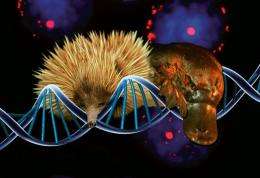
(PhysOrg.com) -- New insights into the biology of the platypus and echidna have been published, providing a collection of unique research data about the world's only monotremes.

University of Adelaide geneticist Dr Frank Grützner and his team have authored five of 28 papers which appear in two special issues of the Australian Journal of Zoology and Reproduction Fertility and Development.

The articles shed new light on the extraordinary complex system.

"For the first time we have looked at how the 10 sex chromosomes find each other during sperm development in platypus," Dr Grützner says.

"We discovered that a remarkably organised mechanism must exist in platypus, where sex chromosomes from one end pair first and then they go down the sex chromosome chain, just like a zipper. There is nothing random about it."

Dr Grützner and his colleagues also isolated and analysed for the first time the sequence of the male-specific Y chromosomes.

"Previously we knew nothing about the Y chromosomes because only the female platypus genome was sequenced. The data we found has given us valuable clues about the evolution of Y in all , including humans," Dr Grützner says.

All 28 published articles in the CSIRO journals have arisen from the Boden Research Conference, "Beyond the Platypus Genome", hosted by the University of Adelaide in November 2008, which attracted researchers from around the world.

The published papers represent a wide range of monotreme research, from to field biology, population genetics and captive breeding, evolution to immunology, venom, sperm and milk in both the platypus and echidna.

"I expect these results to make a major impact in the field of monotreme research and mammal evolution," Dr Grützner says.

"We have entered a new era in monotreme research, where we are seeing a more integrated approach using genomics, biochemistry and field biology to tackle important questions in monotreme biology. This knowledge will also help us conserve these iconic Australian mammals," he says.

Provided by University of Adelaide (news : web)


print this article email this article download pdf blog this article bookmark this article     Stumble it Digg this share on Facebook retweet share on Reddit add to delicious
Rate this story - 4.5 /5 (2 votes)


November 2, 2009 all stories

Comments: 0

4.5 /5 (2 votes)
  • Stumble this up

  • Digg this

  • share this

  • hide
  • Related Stories

  • Uni leads study on echidna sex life
    created Aug 22, 2007 | popularity not rated yet | comments 0
  • Platypus link to ovarian cancer
    created Jun 26, 2009 | popularity not rated yet | comments 0
  • Male sex chromosome losing genes by rapid evolution, study reveals
    created Jul 17, 2009 | popularity not rated yet | comments 0
  • Platypus genome explains animal's peculiar features; holds clues to evolution of mammals
    created May 07, 2008 | popularity not rated yet | comments 0
  • Australian marsupials challenge gene theory
    created Apr 30, 2007 | popularity not rated yet | comments 0


  • hide
  • Relevant PhysicsForums posts

  • Questions about diffusion
    created 6 hours ago
  • Human Leukocyte Antigen (HLA) typing
    created 13 hours ago
  • Breeding program
    created Nov 20, 2009
  • How does a concentration gradient provide energy?
    created Nov 20, 2009
  • More from Physics Forums - Biology

Other News

The Monarchs' annual migration ritual has yet to be scientifically explained

Tree-eating bugs threaten Monarch butterfly in Mexico

Biology / Ecology

created 14 hours ago | popularity 4 / 5 (1) | comments 0

The mysterious Monarch butterfly, which migrates en masse annually between Canada and Mexico, is now facing a new peril: another insect thriving in Western Mexican forests.


Bigger not necessarily better, when it comes to brains

Bigger not necessarily better, when it comes to brains

Biology / Plants & Animals

created Nov 17, 2009 | popularity 4.5 / 5 (18) | comments 11

(PhysOrg.com) -- Tiny insects could be as intelligent as much bigger animals, despite only having a brain the size of a pinhead, say scientists at Queen Mary, University of London.


Extinct goat Myotragus balearicus

Extinct goat was cold-blooded

Biology / Plants & Animals

created Nov 18, 2009 | popularity 4.9 / 5 (33) | comments 10

(PhysOrg.com) -- An extinct goat that lived on a barren Mediterranean island survived for millions of years by reducing in size and by becoming cold-blooded, which has never before been discovered in mammals.


Right-handed chimpanzees provide clues to the origin of human language

Biology / Plants & Animals

created Nov 16, 2009 | popularity 3 / 5 (1) | comments 7

Most of the linguistic functions in humans are controlled by the left cerebral hemisphere. A study of captive chimpanzees at the Yerkes National Primate Research Center (Atlanta, Georgia), reported in the January 2010 issue ...


The creature was found at a depth of 161 metres

Japanese researchers film rare baby fish 'fossil'

Biology / Plants & Animals

created Nov 17, 2009 | popularity 4.7 / 5 (7) | comments 4

Japanese marine researchers said Tuesday they had found and successfully filmed a young coelacanth -- a rare type of fish known as "a living fossil" -- in deep water off Indonesia.