Solar winds triggered by magnetic fields
November 2, 2009
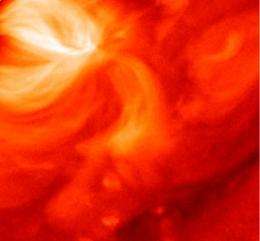
Solar winds (courtesy of Hinode)
(PhysOrg.com) -- Solar wind generated by the sun is probably driven by a process involving powerful magnetic fields, according to a new study led by UCL (University College London) researchers based on the latest observations from the Hinode satellite.
Scientists have long speculated on the source of solar winds. The Extreme Ultraviolet Imaging Spectrometer (EIS), on board the Japanese-UK-US Hinode satellite, is now generating unprecedented observations enabling scientists to provide a new perspective on the 50-year old question of how solar wind is driven. The collaborative study, published in this month’s issue of Astrophysical Journal, suggests that a process called slipping reconnection may drive these winds.
Deb Baker, lead author from UCL Mullard Space Science Laboratory, says: “Solar wind is an outflow of million-degree gas and magnetic field that engulfs the Earth and other planets. It fills the entire solar system and links with the magnetic fields of the Earth and other planets. Changes in the Sun’s million-mile-per-hour wind can induce disturbances within near-Earth space and our upper atmosphere and yet we still don’t know what drives these outflows."
“However, our latest study suggests that it is the release of energy stored in solar magnetic fields which provides the additional driver for the solar wind. This magnetic energy release is most efficient in the brightest regions of activity on the Sun’s surface, called active regions or sunspot groups, which are strong concentrations of magnetic field. We believe that this fundamental process happens everywhere on the Sun on virtually all scales.”
Images taken in February 2007 from the EIS instrument showed that hot plasma outflows are due to a process called slipping reconnection. At the edges of active regions where this process can occur, a slow, continuous restructuring of the magnetic field leads to the release of energy and acceleration of particles in the Sun’s hot outer atmosphere, known as the corona. Slipping reconnection is the first theory to explain how observed outflows from the Sun can be located over areas of a single magnetic sign, something previously considered improbable.
Computer models of the Sun’s magnetic field were used to identify regions where slipping reconnection could occur. The locations proposed by the computer model were compared with measurements of the speed of the gas coming from the solar corona. The comparison showed the gas was moving outward at up to 100,000 mph, 1,000 times the wind speed in a hurricane, over the possible slipping reconnection regions.
The study was carried out by the UCL Mullard Space Science Laboratory, Observatoire de Paris, Konkoly Observatory in Hungary and Instituto de Astronomía y Física del Espacio in Argentina. Deborah Baker is funded by a Science and Technology Funding Council (STFC) studentship.
Hinode is a Japanese mission developed and launched by the Institute of Space and Astronautical Science (ISIS) and Japanese Aerospace Exploration Agency (JAXA), with the National Astronomical Observatory of Japan (NAOJ) as domestic partner and NASA and STFC (UK) as international partners. It is operated by these agencies in co-operation with the European Space Agency (ESA) and Norwegian Space Centre (NSC).
Data that served as the basis for the magnetic modelling was provided by the Solar and Heliospheric Observatory (SOHO) Michelson Doppler Imager (MDI) consortium. SOHO is a project of international cooperation between ESA and NASA.
Provided by University College London
-
Hinode reveals new insights about the origin of solar wind
Dec 06, 2007 |
not rated yet |
0
-
ESA’s Cluster flies through Earth’s electrical switch
May 19, 2006 |
not rated yet |
0
-
The Spooky Sun
Oct 31, 2006 |
not rated yet |
0
-
First Images from Hinode Offer New Clues About Our Violent Sun
Dec 22, 2006 |
not rated yet |
0
-
Solar Eruption Seen in Unprecedented Detail
May 27, 2008 |
not rated yet |
0
-
Engineers build first sub-10-nm carbon nanotube transistor
Feb 01, 2012 |
4.9 / 5 (31) |
30
-
Something old, something new: Evolution and the structural divergence of duplicate genes
Jan 31, 2012 |
4.6 / 5 (7) |
1
-
The hidden nanoworld of ice crystals: Revealing the dynamic behavior of quasi-liquid layers
Jan 30, 2012 |
5 / 5 (3) |
1
-
Stock market network reveals investor clustering
Jan 27, 2012 |
3.9 / 5 (23) |
8
-
Of microchemistry and molecules: Electronic microfluidic device synthesizes biocompatible probes
Jan 26, 2012 |
5 / 5 (1) |
0
-
Scale of the Universe
5 hours ago
-
Titan's lack of impact craters
Feb 09, 2012
-
Real pictures of black hole eating a star?
Feb 08, 2012
-
Hypothetical way to travel faster than light, but not technically exceed lightspeed
Feb 06, 2012
-
How do scientists monitor the Sun's activity?
Feb 05, 2012
-
Search patterns in observational studies
Feb 05, 2012
- More from Physics Forums - General Astronomy
More news stories
Humans may have helped the decline of African rainforests 3000 years ago
(PhysOrg.com) -- Large areas of rainforests in Central Africa mysteriously disappeared over three thousand years ago, to be replaced by savannas. The prevailing theory has been that the cause was a change ...
Could Venus be shifting gear?
(PhysOrg.com) -- ESAs Venus Express spacecraft has discovered that our cloud-covered neighbour spins a little slower than previously measured. Peering through the dense atmosphere in the infrared, the ...
Space & Earth / Space Exploration
12 hours ago |
5 / 5 (7) |
7
|
NASA sees wide-eyed cyclone Jasmine
Cyclone Jasmine's eye has opened wider on NASA satellite imagery, as it moves through the Southern Pacific Ocean.
Space & Earth / Earth Sciences
4 hours ago |
2 / 5 (1) |
1
NASA sees Giovanna reach cyclone strength, threaten Madagascar
Tropical Storm 12S built up steam and became a cyclone on February 10, 2012 as NASA's Terra satellite passed overhead. Residents of east-central Madagascar should prepare for this cyclone to make landfall ...
Space & Earth / Earth Sciences
4 hours ago |
not rated yet |
0
Mars Science Laboratory computer issue resolved
(PhysOrg.com) -- Engineers have found the root cause of a computer reset that occurred two months ago on NASA's Mars Science Laboratory and have determined how to correct it.
Space & Earth / Space Exploration
13 hours ago |
4.7 / 5 (6) |
3
|
Google users warned of threat to smartphone wallets
Users of Google smartphone wallets were being warned on Friday that there is a way to crack pass codes intended to thwart thieves from going on illicit shopping sprees.
Anonymous knocks CIA website offline (Update)
The website of the Central Intelligence Agency was inaccessible on Friday after the hacker group Anonymous claimed to have knocked it offline.
Complex wiring of the nervous system may rely on a just a handful of genes and proteins
Researchers at the Salk Institute have discovered a startling feature of early brain development that helps to explain how complex neuron wiring patterns are programmed using just a handful of critical genes. ...
New error-correcting codes guarantee the fastest possible rate of data transmission
Error-correcting codes are one of the triumphs of the digital age. Theyre a way of encoding information so that it can be transmitted across a communication channel such as an optical fiber o ...
The power of estrogen -- male snakes attract other males
A new study has shown that boosting the estrogen levels of male garter snakes causes them to secrete the same pheromones that females use to attract suitors, and turned the males into just about the sexiest ...
Putting the squeeze on planets outside our solar system
(PhysOrg.com) -- Using high-powered lasers, scientists at Lawrence Livermore National Laboratory and collaborators discovered that molten magnesium silicate undergoes a phase change in the liquid state, abruptly ...
Nov 02, 2009
Rank: not rated yet
Magnetic fields do not reconnect. At any one point in space a magnetic field is either increasing or decreasing. The only thing you can say about the "vector" is it either north or south or is decreasing or increasing in density. There are no lines to reconnect. You could say the field has contours due to the underlying current flow and as the flow changes the contours change.
Basic physics Maxwells equations and all that.
Nov 03, 2009
Rank: not rated yet
Also, moving ions (or electrons) are also a sign of electric current. Think of the basic chemical battery. Thus electric current creates a magnetic field.
With the non-reconnecting magnetic fields, do you mean by this that you cannot have a point wise magnet? This is indeed true, but if you have a magnet (the sun is a rather large one), it has fieldline that you can visualize using Ferro-powder (iron, sorry) (btw, in theory that is).
You are indeed right that if the output is changing, the magnetic field will change. As the data also shows, this is a constant changing environment.