Laser-plasma accelerators ride on Einstein's shoulders
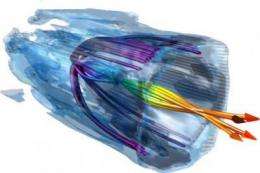
Using Einstein's theory of special relativity to speedup computer simulations, scientists have designed laser-plasma accelerators with energies of 10 billion electron volts (GeV) and beyond. These systems, which have not been simulated in detail until now, could in the future serve as a compact new technology for particle colliders and energetic light sources.
Researchers at Instituto Superior Técnico of Portugal (IST), the University of California at Los Angeles (UCLA), and the U.S. Department of Energy's Lawrence Berkeley National Laboratory (Berkeley Lab) used Einstein's principle that length and time scales change with the speed of the observer (in this case, the simulator) to incorporate otherwise intractable calculations into the simulations required to design these novel accelerators.
High-energy particle accelerators are used in many areas of science and technology, including fundamental physics exploration and discovery, medical science, chemistry, biology, and material science, among others. In the past couple of decades, a new concept of acceleration based on laser (or particle beam) plasma interactions has been demonstrated, with the potential to greatly reduce the size and cost of the world's largest atom smashers and to create very compact accelerators for a wide variety of applications.
In a laser wakefield accelerator (LWFA), an intense, short laser pulse is sent through a column of tenuous plasma, generating a wave wake on which particles can surf to very high energies. The acceleration gradients obtained are more than three orders of magnitude higher than conventional radio-frequency accelerators. In the last five years, LWFA experiments have produced electron beams with energies from 100 million electron volts to 1 GeV within millimeter to centimeter distances. At 1 GeV, an electron is traveling at 99.99999 percent of the speed of light. The next decade promises tremendous improvements as a new generation of more powerful lasers becomes available, and the process becomes better understood.
It is at this point that numerical simulations play a critical role, not only to determine the optimal laser and plasma parameters, but also as a tool to explore new concepts and configurations. The challenge, however, is that accurate one-to-one simulations of the next generation of laser wakefield experiments are not easily possible: it would take more than one year to perform a single simulation using standard techniques. The difficulty arises from the necessity to resolve the laser wavelength of about one micron (1 millionth of a meter) while simulating a laser propagating through a plasma that can be several meters long—distances that are more than six orders of magnitude apart. To access this range of scales in reasonable computational times, researchers have successfully used reduced models. These models, however, cannot capture some of the physics required for next-generation experiments.
Performing simulations in a frame of reference that moves close to the speed of light makes simulations of next-generation experiments possible. By Einstein's theory of special relativity, the laser pulse will stretch and the plasma will contract, which brings the scales of the two entities closer together. This means that modeling an experiment in this "boosted frame" can be more than 1,000 times faster than a simulation in the standard "laboratory frame."
Using this technique, scientists at IST, UCLA, and LBNL are now designing and simulating self-guided stages up to 12 GeV - and externally guided and injected stages up to 50 GeV. These new kinds of numerical experiments enable the scientists to understand the new physical processes involved, to optimize experimental parameters, and to estimate the acceleration possible with the next generation of laser systems. The new results show that laser wakefield acceleration with near term lasers could lead to compact, less expensive infrastructures for fundamental science research, for new accelerator technology development, and might potentially lead to a future particle collider at very high energies.
Source: American Physical Society


