The terrible teens of T. rex
We all know adolescents get testy from time to time. Thank goodness we don't have young tyrannosaurs running around the neighborhood.
In a new scientific paper, researchers from Northern Illinois University and the Burpee Museum of Natural History in Rockford report that adolescent tyrannosaurs got into some serious scraps with their peers.
The evidence can be found on Jane, the museum's prized juvenile Tyrannosaurus rex, discovered in 2001 in Montana.
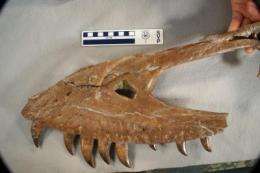
Jane's fossils show that she sustained a serious bite that punctured through the bone of the dinosaur's left upper jaw and snout in four places, the researchers report. The injury wasn't life threatening and eventually healed over, according to the scientists.
The bite did leave scars, however.
"Jane has what we call a boxer's nose," says Joe Peterson, an NIU Ph.D. candidate in geology and lead author of the study published in the November issue of the journal, Palaios.
"Her snout bends slightly to the left. It was probably broken and healed back crooked."
The researchers determined that another juvenile tyrannosaur was responsible for the injury.
"Only a few animals could have inflicted the wound," Peterson says, noting that the bite marks were oblong-shaped. A crocodile or an adult T. rex would have left different types of bite marks.
"When we looked at the jaw and teeth of Jane, we realized her bite would have produced a very close match to the injuries on her own face," Peterson says. "That leads us to believe she was attacked by a member of the same species that was about the same age. Because the wound had healed, we think this happened when Jane was possibly a few years younger."
Peterson and Mike Henderson, curator of earth sciences at the Burpee Museum and also a Ph.D. candidate in geology at NIU, were members of the museum group that unearthed the pristine dinosaur skeleton. NIU Presidential Research Professor Reed Scherer, also among the new study's authors, worked as an adviser on the find.
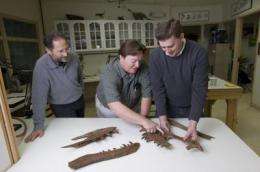
"What's unique about this work is we learn something very, very specific about juvenile dinosaur behavior," Scherer says. "This was an animal about the same size that attacked Jane. Whether it was a sibling or from a rival group, we don't know, but it's fun to speculate."
The sex of Jane, who was named after a museum donor, is unknown. The dinosaur was young when it died, but the Burpee Museum's display leaves no doubt that it was still a creature to be reckoned with. Twenty-two feet long and 7 1/2 feet high at the hip, the young dinosaur tipped the scales at about 1,500 pounds. And it was built to kill, with 71 serrated teeth.
Still, Jane was vastly smaller than an adult T. rex. After much study and consultation with leading U.S. dinosaur experts, Henderson, who led the Montana expeditions, announced in 2006 that Jane was a late juvenile T. rex, about 11 or 12 years old.
"The study of the bite marks on Jane's face demonstrates that even at a young age this dinosaur was engaging in some pretty serious combat," Peterson says. He likened the animal to an adolescent that hadn't quite reached what would have been a huge growth spurt.
The puncture wounds were first noticed several years after the dinosaur was discovered.
"When Jane's skull was found, the bones were disarticulated, or in pieces," Peterson says. "I was examining the casts of the skull bones. I saw that when the left maxilla (upper jawbone) was pieced together, it had more holes in it than the right side. And there was a pattern to the gaps in the side of the face.
"The surface of the face and edges around the puncture marks were smooth, indicating that there hadn't been a fresh break there and the wounds must have healed over while the animal was alive," he adds.
Dr. Christopher Vittore, a Burpee Museum board member and radiologist at Rockford Memorial Hospital, who also contributed to the study in Palaios, took CT scans of the fossils and confirmed Peterson's hypothesis.
"CT scans demonstrated that the holes are most consistent with traumatic puncture injuries that had significant time for healing," Vittore says.
"Complete bone healing requires time for bone remodeling, and CT images show the internal structure of the bone adjacent to the puncture lesions," Vittore adds. "The internal character of the bone showed the injuries occurred significantly earlier in the animal's life, and there was time for healing. It also confirmed that there were no other abnormalities in the bone adjacent to the lesions."
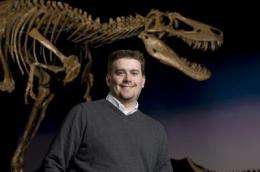
Because the dinosaur had not reached maturity, the researchers concluded that the combat was not likely over sexual conflict or competition but might have been a learning behavior for young dinosaurs prompted by a show of dominance or territorial dispute.
Peterson says other adolescent animals, particularly juvenile crocodiles, exhibit such fighting behavior.
"It's common to find similar puncture marks on young crocodiles," he says. "We can look at the behavior of these modern living ancestors of dinosaurs and get a good idea of what was going on here."
A recent study suggested that, in some dinosaurs, apparent bite marks are actually holes in the skull caused by a parasite. Researchers speculated that such a parasitic infection might have led to the demise of Sue, the famous T. rex at the Field Museum in Chicago.
NIU researchers don't believe a parasite caused Jane's injuries.
"The parasite that has been described causes lesions on the lower jaw," Peterson says. "With Jane, the lesions are on the actual face and are not the same type of structures we see on Sue."
Source: Northern Illinois University


