Possible origins of pancreatic cancer revealed
November 2, 2009 by Anne Trafton
Possible origins of pancreatic cancer revealed

Enlarge

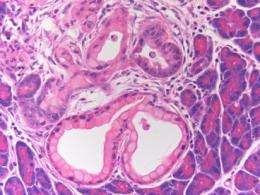
Seen here are two clusters of precancerous cells (lower half of image), which arose in pancreatic cells expressing the pdx1 protein and the cancer gene K-ras. Image courtesy of Sharon Friedlander

(PhysOrg.com) -- MIT cancer biologists have identified a subpopulation of cells that can give rise to pancreatic cancer. They also found that tumors can form in other, more mature pancreatic cell types, but only when they are injured or inflamed, suggesting that pancreatic cancer can arise from different types of cells depending on the circumstances.

Pancreatic cancer is the fourth-leading cause of cancer death in the United States, killing an estimated 35,000 Americans each year. One of the reasons pancreatic cancer is so deadly is that it is hard to detect it in the early stages, and that’s partly because scientists aren't sure from which cell(s) it arises.

Now, in findings that could help answer that question, MIT cancer biologists have identified a subpopulation of cells that can give rise to this disease. They also found that tumors can form in other, more mature pancreatic cell types, but only when they are injured or inflamed, suggesting that pancreatic cancer can arise from different types of cells depending on the circumstances.

“By the time pancreatic disease is typically diagnosed, it’s already very advanced and non-curable. Our new findings can help scientists focus their drug development efforts and lead them to new ways to detect the disease in early stages,” says Sharon Friedlander, a postdoctoral associate at the David H. Koch Institute for Integrative Cancer Research at MIT and lead author of a paper describing the work in the Nov. 3 issue of Cancer Cell.

The team, led by Koch Institute Director Tyler Jacks, found that in adult mice, tumors originate from a subpopulation of pancreatic cells that express a protein called pdx1 (but not from all cells that express pdx1). This protein plays a critical role in pancreas development and differentiation, a process of specialization that normally occurs during embryonic development but can also occur later in life. This suggests that under normal conditions, pancreatic cancer may arise from a type of adult stem cell that can differentiate into mature pancreatic cells, says Friedlander.

When the cancer-promoting gene K-ras, commonly activated in tumors, was turned on in the pdx1-expressing cells, they became cancerous. However, mature pancreatic cells, such as insulin-secreting cells, became cancerous only when they expressed K-ras and also suffered from chronic inflammation. Under these conditions, the insulin-secreting cells became another cell type, a condition that appears necessary before they can initiate pancreatic cancer.

In humans, 90 percent of pancreatic tumors express K-ras, though activation of that gene alone is not enough to cause cancer — most tumors have dozens of mutations.

Charles Murtaugh, a genetics professor at the University of Utah, who was not involved in the research, says the paper draws attention to the role of injury and inflammation in pancreatic cancer initiation. “It appears that these processes, coupled with specific changes to the genome of pre-cancer cells, are able to override normal differentiation controls to an extent not previously appreciated,” says Murtaugh, who studies the genetics of pancreatic diseases.

In future studies, the MIT researchers plan to use their mouse models to follow the molecular events that take place during pancreatic cancer development and identify potential targets for drug treatments and protein markers for early diagnosis. These new mouse models could also help researchers test potential pancreatic cancer treatments.

More information: "Context-dependent transformation of adult pancreatic cells by oncogenic K-ras," Sharon Gidekel Friedlander, Tyler Jacks, et al. Cancer Cell, Nov. 3 issue.

Source: Massachusetts Institute of Technology (news : web)


Rank 3 /5 (1 vote)
Relevant PhysicsForums posts
  • We the immaterial soul
    created8 hours ago
  • Is Everyday Technology Killing Us?
    createdFeb 08, 2012
  • Exercise and weight loss
    createdFeb 08, 2012
  • Why do we have head aches? Our brains can't feel anything.
    createdFeb 07, 2012
  • "The end of diseases" by David Agus, interview from Daily Show with Jon Stewart
    createdFeb 04, 2012
  • Oncolytic adenovirus
    createdFeb 04, 2012
  • More from Physics Forums - Medical Sciences

More news stories

Injured boomers beware: Know when to see doctor

(AP) -- It happened to nurse Jane Byron years after an in-line skating fall, business owner Haralee Weintraub while doing "men's" push-ups, and avid cyclist Gene Wilberg while lifting a heavy box.

Medicine & Health / Health

created 16 minutes ago | popularity not rated yet | comments 0

FDA-approved drug rapidly clears amyloid from the brain, reverses Alzheimer's symptoms in mice

Neuroscientists at Case Western Reserve University School of Medicine have made a dramatic breakthrough in their efforts to find a cure for Alzheimer's disease. The researchers' findings, published in the journal Science, show t ...

Medicine & Health / Neuroscience

created Feb 09, 2012 | popularity 4.9 / 5 (53) | comments 21 | with audio podcast

Green tea found to reduce disability in the elderly

(Medical Xpress) -- A lot of research has been done over the past several years looking into the health benefits of green tea. As a result, scientists have found that regular consumption of the beverage leads ...

Medicine & Health / Health

created Feb 07, 2012 | popularity 4.4 / 5 (14) | comments 11 | with audio podcast report

Teen school drop-outs three times as likely to be on benefits in later life

Teen school drop-outs are almost three times as likely to be on benefits in later life as their peers who complete their schooling, indicates research published online in the Journal of Epidemiology and Community Health.

Medicine & Health / Health

created Feb 06, 2012 | popularity not rated yet | comments 13

To perform with less effort, practice beyond perfection

Whether you are an athlete, a musician or a stroke patient learning to walk again, practice can make perfect, but more practice may make you more efficient, according to a surprising new University of Colorado Boulder study.

Medicine & Health / Neuroscience

created Feb 09, 2012 | popularity 4.4 / 5 (15) | comments 6 | with audio podcast


Google might launch Drive for cloud storage soon

(PhysOrg.com) -- Google's next big move, according to the Wall Street Journal, is a cloud storage service called Drive. Hardly first to the plate, Google is simply catching up to introducing its cloud reposi ...

Latin America mining boom clashes with conservation

Latin America is experiencing a mining boom as prices rise fuelled by a hike in global demand, but the region is also being hit by a wave of violent protests, strikes and rallies by environmentalists.

Love a click away in Indonesia's Twitter Republic

He was a geeky kid from Yogyakarta, she a glamorous city girl in Jakarta. In a country with one of the world's most vibrant social networking scenes they fell in love on Twitter.

Europeans protest controversial Internet pact

Tens of thousands of people marched in protests in more than a dozen European cities Saturday against a controversial anti-online piracy pact that critics say could curtail Internet freedom.

Walney offshore wind farm is world's biggest (for now)

(PhysOrg.com) -- The Walney wind farm on the Irish Sea--characterized by high tides, waves and windy weather--officially opened this week. The farm is treated in the press as a very big deal as the Walney ...

Navy to begin tests on electromagnetic railgun prototype launcher

The Office of Naval Research (ONR)'s Electromagnetic (EM) Railgun program will take an important step forward in the coming weeks when the first industry railgun prototype launcher is tested at a facility ...