Researchers to perform sex change operation on papaya
November 2, 2009
Researchers to perform sex change operation on papaya

Enlarge

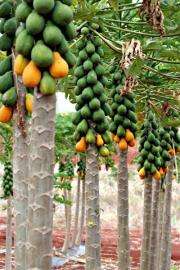
Researchers will produce true-breeding hermaphrodite papayas, an advance that will boost plant health, reduce growers' costs and their use of fertilizers and water. Credit: Photo courtesy of James Carr

The complicated sex life of the papaya is about to get even more interesting, thanks to a $3.1 million grant from the National Science Foundation. The grant will fund basic research on the papaya sex chromosomes and will lead to the development of a papaya that produces only hermaphrodite offspring, an advance that will enhance papaya health while radically cutting papaya growers' production costs and their use of fertilizers and water.

"We're going to change the sex of the papaya to help the farmers," said University of Illinois professor Ray Ming, who will lead the effort with researchers from the Hawaii Agriculture Research Center, Texas A&M University and Miami University. A USDA scientist will also collaborate on the initiative.

"This is a perfect case to demonstrate how basic science can help the farmers directly," Ming said. "In our case we can apply it immediately as a byproduct of the research program."

Papayas already come in three sexual varieties: male, female and hermaphrodite. The hermaphrodite produces the flavorful fruit that is sold commercially. From the grower's perspective, however, hermaphrodite plants come with a severe handicap: their seeds produce some female plants (which are useless commercially) and some hermaphrodites.

The problem is exacerbated by the fact that it is impossible to tell the sex of a seed until it has grown up and flowered. This means that papaya farmers must plant five or more seeds together to maximize the likelihood of obtaining at least one hermaphrodite plant. Once they identify a desired plant, they cut the others down.

"This is labor intensive, resource intensive," Ming said. Crowding also causes the plants to "develop a poor root system and small canopy that delays fruit production," he said.

Ming co-led an international team that produced a first draft of the papaya genome in 2008. This draft, which sequenced more than 90 percent of the plant's genes, offered new insights into the evolution of flowering plants in general, and the unusual sexual evolution of the papaya.

Ming and his colleagues have identified regions of interest on the papaya's three sex chromosomes: the X, Y, and Yh. (XX produces a female plant, XY a male, and XYh a hermaphrodite. All combinations of Y and Yh fail to develop beyond the early embryonic stage after pollination.)

The Y and Yh chromosomes contain genes that promote the development of the male reproductive organ, the stamen, in male and hermaphrodite trees. And, the researchers hypothesize, the Y chromosome also contains a gene that disables the development of the female sexual organ, the carpel. The researchers theorize that the Yh chromosome lacks the gene that turns off development of the carpel, however, allowing both male and female organs to grow in XYh plants.

The researchers will focus on finding these genes and testing their hypotheses, Ming said.

Once they have identified the sex-determining genes of the Y chromosome, they will move the gene responsible for stamen development into the female genome and change the sex from female to hermaphrodite - without the Yh chromosome. The resulting hermaphrodite will produce only hermaphrodite seeds, Ming said, eliminating a major headache for farmers while improving the health of the papayas and the environment.

Further research will explore the origin and evolution of the sex chromosomes by comparing the papaya to five other related species in two genera and by conducting population genetic studies of the papaya sex chromosomes.

Source: University of Illinois at Urbana-Champaign (news : web)

3.3 /5 (3 votes)  

Rank 3.3 /5 (3 votes)
Relevant PhysicsForums posts
  • a single mRNA strand is attached to sevaral ribosomes?
    created14 hours ago
  • Oestrogen and FSH
    createdFeb 07, 2012
  • Linear Blood Vessel Network Examples in Animals or Plants
    createdFeb 07, 2012
  • Neuroscientists: What is a Principal Cell Layer?
    createdFeb 06, 2012
  • How does slime mould grow?
    createdFeb 04, 2012
  • Why are mosquitoes and bedbugs successful?
    createdFeb 04, 2012
  • More from Physics Forums - Biology

More news stories

Study shows how DNA finds its match

It's been more than 50 years since James Watson and Francis Crick showed that DNA is a double helix of two strands that complement each other. But how does a short piece of DNA find its match, out of the millions ...

Biology / Cell & Microbiology

created 2 hours ago | popularity 5 / 5 (2) | comments 0 | with audio podcast

Obstacles no barrier to higher speeds for worms, researchers find

Obstacles in an organism's path can help it to move faster, not slower, researchers from New York University's Applied Math Lab at the Courant Institute of Mathematical Sciences have found through a series ...

Biology / Plants & Animals

created 4 hours ago | popularity 3 / 5 (1) | comments 3 | with audio podcast

Transformational fruit fly genome catalog completed

Scientists searching for the genomics version of the holy grail – more insight into predicting how an animal's genes affect physical or behavioral traits – now have a reference manual that should ...

Biology / Biotechnology

created 2 hours ago | popularity 5 / 5 (1) | comments 0 | with audio podcast

Tiny primate 'talks' in ultrasound

One of the world's smallest primates, the Philippine tarsier, communicates in a range of ultrasound inaudible to predator and prey alike, according to a study published on Wednesday.

Biology / Plants & Animals

created 11 hours ago | popularity 4.8 / 5 (5) | comments 0

Scared of a younger rival? Not for some male songbirds

When mature male white-crowned sparrows duel to win a mate or a nesting territory, a young bird just doesn't get much respect.

Biology / Plants & Animals

created 11 hours ago | popularity 4 / 5 (2) | comments 0 | with audio podcast


Short fasting cycles work as well as chemotherapy in mice

Man may not live by bread alone, but cancer in animals appears less resilient, judging by a study that found chemotherapy drugs work better when combined with cycles of short, severe fasting.

Physicists build highly efficient 'no-waste' laser

A team of University of California, San Diego researchers has built the smallest room-temperature nanolaser to date, as well as an even more startling device: a highly efficient, "thresholdless" laser that ...

Transparent iron? For the first time, an experiment shows that atomic nuclei can become transparent

At the high-brilliance synchrotron light source PETRA III, a team of DESY scientists headed by Dr. Ralf Röhlsberger has succeeded in making atomic nuclei transparent with the help of X-ray light. At the ...

Quantum physicist explains $100K offer for proof scaled-up quantum computing is impossible

(PhysOrg.com) -- MIT researcher Scott Aaronson has certainly riled the physics community with his offer this past Friday, of $100,000 to anyone who can prove that scaled-up quantum computing is impossible. ...

'Explorers,' who embrace the uncertainty of choices, use specific part of cortex

Life shrouds most choices in mystery. Some people inch toward a comfortable enough spot and stick close to that rewarding status quo. Out to dinner, they order the usual. Others consider their options systematically ...

Scientists delve into the brain roots of hunger and eating

Synaptic plasticity – the ability of the synaptic connections between the brain's neurons to change and modify over time -- has been shown to be a key to memory formation and the acquisition of new learning behaviors. ...