Science Begins at the World's Most Powerful X-ray Laser (w/ Video)
November 2, 2009 Science begins at the world's most powerful X-ray laser

Enlarge

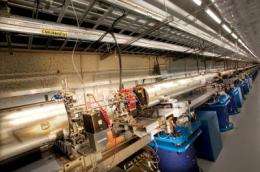
Thirty-three LCLS undulator magnets create intense X-ray laser light from a pulse of electrons traveling 99.9999999 percent the speed of light. Credit: Image courtesy of Brad Plummer, SLAC.

(PhysOrg.com) -- The first experiments are now underway using the world's most powerful X-ray laser, the Linac Coherent Light Source, located at the Department of Energy's SLAC National Accelerator Laboratory. Illuminating objects and processes at unprecedented speed and scale, the LCLS has embarked on groundbreaking research in physics, structural biology, energy science, chemistry and a host of other fields.

In early October, researchers from around the globe began traveling to SLAC to get an initial glimpse into how the X-ray interacts with atoms and molecules. The LCLS is unique, shining light that can resolve detail the size of atoms at ten billion times the brightness of any other manmade X-ray source.

"No one has ever had access to this kind of light before," said LCLS Director Jo Stöhr. "The realization of the LCLS isn't only a huge achievement for SLAC, but an achievement for the global science community. It will allow us to study the atomic world in ways never before possible."

The LCLS is a testament to SLAC's continued leadership in accelerator technology. Over 40 years ago, the laboratory's two-mile linear accelerator, or linac, was built to study the fundamental building blocks of the universe. Now, decades later, this same machine has been revitalized for frontier research underway at the LCLS.

You need Flash installed to watch this ideo

The first experiments are now underway using the world's most powerful X-ray laser, the Linac Coherent Light Source, located at the Department of Energy's SLAC National Accelerator Laboratory. Illuminating objects and processes at unprecedented speed and scale, the LCLS has embarked on groundbreaking research in physics, structural biology, energy science, chemistry and a host of other fields. Credit: Video courtesy of SLAC National Accelerator Laboratory.

After SLAC's linac accelerates very short pulses of electrons to 99.9999999 percent the speed of light, the LCLS takes them through a 100-meter stretch of alternating magnets that force the electrons to slalom back and forth. This motion causes the electrons to emit X-rays, which become synchronized as they interact with the electron pulses over this long slalom course, thereby creating the world's brightest X-ray laser pulse. Each of these packs as many as 10 trillion X-ray photons into a bunch that's a mere 100 femtoseconds long—the time it takes light to travel the width of a human hair.

Currently, user-assisted commissioning is underway, with researchers conducting experiments using the Atomic, Molecular and Optical science instrument, the first of six planned instruments for the LCLS. In these first AMO experiments, researchers are using X-rays from the LCLS to gain an in-depth understanding of how the ultra-bright beam interacts with matter.

Early experiments are already revealing new insights into the fundamentals of atomic physics and have successfully proven the machine's unique capabilities to control and manipulate the underlying properties of atoms and molecules. Earlier this month, researchers used the LCLS's strobe-like pulses to completely strip neon atoms of all their . Researchers also watched for two-photon ionization—an event where two photons pool their energy to eject a single electron from an atom. Normally difficult to observe at X-ray facilities, researchers at the LCLS were able to study these events using the extreme brightness of the laser beam.

Future AMO experiments will create stop-action movies of molecules in motion. The LCLS's quick, short, repetitive X-ray bursts enable researchers to take individual photos as molecules move and interact. By stringing together many such images to make a movie, researchers will for the first time have the ability to watch the molecules of life in action, view chemical bonds forming and breaking in real time, and see how materials work on the quantum level.

By 2013, all six LCLS scientific instruments will be online and operational, giving researchers unprecedented tools for a broad range of research in material science, medicine, chemistry, energy science, physics, biology and environmental science.

"It's hard to overstate how successful these first experiments have been," said AMO Instrument Scientist John Bozek. "We look forward to even better things to come."

Source: SLAC National Laboratory (news : web)


Rate this story - 4.4 /5 (9 votes)

Rank Filter

Move the slider to adjust rank threshold, so that you can hide some of the comments.


Display comments: newest first

  • danman5000 - Nov 02, 2009
    • Rank: 5 / 5 (5)
    Very well done movie! That was informative and superbly animated. Amazing stuff!
  • Alexa - Nov 02, 2009
    • Rank: not rated yet
    X-ray beam is visible in air by naked eye as a smelling blue jet, as it ionizes air molecules under ozone formation. In addition, it would pass through your body like through ghost. A scary stuff!

November 2, 2009 all stories

Comments: 2

4.4 /5 (9 votes)

  • hide
  • Related Stories

  • First Test of New X-ray Laser Strips Neon Bare
    created Sep 18, 2009 | popularity not rated yet | comments 0
  • World's First Hard X-ray Laser Achieves 'First Light'
    created Apr 21, 2009 | popularity not rated yet | comments 0
  • Free Electron Lasers and You: An LCLS Primer
    created Dec 05, 2008 | popularity not rated yet | comments 0
  • Ground Breaking New Science at SLAC
    created Oct 23, 2006 | popularity not rated yet | comments 0
  • World's first X-ray free electron laser is on course to completion
    created Jun 25, 2007 | popularity not rated yet | comments 0


  • hide
  • Relevant PhysicsForums posts

  • Calculating decible increases
    created 6 hours ago
  • Coefficients of friction
    created 6 hours ago
  • Deduction of centripetal force
    created 6 hours ago
  • Touching both terminals of a battery
    created 7 hours ago
  • Deduction of thrust force
    created 7 hours ago
  • mass and weight
    created 9 hours ago
  • More from Physics Forums - General Physics

Other News

Extra large carbon

Extra large carbon

Physics / General Physics

created 6 hours ago | popularity 4.7 / 5 (9) | comments 5 | with audio podcast

An exotic form of carbon has been found to have an extra large nucleus, dwarfing even the nuclei of much heavier elements like copper and zinc, in experiments performed in a particle accelerator in Japan. ...


Scientist explore future of high-energy physics

Scientist explore future of high-energy physics

Physics / General Physics

created 12 hours ago | popularity 4.9 / 5 (10) | comments 4 | with audio podcast

In a 1954 speech to the American Physical Society, the University of Chicago's Enrico Fermi fancifully envisioned a particle accelerator that encircled the globe. Such would be the ultimate theoretical outcome, ...


Leaf veins inspire a new model for distribution networks (w/ Video)

Physics / General Physics

created 9 hours ago | popularity 5 / 5 (2) | comments 0 | with audio podcast

(PhysOrg.com) -- Following the straight and narrow may be good moral advice, but it’s not a great design principle for a distribution network. In new research, a team of biophysicists describe a complex netting of interconnected ...


New magnetic tuning method enhances data storage

New magnetic tuning method enhances data storage

Physics / General Physics

created 12 hours ago | popularity 4.3 / 5 (3) | comments 0 | with audio podcast

Researchers in Chicago and London have developed a method for controlling the properties of magnets that could be used to improve the storage capacity of next-generation computer hard drives.


New method for measuring fluid flow in algae could herald revolution for fluid mechanics

Physics / General Physics

created 15 hours ago | popularity 5 / 5 (2) | comments 0 | with audio podcast

In the words of Todd Squires, of the University of California, Santa Barbara "Nature has long inspired researchers in fluid mechanics to explore the mechanical strategies used by living creatures. Where better to look for ...