Precise picture of early Universe supports 'dark matter' theory
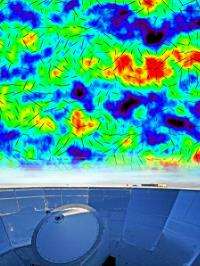
A detailed picture of the seeds of structures in the universe has been unveiled by an international team co-led by a Cardiff University scientist.
The team has obtained extremely precise data about the early universe, using a telescope near the South Pole in the Antarctic.
Their measurements of the cosmic microwave background - a faintly glowing relic of the hot, dense, young universe - provide further support for the standard cosmological model of the universe. The findings confirm the model's prediction that dark matter and dark energy make up 95% of everything in existence, while ordinary matter makes up just 5%.
In a paper published in the November 1 issue of The Astrophysical Journal, researchers on the QUaD telescope project have released detailed maps of the cosmic microwave background (CMB). The researchers focused their measurements on variations in the CMB's temperature and polarization to learn about the distribution of matter in the early universe. Polarization is the direction in which vibrations travel from all light rays, which is at right angles to the ray's direction of travel.
The light from the early universe was initially unpolarized but became polarized when it struck moving matter in the very early universe. By creating maps of this polarization, the QUaD team was able to investigate not just where the matter existed, but also how it was moving. The results very closely match the temperature and polarization predicted by the existence of dark matter and dark energy in the standard cosmological model.
The team was jointly led by Professor Walter Gear, Head of the School of Physics and astronomy at Cardiff University and Professor Sarah Church of the Kavli Institute for Particle Astrophysics and Cosmology (KIPAC), jointly located at the Department of Energy's SLAC National Accelerator Laboratory and Stanford University.
Professor Gear said: "Studying the CMB radiation has given us extremely precise pictures of the Universe at just 400,000 years old. When we first started working on this project the polarization of the CMB hadn't even been detected and we thought we might be able to find something wrong with the theory. The fact that these superb data fit the theory so beautifully is in many ways even more amazing. This reinforces the view that researchers are on the right track and need to learn more about the strange nature of dark energy and dark matter if we are to fully understand the workings of the universe."
Michael Brown, of the Kavli Institute for Cosmology at the University of Cambridge, lead author of the new study added: "With these new QUaD measurements, we have tested further our standard model of the Universe. Reassuringly, the model has passed this test remarkably well."
Professor Sarah Church, Deputy Director of KIPAC, said: "When I first started in this field, some people were adamant that they understood the contents of the universe quite well. But that understanding was shattered when evidence for dark energy was discovered. Now that we again feel we have a very good understanding of what makes up the universe, it's extremely important for us to amass strong evidence using many different measurement techniques that this model is correct, so that this doesn't happen again."
Source: Cardiff University (news : web)


