Study reveals a 'missing link' in immune response to disease (w/ Video)
The immune system's T cells have the unique responsibilities of being both jury and executioner. They examine other cells for signs of disease, including cancers or infections, and, if such evidence is found, rid them from the body. Precisely how T cells shift so swiftly from one role to another, however, has been a mystery.
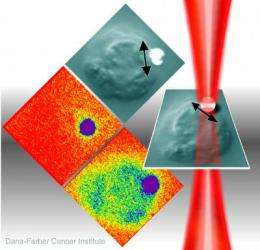
In a new study, investigators at Dana-Farber Cancer Institute, Harvard Medical School, and the Massachusetts Institute of Technology used an array of techniques -- including "optical tweezers" that exploit laser light to press molecules against surface structures found on T cells -- to find out what operates the switch. Their answer: sheer mechanical force. Hence, the T cell receptor is a mechanosensor.
When a T cell's "receptors" lock onto their targeted structures called antigens on the surface of a diseased cell, parts of the receptors bend in a way that signals the T cell to change from disease-scanning to disease-fighting mode, the researchers report. (Antigens are made of peptides bound to histocompatibility proteins, or pMHCs.) They also found that after T cell receptors (TCRs) and antigens meet, an additional force generated during scanning triggers the T cell's response to disease.
Their findings will be published in the Nov. 6 issue of the Journal of Biological Chemistryand currently are available on the journal's Web site.
"The study fills a major gap in our understanding of the molecules that make up the TCR - the role they play in recognizing abnormal antigens and in subsequently activating a T cell to attack diseased cells," says senior author Ellis L. Reinherz, MD, of Dana-Farber and Harvard Medical School. "Our findings explain how TCRs can detect 'a needle in a haystack,' enabling T cells to identify infected or cancerous cells that may look very similar to normal cells, and destroy the diseased cells for the good of the body. Distinguishing between cells that belong in the body from those that don't is the key function of T cells, a discriminative task mediated by their TCRs."
Understanding the details of T cell activation opens the way to development of better immune-based therapies against viral infections and cancers, the authors state. "Vaccines have shown a great deal of promise as cancer treatments, but they need to be made more efficient," says Reinherz. "This fundamental discovery offers important insights that may make it possible to target such vaccines precisely, destroying cancer cells without the harsh side effects of more traditional therapies."
Reinherz says that a broader range of tumor antigens can be selected as potential targets because of the intrinsic sensitivity of the TCR triggering mechanism revealed by this study. Likewise, the discovery offers promise for the development of T cell-based vaccines for infectious disease prevention, currently an area almost exclusively restricted to antibody-based approaches. Antibodies target regions of viruses that vary substantially in many cases, requiring alterations of vaccines, as in the annual flu vaccines. This is not the case for T cell-based therapies, since they can target antigens that don't vary among diverse strains of the same type of virus.
Disease inspectors
T cells are white blood cells that patrol the bloodstream and body's organs for signs of disease, a process termed immune surveillance. When they encounter another cell, they "frisk" it to determine if it is normal or infected, cancerous, or foreign to the body. This inspection takes the form of the T cell brushing against the surface of the other cell. The T cell's surface bristles with receptors -- intricate webs of proteins designed to snag specific antigens, much as a lock accepts only certain keys. Each T cell displays a distinct TCR capable of binding to a specific antigen. The millions of T cells within the bloodstream protect people from a wide variety of invading germs or cells altered by cancerous changes.
TCRs are built of eight individual molecules. Investigators have sought to uncover the basic mechanics of the coupling between TCR and antigen by exploring the role of these eight molecules in recognizing foreign antigens and activating T cells' disease-fighting abilities.
First, immunologists identified monoclonal antibodies (mAbs) that target a portion of the TCR - known as CD3 subunits - involved in T cell activation. They determined which anti-CD3 mAbs activate T cells and which others are non-stimulatory. Using recombinant molecular biology, they generated pMHCs specific for, or irrelevant to, a particular TCR.
Next, structural biologists led by Harvard Medical School's Gerhard Wagner, PhD, used Nuclear Magnetic Resonance techniques to determine the shape of the TCR and the arrangement of its component molecules. Biomechanics scientists led by Matthew Lang, PhD, of MIT then devised a set of experiments involving mAbs and pMHC molecules.
The experiments sought to mimic, under controlled conditions, what normally happens when the TCR encounters an antigen from a diseased cell. The mAbs or pMHCs were mounted on tiny beads called microspheres that can be guided into place by laser beams. The mAbs and pMHCs were brought into contact with TCRs on T cells. By adjusting the angle of the laser beams, researchers could subtly alter the strength and direction with which the TCR and mAb or TCR and pMHC were brought together.
They found that although certain mAbs may bind quite well to the TCR, they were unable to activate the T cells if they bound in a perpendicular fashion -- that is, in a mode similar to pMHC binding to the TCR. The activation occurred only after the mAb or pMHC bound to the TCR was dragged along the T cell surface with optical tweezers. Application of force to other surface molecules including the co-receptor molecule CD8, failed to activate T cells.
The authors also observed that when certain anti-CD3 mAbs attached diagonally beneath a lever-like portion of the TCR, the T cell was signaled to activate without any additional force application. These mAbs bind to the most sensitive part of the TCR, suggesting how the relay of TCR signals operates via its various component parts.
"Our findings with mAbs demonstrate that TCR activation function depends on the angle at which anti-CD3 mAb binding takes place," says the study's lead author, Sun Taek Kim, PhD, of Dana-Farber and Harvard. "The mechanical energy generated by diagonal binding is converted into a signal for activating the T cell."
Kim explains that as a T cell scans the surface of antigen-displaying cells in the body looking for foreign intruders such as viruses or dangerous cancerous mutations, the binding of the TCR by pMHC pulls on the TCR. This dual "ligation plus scanning" operation converts a pull to a push, much like opening a flip lid on a can of soda. This diagonal force on the lever is equivalent to that given spontaneously by the stimulatory anti-CD3 mAb. Once the T cell recognizes its target antigen, T cell movement ceases and the cell transitions from its search mode into destroy mode.
"Immune system-based therapies such as cancer vaccines work by increasing the strength of the immune response to disease through expanding the number of T cells that see a particular tumor antigen," Reinherz explains. "Our findings concerning the mechanosensor function of the TCR imply that specific target antigens can be expressed at very low levels on tumor cells and still be recognized efficiently by these T cells. With this insight, the number of tumor target antigens for cancer-based vaccine therapies can be increased."
Source: Dana-Farber Cancer Institute


