Starburst galaxy sheds light on longstanding cosmic mystery
November 2, 2009 Starburst galaxy sheds light on longstanding cosmic mystery

Enlarge

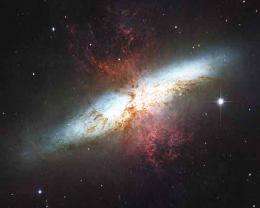
The Cigar Galaxy (M82) is located 12 million light years from Earth, in the direction of the Ursa Major constellation. It has an active starburst region in its center. Image courtesy of NASA, ESA, and the Hubble Heritage Team (STScI/AURA).

(PhysOrg.com) -- An international collaboration that includes scientists from the University of Delaware's Bartol Research Institute in the Department of Physics and Astronomy has discovered very-high-energy gamma rays in the Cigar Galaxy (M82), a bright galaxy filled with exploding stars 12 million light years from Earth.

The gamma rays observed by the team have energies more than a trillion times higher than the energy of visible light and are the highest-energy photons ever detected from a galaxy undergoing large amounts of star formation.

The discovery, made from data taken over a two-year-long observing campaign by the VERITAS collaboration of more than 100 scientists from 22 different institutions in the United States, Ireland, United Kingdom, and Canada, appears in the Nov. 1 advance online edition of the scientific journal Nature.

VERITAS (Very Energetic Radiation Imaging System) is a gamma ray observatory located at the Fred Lawrence Whipple Observatory near Amado, Ariz.

The finding provides "strong evidence" that exploding stars are the origin of cosmic rays, according to Jamie Holder, assistant professor of physics and astronomy at the University of Delaware and deputy spokesperson for the VERITAS collaboration.

Produced in violent processes in our own galaxy and beyond, cosmic rays are actually that continually bombard Earth's atmosphere. They are important, Holder says, because they make up a large fraction of the energy budget of our galaxy, The Milky Way. The amount of energy in cosmic rays is comparable to the energy contained in both starlight, and in Galactic magnetic fields, Holder notes.

"Although cosmic rays were first detected 100 years ago, their origins have been a mystery," says Holder. "One idea has been that they are produced by supernova explosions, but there was never any direct proof until now. This gamma ray measurement by VERITAS looks at a galaxy different from our own where there are 30 times as many supernovae. The fact that we see indicates that there are many more cosmic rays being produced by these supernovae."
VERITAS telescopes help solve 100-year-old mystery: The origin of cosmic rays
Enlarge

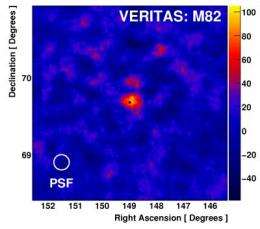
This representative-color figure shows the very-high-energy gamma-ray emission observed by VERITAS coming from the Cigar Galaxy, also known as Messier 82. The black star is the location of the active starburst region. The emission from M82 is effectively point-like for VERITAS, and the white circle indicates the size of a simulated point source. The entire galaxy would be contained within the circle. Credit: CfA/V.A. Acciari

In the active starburst region at the Cigar Galaxy's center, stars are being formed at a rate approximately ten times more rapidly than in "normal" like our Milky Way, Holder says.

The produced in the formation, life, and death of the massive stars in this region eventually produce diffuse gamma-ray emission via their interactions with interstellar gas and radiation.

Holder and former postdoctoral researcher Ester Aliu and doctoral student Dana Boltuch were involved in the study from UD.

Holder scheduled all of the observations as chair of the team's observing time allocation committee, and he and Aliu ran the array of telescopes based in southern Arizona to collect a significant portion of the 137 hours of data collected for the study. Holder provided a critical secondary analysis with an independent analysis package to confirm the result.

Source: University of Delaware (news : web)


print this article email this article download pdf blog this article bookmark this article     Stumble it Digg this share on Facebook retweet share on Reddit add to delicious
Rate this story - 4.3 /5 (3 votes)


November 2, 2009 all stories

Comments: 0

4.3 /5 (3 votes)
  • Stumble this up

  • Digg this

  • share this

  • hide
  • Related Stories

  • Very High Energy Gamma Rays
    created Sep 25, 2009 | popularity not rated yet | comments 0
  • Iowa astrophysicists provide the eyes for new gamma ray telescope system
    created Apr 19, 2007 | popularity not rated yet | comments 0
  • A new unidentified very high energy gamma-ray source in our Galaxy
    created Dec 14, 2004 | popularity not rated yet | comments 0
  • Galactic Center Found To Glow Unevenly
    created Feb 21, 2006 | popularity not rated yet | comments 0
  • On the Scent of a Pre-Historic Particle Accelerator?
    created Feb 09, 2006 | popularity not rated yet | comments 0


  • hide
  • Relevant PhysicsForums posts

  • Earth v. Moon
    created 2 hours ago
  • help me with coordinates and orbits
    created 2 hours ago
  • basic 'our universe' question..
    created 12 hours ago
  • deriving keplers law
    created Nov 19, 2009
  • rotation of Earth
    created Nov 18, 2009
  • elliptical orbits
    created Nov 18, 2009
  • More from Physics Forums - General Astronomy

Other News

Cassini's Big Sky: The View from the Center of Our Solar System

Cassini's Big Sky: The View from the Center of Our Solar System

Space & Earth / Space Exploration

created 21 hours ago | popularity 4.7 / 5 (10) | comments 1

(PhysOrg.com) -- When NASA's Cassini spacecraft began orbiting Saturn five years ago, a dozen highly-tuned science instruments set to work surveying, sniffing, analyzing and scrutinizing the Saturnian system.


Some 6,000 families were affected by the drought in the Chaco region of Paraguay, particularly indigenous populations

El Nino intensifies Latin America drought

Space & Earth / Earth Sciences

created 23 hours ago | popularity 5 / 5 (2) | comments 0

From a devastating food crisis in Guatemala to water cuts in Venezuela, El Nino has compounded drought damage across Latin America this year.


More than 18 million cubic metres of sand are set to be poured onto the new coastal band of dunes until 2011

Dutch build more dunes against rising seas

Space & Earth / Environment

created 16 hours ago | popularity 4.3 / 5 (6) | comments 0

On the beach at Monster, bulldozers painstakingly turn sand dredged from the bottom of the North Sea bed into dunes in an ambitious effort to safeguard the Netherlands from flooding.


New Method to Measure Snow, Soil Moisture With GPS May Benefit Meteorologists, Farmers

Space & Earth / Earth Sciences

created 16 hours ago | popularity not rated yet | comments 1

(PhysOrg.com) -- A research team led by the University of Colorado at Boulder has found a clever way to use traditional GPS satellite signals to measure snow depth as well as soil and vegetation moisture, a technique expected ...


Astronauts await word of baby girl on Earth (AP)

Astronauts await word of baby girl on Earth

Space & Earth / Space Exploration

created 18 hours ago | popularity 5 / 5 (1) | comments 0

(AP) -- Atlantis' astronauts anxiously awaited word on the birth of one crewman's daughter Friday, as they moved more supplies into the International Space Station and geared up for another spacewalk.