Green is cool, but US land changes generally are not
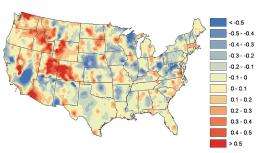
Most land use changes occurring in the continental U.S result in raised regional surface temperatures, says a new study by scientists at the University of Maryland, Purdue University and the University of Colorado in Boulder.
The study, which will appear in the Royal Meteorological Society's International Journal of Climatology, found that almost any change that makes land cover less "green" contributes to warming. A perhaps less intuitive finding is that conversion of any land to agricultural use results in cooling, even land that was previously forested.
Derived using a University of Maryland developed analytical approach known as OMR, the findings build on previous research and add significant weight to a growing recognition among climate scientists for the need to more fully incorporate land use change into computer models that are designed to forecast future changes in climate conditions.
"We found that most land-use changes, especially urbanization, result in warming," said University of Maryland Professor Eugenia Kalnay, one of the study's co-authors. "A clear exception is conversion of land from other uses to agriculture, which produces relative cooling, presumably because of increased evaporation," said Kalnay, who developed the now widely used OMR (observation minus reanalysis) method with former Maryland colleague Ming Cai, now an associate professor at Florida State University.
"The study's results also confirm the robustness of the OMR method, particularly in providing an estimate of the impact of local and regional land cover changes on temperature trends," said Kalnay, a professor in Maryland's department of atmospheric and oceanic science.
The study was led by Purdue University researchers Souleymane Fall and Dev Niyogi and brought together two pioneers in the study of temperature effects of land use change, Maryland's Kalnay and Roger Pielke of the University of Colorado in Boulder, who is widely recognized as a research leader in, and outspoken advocate for, the need to understand climate change at regional and local levels and the significant role land use change plays in climate change.
More to Climate Change than CO2
The coauthors (who in addition to Fall, Niyogi, Kalnay and Pielke also include Alexander Gluhovsky and Gilbert Rochonf of Purdue) note in their paper that, until recently, human-induced changes (warming) in climate have been seen by most scientists as primarily the result of increasing concentrations of carbon dioxide and other greenhouse gases. However, their current paper is the latest of a number of papers in recent years that are shedding light on the climate change impact of land cover change.
"What we highlight here is that a significant trend, particularly the warming trend in terms of temperatures, can also be partially explained by land use change," said Niyogi, a Purdue earth and atmospheric sciences professor and the Indiana state climatologist, who is the corresponding author of the article.
"People realize that land use cover also is an important forcing and not only at local but at regional scale," said Fall, whose doctoral research at Purdue focuses on the impacts of land surface properties on near surface temperature trends.
These finding don't negate the effects of greenhouses gases like carbon dioxide, explained Kalnay, who this year was given the International Meteorological Organization (IMO) Prize, the World Meteorological Organization's most prestigious award. "I think that greenhouse warming is incredibly important, but land use should not be neglected," she said. "It clearly contributes to warming, especially in urban and arid areas."
A map shows observation minus reanalysis (OMR) trends in the continental United States from 1979-2003. The trends are associated with land use and land use changes. Researchers from Purdue University and the universities of Colorado and Maryland conducted a study of the continental United States. Their results show that land use can affect surface temperatures locally and regionally. Units are in degrees Celsius per decade. Credit: Souleymane Fall
Among the study's specific findings:
- In general, the more the vegetation (greener) covering area of land, the cooler its contribution to surface temperature.
- Land use conversion more often results in warming than cooling.
- Urbanization and conversion to bare soils have the largest warming impacts
- Conversion to agriculture results in cooling, while conversion from agriculture generally results in warming.
- Deforestation generally results in warming, with the exception of a shift from forest to agriculture
- the temperature effect of planting a new forest is unclear.
Source: University of Maryland (news : web)


