Mirinae floods Philippines, makes landfall in Vietnam with strong thunderstorms
November 2, 2009 Mirinae floods Philippines, makes landfall in Vietnam with strong thunderstorms

Enlarge

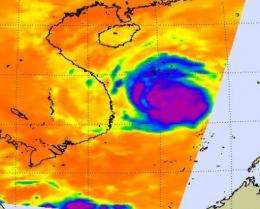
NASA's Aqua satellite AIRS instrument captured Tropical Storm Mirinae Nov. 1 while it was tracking toward Vietnam for a final landfall. The infrared imagery still showed some high thunderstorms (purple), despite a weakening storm. Look closely to see the eye. Credit: NASA JPL, Ed Olsen

Mirinae (Santi) caused 12 hours of flooding rains in the Philippines when it crossed the northern Luzon region over the weekend. On October 31 at 5 a.m. Local (Asia/Manila) Time (October 30 at 2100 UTC) Typhoon Mirinae weakened dramatically after it moved inland over central Luzon, the Philippines. By October 31 at 5 p.m. Local time, Mirinae had already reemerged into the South China Sea as a tropical storm and was headed for Vietnam, but it left behind floods, destruction and death. Mirinae made landfall in Vietnam early this morning, Eastern Time.

NASA's Aqua satellite captured an image of Mirinae as it tracked through the South yesterday, November 1 and had near 57 mph. The storm still maintained good formation, and Aqua's Atmospheric Infrared Sounder (AIRS) instrument still showed some high thunderstorms implying moderate to heavy rainfall, within. The also showed an eye in the storm, where the clouds were lower and warmer. The surrounding clouds had temperatures colder than -63F than those in the "eye."

By November 2 at 10 a.m. EDT or 7 p.m. local (Asia/Ho_Chi_Minh) time in Vietnam, Tropical Storm Mirinae had already crossed the South China Seas and made landfall in Vietnam. It made landfall around 1 a.m. EDT this morning, November 2. By 10 a.m. EDT today, it was located 155 miles northeast of Ho Chi Minh, Vietnam, near 12.7 North and 108.5 East. Mirinae had maximum sustained winds near 52 mph, and was moving west near 14 mph.

Mirinae is now dissipating over Vietnam and western Cambodia. The storm's remnants could move into the Gulf of Thailand, but Mirinae isn't expected to regenerate.

When Mirinae, or Santi as it was called in the Philippines, tracked over northern Luzon, it dropped copious amounts of rainfall causing serious flooding, power outages and taking at least 10 lives. More than 10,000 people in 54 villages were reported affected.

When Mirinae left Luzon and entered the South Sea late on October 31, its maximum sustained winds were down to 63 mph (55 knots) and it was a . Early this morning it made its final in Vietnam.

Today brings a day of clean up in Luzon, but an awareness of yet another tropical threat. 320 miles northeast of Manila in the Philippine Sea, another tropical depression has formed and it may track over the northern Philippines in the next several days.

Source: JPL/NASA (news : web)


print this article email this article download pdf blog this article bookmark this article     Stumble it Digg this share on Facebook retweet share on Reddit add to delicious
Rate this story - not rated yet


November 2, 2009 all stories

Comments: 0

not rated yet
  • Stumble this up

  • Digg this

  • share this

  • hide
  • Related Stories


  • hide
  • Relevant PhysicsForums posts

Other News

Baby can wait as expectant dad finishes spacewalk (AP)

Baby can wait as expectant dad finishes spacewalk

Space & Earth / Space Exploration

created 20 hours ago | popularity 3 / 5 (2) | comments 0

(AP) -- A spacewalking astronaut put aside the impending birth of his daughter and blazed through his first-ever venture outside the International Space Station on Saturday.


Commuters wait on the platform shrouded by fog in London

Climate change not man-made, say majority of Britons: poll

Space & Earth / Environment

created Nov 15, 2009 | popularity 3.3 / 5 (15) | comments 46

Less than half of Britons believes that human activity is to blame for global warming, according to a poll carried out for The Times newspaper and published on Saturday.


Mysteriously warm times in Antarctica

Mysteriously warm times in Antarctica

Space & Earth / Earth Sciences

created Nov 18, 2009 | popularity 4.2 / 5 (21) | comments 28

(PhysOrg.com) -- A new study of Antarctica's past climate reveals that temperatures during the warm periods between ice ages (interglacials) may have been higher than previously thought. The latest analysis ...


UN: Fight climate change with free condoms (AP)

UN: Fight climate change with free condoms

Space & Earth / Environment

created Nov 18, 2009 | popularity 3.1 / 5 (11) | comments 30

(AP) -- The battle against global warming could be helped if the world slowed population growth by making free condoms and family planning advice more widely available, the U.N. Population Fund said Wednesday.


Mystery of the Solar Tsunami -- Solved

Mystery of the Solar Tsunami -- Solved (w/ Video)

Space & Earth / Astronomy

created Nov 19, 2009 | popularity 4.9 / 5 (24) | comments 8

(PhysOrg.com) -- Sometimes you really can believe your eyes. That's what NASA's Solar Terrestrial Relations Observatory (STEREO) is telling researchers about a controversial phenomenon on the sun known as ...