Digital 'plaster' for monitoring vital signs undergoes first clinical trials
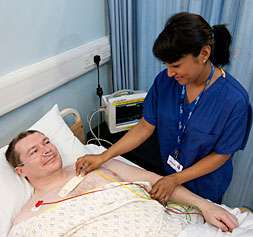
A wireless digital 'plaster' that can monitor vital signs continuously and remotely is being tried out with patients and healthy volunteers at Imperial College Healthcare NHS Trust, in a new clinical trial run by Imperial College London researchers.
Toumaz Technology Ltd's Sensium™ digital 'plaster' or 'patch' is a disposable device that sticks to a patient's chest. It is designed to allow patients to have their health monitored continuously without being wired up to bulky, fixed monitoring machines, potentially freeing some patients from their hospital beds.
The digital plaster is based on innovative technology created by engineers at Imperial College London. It contains a wireless, smart, ultra-low power sensor platform in a silicon chip, which can monitor a range of vital signs like body temperature, heart rate and respiration in real-time.
The intention is that healthcare professionals will be able to download this information using a mobile phone, enabling them to pick up on any critical changes in their patients' status on a 24-7 basis and allowing early detection and treatment of any unforeseen complications.
The data can also be integrated automatically into the patient's electronic medical record.
The team that developed the Sensium digital plaster from Toumaz Technology Ltd, a spin-out from Imperial College London, hope that it will enable some patients to recover from surgery and illness at home rather than in hospital. It should also mean that hospital in-patients have greater mobility. In addition, it could allow doctors to extend continuous monitoring of vital signs to a broader range of patients.
The disposable plaster has a working life of several days, after which it can be replaced, ensuring that infection control can be maintained.
Professor Chris Toumazou FRS led the team that developed the plaster and he is the CEO and co-founder of Toumaz Technology Ltd and the Director of the Institute of Biomedical Engineering at Imperial College London. He said:
"We think the digital plaster could revolutionise healthcare and we're really excited to see it being tried out with patients for the first time. Ultimately, the plaster could mean that doctors can keep track of any worrying changes in patients' vital signs 24 hours a day, 7 days a week, and then deal with any problems that arise really quickly. We think that fewer patients will have medical complications if doctors can spot health problems as soon as they arise and then treat each patient accordingly.
"We're hoping that the plaster will improve the health and wellbeing of a vast range of patients - from patients on a general hospital ward to people with chronic diseases like diabetes and cardiovascular disease who want to have their health monitored without having to keep visiting the hospital. At the same time, the plaster should free up doctors and nurses' time by allowing them to keep an eye on patients without continuously checking bits of machinery," added Professor Toumazou.
In the new trial, which is funded by CareFusion, researchers will be exploring whether the physiological data that doctors and nurses can obtain using the digital plaster system is equivalent to that which can be acquired using the current gold-standard monitors in use in hospitals.
The trial is being conducted in three phases: an initial phase with non-patient volunteers, followed by two patient study groups from Imperial College Healthcare NHS Trust - patients recovering from surgery and patients with specific medical conditions in the general wards. Those taking part in the trial will wear the digital plaster and they will also be connected to a state-of-the-art monitoring machine, so that the researchers can compare the performance of the two. Initial results are expected by the end of December 2009.
Dr Stephen Brett, the researcher who is leading the clinical trial, who is an Honorary Senior Lecturer at Imperial College London and a Consultant in Intensive Care Medicine at Imperial College Healthcare NHS Trust, said: "This project involves taking an elegant piece of engineering, developing it into a potentially clinically usable system and evaluating it in an acute hospital setting. Currently, unless they are in critical care or are identified as being at particular risk, most patients only have their vital signs measured every few hours. This can't give us a complete picture of a patient's health.
"If the new technology proves effective, it could enable us to collect vital sign information really frequently from large numbers of hospital patients, with minimal inconvenience to them. As the plaster is wireless, we would be able to collect the data without impairing patients' ability to move about. This would be great because it is often important for a patient's recovery to ensure that they can stay mobile."
The trial is taking place within the Academic Health Science Centre (AHSC), a partnership between Imperial College London and Imperial College Healthcare NHS Trust, formed in October 2007. The AHSC's aim is to improve the quality of life of patients and populations by taking new discoveries and translating them into new therapies as quickly as possible.
Source: Imperial College London (news : web)


