Fermi Telescope Detects Gamma-Ray From 'Star Factories' in Other Galaxies
November 2, 2009 by Francis Reddy
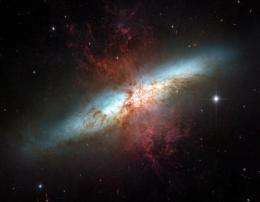
M82, also known as the Cigar Galaxy, lies 12 million light-years away in the constellation Ursa Major. Fermi’s LAT and the ground-based VERITAS observatory have detected diffuse gamma rays from the galaxy’s core, which produces stars at a rate ten times faster than our entire galaxy. Credit: NASA/ESA/Hubble Heritage Team (STScI/AURA)
Nearby galaxies undergoing a furious pace of star formation also emit lots of gamma rays, say astronomers using NASA's Fermi Gamma-ray Space Telescope. Two so-called "starburst" galaxies, plus a satellite of our own Milky Way galaxy, represent a new category of gamma-ray-emitting objects detected both by Fermi and ground-based observatories.
"Starburst galaxies have not been accessible in gamma rays before," said Fermi team member Seth Digel, a physicist at SLAC National Accelerator Laboratory in Menlo Park, Calif. "Most of the galaxies Fermi sees are exotic and distant blazars, which produce jets powered by matter falling into enormous black holes. But these new galaxies are much closer to us and much more like our own."
Gamma rays are the most energetic form of light. Fermi has detected more than a thousand point sources and hundreds of gamma-ray bursts, but the satellite also detects a broad glow that roughly follows the plane of our galaxy. This diffuse gamma-ray emission results when fast-moving particles called cosmic rays strike galactic gas or even starlight.
Cosmic rays are hyperfast electrons, positrons, and atomic nuclei moving at nearly the speed of light. But, although Earth is constantly bombarded by these particles, their origin remains a mystery nearly a century after their discovery. Astronomers suspect that the rapidly expanding shells of exploded stars somehow accelerate cosmic ray particles to their fantastic energy.
"For the first time, we're seeing diffuse emission from star-forming regions in galaxies other than our own," noted Jürgen Knödlseder, a Fermi collaborator at the Center for the Study of Space Radiation in Toulouse, France. He spoke to reporters today at the 2009 Fermi Symposium, a Washington gathering of hundreds of astrophysicists involved in the Fermi mission and related studies. The meeting continues through Nov. 5.
Knödlseder revealed an image captured by Fermi's Large Area Telescope (LAT) of a star-forming region known as 30 Doradus within the Large Magellanic Cloud (LMC). Located 170,000 light-years away in the southern constellation Dorado, the LMC is the largest of several small satellite galaxies that orbit our own.
More stars form in the 30 Doradus "star factory" than in any similar location in the Milky Way. "The region is an intense source of gamma rays, and the diffuse emission we see with Fermi follows the glowing gas we see in visible light," Knödlseder explained.
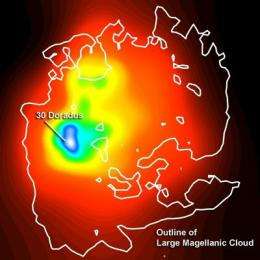
Fermi's Large Area Telescope (LAT) shows that an intense star-forming region in the Large Magellanic Cloud named 30 Doradus is also a source of diffuse gamma rays. Brighter colors indicate larger numbers of detected gamma rays. Credit: NASA/DOE/Fermi LAT Collaboration
The region lights up in gamma rays for the same reason the Milky Way does -- because cosmic rays strike gas clouds and starlight. But Fermi shows that the LMC's brightest diffuse emission remains close to 30 Doradus and doesn't extend across the galaxy. This implies that the stellar factory itself is the source of the cosmic rays producing the glow."Star-forming regions produce lots of massive, short-lived stars, which explode when they die," Digel said. "The connection makes sense."
"The tangled magnetic fields near 30 Doradus probably confine the cosmic rays to their acceleration sites," Knödlseder said.
Fermi's LAT sees diffuse emission from the starburst galaxies M82 and NGC 253, both of which were also seen this year by ground-based observatories sensitive to gamma rays hundreds of times more energetic than the LAT can detect. They do this by imaging faint flashes in the upper atmosphere caused by the absorption of gamma rays carrying trillions of times the energy of visible light.
"The core of M82 forms stars at a rate ten times greater than the entire Milky Way galaxy," said Niklas Karlsson, a postdoctoral fellow at Adler Planetarium in Chicago. He is also a member of the science team for VERITAS, an array of gamma-ray telescopes in Arizona that detected M82, which lies 12 million light-years away in the constellation Ursa Major.
"These very-high-energy gamma rays probe physical processes in other galaxies that will help us understand how and where cosmic rays become accelerated," Karlsson explained.
"Our sensitivity to gamma-rays -- both in space and on the ground -- has increased enormously thanks to Fermi and observatories like VERITAS," Digel said. "This is opening up the detailed study of high-energy processes in galaxies very close to home." NASA's Fermi Gamma Ray Space Telescope is an astrophysics and particle physics partnership, developed in collaboration with the U.S. Department of Energy, along with important contributions from academic institutions and partners in France, Germany, Italy, Japan, Sweden and the United States.
-
Active galaxies flare and fade in Fermi telescope all-sky movie (w/Video)
Apr 24, 2009 |
not rated yet |
0
-
Fermi telescope finds gamma-ray galaxy surprises
Jul 14, 2009 |
not rated yet |
0
-
Fermi telescope explores high-energy 'space invaders'
May 04, 2009 |
not rated yet |
0
-
Large Area Telescope explores high-energy particles
Jul 28, 2009 |
not rated yet |
0
-
Starburst galaxy sheds light on longstanding cosmic mystery
Nov 02, 2009 |
not rated yet |
0
-
Engineers build first sub-10-nm carbon nanotube transistor
Feb 01, 2012 |
4.9 / 5 (31) |
30
-
Something old, something new: Evolution and the structural divergence of duplicate genes
Jan 31, 2012 |
4.6 / 5 (7) |
1
-
The hidden nanoworld of ice crystals: Revealing the dynamic behavior of quasi-liquid layers
Jan 30, 2012 |
5 / 5 (3) |
1
-
Stock market network reveals investor clustering
Jan 27, 2012 |
3.9 / 5 (23) |
8
-
Of microchemistry and molecules: Electronic microfluidic device synthesizes biocompatible probes
Jan 26, 2012 |
5 / 5 (1) |
0
-
Scale of the Universe
2 hours ago
-
Titan's lack of impact craters
Feb 09, 2012
-
Real pictures of black hole eating a star?
Feb 08, 2012
-
Hypothetical way to travel faster than light, but not technically exceed lightspeed
Feb 06, 2012
-
How do scientists monitor the Sun's activity?
Feb 05, 2012
-
Search patterns in observational studies
Feb 05, 2012
- More from Physics Forums - General Astronomy
More news stories
NASA sees wide-eyed cyclone Jasmine
Cyclone Jasmine's eye has opened wider on NASA satellite imagery, as it moves through the Southern Pacific Ocean.
Space & Earth / Earth Sciences
2 hours ago |
not rated yet |
1
NASA sees Giovanna reach cyclone strength, threaten Madagascar
Tropical Storm 12S built up steam and became a cyclone on February 10, 2012 as NASA's Terra satellite passed overhead. Residents of east-central Madagascar should prepare for this cyclone to make landfall ...
Space & Earth / Earth Sciences
2 hours ago |
not rated yet |
0
Humans may have helped the decline of African rainforests 3000 years ago
(PhysOrg.com) -- Large areas of rainforests in Central Africa mysteriously disappeared over three thousand years ago, to be replaced by savannas. The prevailing theory has been that the cause was a change ...
Could Venus be shifting gear?
(PhysOrg.com) -- ESAs Venus Express spacecraft has discovered that our cloud-covered neighbour spins a little slower than previously measured. Peering through the dense atmosphere in the infrared, the ...
Space & Earth / Space Exploration
10 hours ago |
5 / 5 (7) |
7
|
Mars Science Laboratory computer issue resolved
(PhysOrg.com) -- Engineers have found the root cause of a computer reset that occurred two months ago on NASA's Mars Science Laboratory and have determined how to correct it.
Space & Earth / Space Exploration
11 hours ago |
4.7 / 5 (6) |
3
|
Google users warned of threat to smartphone wallets
Users of Google smartphone wallets were being warned on Friday that there is a way to crack pass codes intended to thwart thieves from going on illicit shopping sprees.
Anonymous knocks CIA website offline (Update)
The website of the Central Intelligence Agency was inaccessible on Friday after the hacker group Anonymous claimed to have knocked it offline.
Complex wiring of the nervous system may rely on a just a handful of genes and proteins
Researchers at the Salk Institute have discovered a startling feature of early brain development that helps to explain how complex neuron wiring patterns are programmed using just a handful of critical genes. ...
Putting the squeeze on planets outside our solar system
(PhysOrg.com) -- Using high-powered lasers, scientists at Lawrence Livermore National Laboratory and collaborators discovered that molten magnesium silicate undergoes a phase change in the liquid state, abruptly ...
The power of estrogen -- male snakes attract other males
A new study has shown that boosting the estrogen levels of male garter snakes causes them to secrete the same pheromones that females use to attract suitors, and turned the males into just about the sexiest ...
New error-correcting codes guarantee the fastest possible rate of data transmission
Error-correcting codes are one of the triumphs of the digital age. Theyre a way of encoding information so that it can be transmitted across a communication channel such as an optical fiber o ...
