Unraveling the mechanisms behind organ regeneration in zebrafish
The search for the holy grail of regenerative medicine -- the ability to "grow back" a perfect body part when one is lost to injury or disease -- has been under way for years, yet the steps involved in this seemingly magic process are still poorly understood.
Now researchers at the Salk Institute for Biological Studies have identified an essential cellular pathway in zebrafish that paves the way for limb regeneration by unlocking gene expression patterns last seen during embryonic development. They found that a process known as histone demethylation switches cells at the amputation site from an inactive to an active state, which turns on the genes required to build a copy of the lost limb.
"This is the first real molecular insight into what is happening during limb regeneration," says first author Scott Stewart, Ph.D., a postdoctoral researcher in the lab of Juan Carlos Izpisúa Belmonte, Ph.D., who led the Salk team. "Until now, how amputation is translated into gene activation has been like magic. Finally we have a handle on a process we can actually follow."
Their findings, which will be published in a forthcoming issue of Proceedings of the National Academy of Sciences, U.S.A., help to explain how epimorphic regeneration—the regrowing of morphologically and functionally perfect copies of amputated limbs—is controlled, an important step toward understanding why certain animals can do it and we cannot.
"Our experiments show that normal development and limb regeneration are controlled by similar mechanisms," explains Izpisúa Belmonte, a professor in the Gene Expression Laboratory. "This finding will help us to ask more specific questions about mammalian limb regeneration: Are the same genes involved when we amputate a mammalian limb? If not, what would happen if we turned them on? And if we can affect these methylation marks in an amputated limb, what effect would that have?"
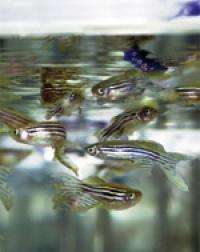
The Belmonte lab uses zebrafish, a small fish from the minnow family, to study limb regeneration. "If you amputate the tail of the zebrafish, it regenerates in about a week, seemingly with no effort and leaving no scar," explains Stewart. "What's more, it regenerates a perfect copy and—like growing grass—it will do this over and over again."
Since regeneration recapitulates in broad strokes embryonic development, during which a complex multi-cellular organism develops from a handful of embryonic stem cells, the researchers began by comparing gene expression patterns between the two processes. During development, genes within specific cell types are turned on and off to trigger the necessary expression patterns that create a whole animal. Once their job is done, they lie silently till they are turned on once again following amputation.

Based on these similarities, Stewart reasoned that genes involved in regeneration may share silencing mechanisms with the ones active in embryonic stem cells. Embryonic stem cells are maintained in a ready-to-go state, "poised" for action to become whatever cell type is needed. The key to this "poised" state are histones, DNA packaging proteins that are also used as carriers for chemical modifications, such as methylation and acetylation. These chemical marks serve as "on" and "off" switches for specific genes.
Stewart discovered that the histone modifications that poise embryonic stem cell-specific genes for activation are also found on the histones near genes involved in regeneration, putting them into a ready-to-go state. "This suggests that two different gene expression programs may exist; one for normal cellular activity and one for regeneration," explains Stewart. To test this hypothesis, the team looked at the histone marks during regeneration. As suspected, they saw a reduction in "off" switches and an increase in "on" switches in regenerating tissue, tipping the balance toward gene expression.
Delving deeper, the researchers found that enzymes that remove the "off" mark, so-called demethylases, are present in high levels in regenerating tissue. One enzyme in particular, called Kdm6b.1, is found exclusively in cells that are undergoing the regeneration process. Without Kdm6b.1, zebrafish failed to regenerate amputated fins, meaning removal of the "off" mark is a prerequisite for fin regeneration.
In the long term, the Salk researchers hope that these findings will help them understand whether we can affect the outcome of mammalian limb regeneration. In the more immediate future, the team plans to use global approaches to identify all the targets of Kdm6b.1 during regeneration, and to find out what gives the signal to turn these genes off when regeneration is complete.
Source: Salk Institute (news : web)


