Climate variability impacts the deep sea
Deep-sea ecosystems occupying 60% of the Earth's surface could be vulnerable to the effects of global warming warn scientists writing in the Proceedings of the National Academy of Sciences.
"Global-scale models are now estimating that climate change will affect the supply of organic matter from surface waters upon which most deep-sea ecosystems depend," says co-author Dr Henry Ruhl of the National Oceanography Centre, Southampton.
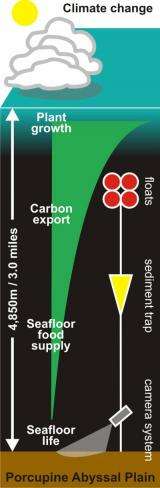
Most scientists believe that the burning of fossil fuels (gas, coal and oil) for energy by humankind is largely responsible for global warming. The resulting increases in sea temperature change the availability of nutrients and light needed by tiny marine plants called phytoplankton for growth.
When phytoplankton die, their remains sink down through the water column, and a small but significant proportion of this organic carbon ends up on the seabed where it drives one of the largest ecosystems on Earth.
"Essentially, deep-sea communities are coupled to surface production," says Dr Ken Smith of the Monterey Bay Aquarium Research Institute and lead author of the paper, "Global change could alter the functioning of these ecosystems and the way that carbon is cycled in the ocean."
Studying the deep ocean is technically very challenging. Although those regions below 2000 metres - the abyssal zone -- cover approximately 60% of the Earth's surface, only a tiny fraction has been observed directly.
Moreover, much of the focus to date has been on exotic features such as hydrothermal vents rather than the vast expanse of sediment-covered seafloor, despite its importance for carbon cycling.
No-one is really sure yet whether global climate change is already having major impacts on deep-sea ecosystems. But what seems certain is that climate variation can and does affect them.
Unprecedented long-term studies over the last two decades have revealed unexpectedly large changes in deep-ocean ecosystems that are clearly linked to changes in the surface ocean resulting from variation in climate.
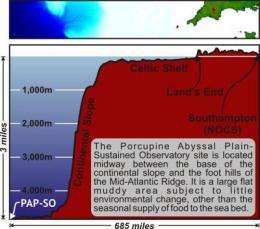
Much of the new understanding has come from two key sites - Station M in the NE Pacific and the Porcupine Abyssal Plain (PAP) in the NE Atlantic, with water depths of around 4100 and 4850 metres, respectively.
"Data from these two widely-separated areas of the deep ocean provide compelling evidence that changes in climate can readily influence deep-sea processes," say the researchers.
The amount of organic matter reaching the abyss can vary nearly ten fold from year to year, and this has been linked to biological production at the surface and climate at both sites.
"Disruption of deep-sea ecosystems could result from long-term changes in the supply of organic matter caused by global climate change," said Dr Ruhl: "This could occur through a combination of known mechanisms, including increased stratification of the water column, changes in ocean upwelling and mixing, aerosol and dust nutrient input, increased acidity, and even changes in water clarity."
There are already signs that surface changes can cascade down even to top predators in the deep-sea community. For example, at the NE Pacific site, the number of grenadier fish rose over a 15-year period from 1989 to 2004. There have also been climate-related changes in the body size and abundance of invertebrate animals such as sea cucumbers and sea urchins. Similar events have also occurred at the PAP site in the NE Atlantic.
"We believe that changes in the amount and/or quality of organic matter reaching the seabed favours particular species," says Dr Ruhl: "For instance, there is evidence that some sea cucumber species do better when feeding on organic matter containing particular nutrient pigments such as carotenoids."
The researchers warn that even "seemingly subtle changes that persist for centuries, as projected by the IPCC [Intergovernmental Panel on Climate Change], could have important implications for biogeochemical processes and other ecological interactions that affect the functioning of the oceans as a whole."
Deep-sea processes are rarely considered in discussions of global warming. The researchers give blunt advice: "This out-of-sight, out-of-mind mentality in ignoring the vast expanse of the deep ocean needs to be reversed in light of long-term datasets from two major ocean basins showing that the deep sea is strongly impacted by climate variation over a range of time scales."
Their research highlights the need for increased long-term monitoring of deep-sea communities, which could perhaps be best achieved using robotic devices linked by satellite to shore-based researchers.
"What we need is to move beyond fragmented research programs and transition to a comprehensive global effort to monitor deep-sea ecosystems," concludes Dr Ruhl.
More information: Smith, K. L. Jr et al. Climate, carbon cycling and deep-ocean ecosystems. Proc. Natl Acad. Sci. USA (published online, November 2009).
Source: National Oceanography Centre, Southampton


