Snows Of Kilimanjaro shrinking rapidly, and likely to be lost
November 2, 2009
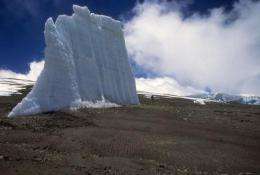
This is one of a growing number of isolated remnants of ice spires that were once full glaciers in the crater of Mount Kilimanjaro in Africa. Credit: Photo by Lonnie Thompson, Ohio State University.
The remaining ice fields atop famed Mount Kilimanjaro in Tanzania could be gone within two decades and perhaps even sooner, based on the latest survey of the ice fields remaining on the mountain .
The findings indicate a major cause of this ice loss is very likely to be the rise in global temperatures. Although changes in cloudiness and precipitation may also play a role, they appear less important, particularly in recent decades.
The first calculation of ice volume loss indicates that from 2000 to 2007, the loss by thinning is now roughly equal to that by shrinking.
These predictions, published in the journal Proceedings of the National Academy of Sciences, are among the latest dramatic physical evidence of global climate change.
Paleoclimatologist Lonnie Thompson, professor of earth sciences at Ohio State University, and his colleagues amassed a trail of data showing the rapid loss of ice atop Africa's highest mountain:
85 percent of the ice that covered the mountain in 1912 had been lost by 2007, and 26 percent of the ice there in 2000 is now gone;
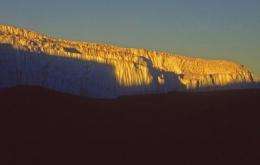
The ice fields atop Africa's Mount Kilimanjaro glow golden as the last of the afternoon sun hits these soon-to-be lost relics. Credit: Photo by Lonnie Thompson, Ohio State University.
A radioactive signal marking the 1951-52 "Ivy" atomic tests that was detected in 2000 1.6 meters (5.25 feet) below the surface of the Kilimanjaro ice is now lost, with an estimated 2.5 meters (8.2 feet) missing from the top of the current ice fields;The presence of elongated bubbles trapped in the frozen ice at the top of one of the cores shows that surface ice has melted and refrozen. There is no evidence of sustained melting anywhere in the rest of the core that dates back 11,700 years;
Even 4,200 years ago, a drought in that part of Africa that lasted about 300 years and left a thick (about 1-inch) dust layer, was not accompanied by any evidence of melting. These observations confirm that the current climate conditions over Mount Kilimanjaro are unique over the last 11 millennia.
"This is the first time researchers have calculated the volume of ice lost from the mountain's ice fields," said Thompson, a research scientist with Ohio State's Byrd Polar Research Center. "If you look at the percentage of volume lost since 2000 versus the percentage of area lost as the ice fields shrink, the numbers are very close."
While the loss of mountain glaciers is most apparent from the retreat of their margins, Thompson said an equally troubling effect is the thinning of the ice fields from the surface.
The summits of both the Northern and Southern Ice Fields atop Kilimanjaro have thinned by 1.9 meters (6.2 feet) and 5.1 meters (16.7 feet) respectively. The smaller Furtwangler Glacier, which was melting and water-saturated in 2000 when it was drilled, has thinned as much as 50 percent between 2000 and 2009.
"It has lost half of its thickness," Thompson explained. "In the future, there will be a year when Furtwängler is present and by the next year, it will have disappeared . The whole thing will be gone!"
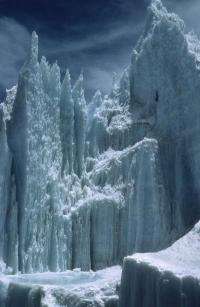
Along with retreat of Kilimanjaro's glaciers at their margins, the surface of these massive ice fields have begun eroding as temperatures rise. Credit: Photo by Lonnie Thompson, Ohio State University.
Thompson's team drilled six cores through Kilimanjaro's ice fields in 2000 and published their findings in the journal Science two years later. That work established a detailed baseline against which more recent data can be compared.Thompson said the changes occurring on Mount Kilimanjaro mirror those on Mount Kenya and the Rwenzori Mountains in Africa, as well as tropical glaciers high in the South American Andes and in the Himalayas.
"The fact that so many glaciers throughout the tropics and subtropics are showing similar responses suggests an underlying common cause. The increase of Earth's near surface temperatures, coupled with even greater increases in the mid- to upper-tropical troposphere, as documented in recent decades, would at least partially explain the observed widespread similarity in glacier behavior," he said.
-
Snows Of Kilimanjaro Disappearing, Glacial Ice Loss Increasing
Feb 14, 2006 |
not rated yet |
0
-
New Tibetan Ice Cores Missing A-Bomb Blast Markers; Suggest Himalayan Ice Fields Haven't Grown In Last 50 Years
Dec 11, 2007 |
not rated yet |
0
-
Missing Radioactivity in Ice Cores Bodes Ill for Part of Asia
Nov 18, 2008 |
not rated yet |
0
-
Ancient drought and rapid cooling drastically altered climate
Jun 18, 2009 |
not rated yet |
0
-
The woes of Kilimanjaro: Don't blame global warming
Jun 12, 2007 |
not rated yet |
0
-
Engineers build first sub-10-nm carbon nanotube transistor
Feb 01, 2012 |
4.9 / 5 (33) |
30
-
Something old, something new: Evolution and the structural divergence of duplicate genes
Jan 31, 2012 |
4.6 / 5 (7) |
1
-
The hidden nanoworld of ice crystals: Revealing the dynamic behavior of quasi-liquid layers
Jan 30, 2012 |
5 / 5 (5) |
1
-
Stock market network reveals investor clustering
Jan 27, 2012 |
3.9 / 5 (23) |
8
-
Of microchemistry and molecules: Electronic microfluidic device synthesizes biocompatible probes
Jan 26, 2012 |
5 / 5 (2) |
0
-
Do some geologists actually act a lot like Randy Marsh?
Feb 11, 2012
-
Discrepancy between oxygen and carbon-dioxide levels
Feb 09, 2012
-
where gems are found in the world
Feb 09, 2012
-
Wind Waves in Reservoir ~ Wind run-up and Wind set-up
Feb 08, 2012
-
Balance of oxygen in the atmosphere
Feb 01, 2012
-
The case for a methanol-based economy
Jan 30, 2012
- More from Physics Forums - Earth
More news stories
New European rocket lifts off on maiden flight
A new lightweight rocket, Vega, lifted off from Europe's space base Monday carrying nine satellites on its inaugural flight, mission control said.
Space & Earth / Space Exploration
25 minutes ago |
5 / 5 (1) |
0
Climate change causes harmful algal blooms in North Atlantic: study
Warming oceans and increases in windiness could be causing of an abundance of harmful algal blooms in the North Atlantic Ocean and North Sea, according to new research.
1 hour ago |
not rated yet |
0
Salvage workers begin pumping fuel from Italian shipwreck
Salvage workers Sunday began pumping fuel from the shipwrecked Italian cruise liner Costa Concordia, a day ahead of schedule, officials said.
16 hours ago |
5 / 5 (2) |
0
Political leaders play key role in how worried Americans are by climate change: study
More than extreme weather events and the work of scientists, it is national political leaders who influence how much Americans worry about the threat of climate change, new research finds.
Feb 06, 2012 |
5 / 5 (8) |
76
NASA budget will axe Mars deal with Europe: scientists
US President Barack Obama's budget proposal to be submitted next week for 2013 will cut NASA's budget by 20 percent and eliminate a major partnership with Europe on Mars exploration, scientists said Thursday.
Space & Earth / Space Exploration
Feb 10, 2012 |
5 / 5 (4) |
59
Ordered planar polymers created for the first time
(PhysOrg.com) -- Scientists under the direction of ETH Zurich have created a minor sensation in synthetic chemistry. They succeeded for the first time in producing regularly ordered planar polymers that form ...
Chinese city seizes Apple iPads in name dispute
(AP) -- Authorities have seized Apple iPads from retailers in a city in northern China due to a dispute with a domestic company that says it owns the iPad name, an official said Monday. The Chinese company said it is asking ...
Microsoft India retail site down after 'cyber attack'
Microsoft India's retail website was down on Monday after reportedly being hacked by a Chinese group calling itself Evil Shadow Team.
Rapunzel, Leonardo and the physics of the ponytail
(PhysOrg.com) -- New research provides the first mathematical understanding of the shape of a ponytail and could have implications for the textile industry, computer animation and personal care products.
Hacker claims porn site users compromised
A hacker claims to have compromised the personal information of more than 350,000 users after breaking into a disused website operated by pornography provider Brazzers.
Scientists discover molecular secrets of 2,000-year-old Chinese herbal remedy
For roughly two thousand years, Chinese herbalists have treated Malaria using a root extract, commonly known as Chang Shan, from a type of hydrangea that grows in Tibet and Nepal. More recent studies suggest that halofuginone, ...


Nov 03, 2009
Rank: 2.3 / 5 (3)
Nov 03, 2009
Rank: 1 / 5 (1)
Nov 03, 2009
Rank: 1 / 5 (1)
Get real, no watershed is dependent upon glaciers for it's recharge. A "healthy" glacier would be but a small fraction of any recharge anywhere. Recharge is dependent on precipitation and, of course, rates of use. I'm not saying there won't be water wars, but they won't be precipitated (hah!) by glaciers disappearing. It's worth noting that warmer air holds more moisture (i.e. more precipitation).
Mainly because it's tremendously energy intensive, requiring expensive technology and lot's of infrastructure and constant maintenance as well.
Great for Western nations, pretty much out of the question for Developing ones, and it's the latter whom will need it first.