Spider mite predators serve as biological control
November 2, 2009
Spider mite predators serve as biological control

Enlarge

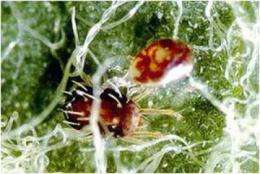
This is a photo of predator mite attacking a spider mite. Credit: David Biddinger, Penn State

The control of spider mites, which damage tree leaves, reduce fruit quality and cost growers millions of dollars in the use of pesticide and oil spraying, is being biologically controlled in Pennsylvania apple orchards with two tiny insects known to be natural predators, according to Penn State researchers.

"Spider mites feed on the chlorophyll in the cells of leaves, damaging their ability to use photosynthesis," said David Biddinger, tree fruit entomologist and biocontrol specialist at the Penn State Fruit Research and Extension Center in Biglerville. "When the numbers of mites per leaf reaches 25 to 30, the tree becomes stressed and the leaves start to bronze. This affects the quality of its fruit and in two to three seasons can actually kill small trees."

The two most popular insect specialists used to control spider mites are a lady bug named Stethorus punctum and a predatory mite named T. pyri. These insects prey on two types of spider mites, the European red mites and the two-spotted spider mites, which are agricultural pests worldwide. Much of Biddinger's work is in Pennsylvania apple orchards, a prime target for both types of pest mites.

Although the lady bug and the predatory mite both hunt spider mites, their ways of tracking them down are different.

"It turns out the predatory mite sort of roams around and bumps into them," said Biddinger. "The lady bug on the other hand is a selective killer, hunting using visual and olfactory cues to prey on spider mites."

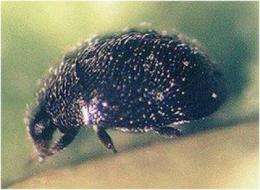
The lady bug is tiny, oval, and black and it is a of pest mites. It is attracted to specific volatile chemical signals given off by the damage the spider mites cause to leaves. It is not just the smell that drives the lady bugs wild; this insect cannot resist the yellowing of the leaves damaged by spider mites. Adult lady bugs can live for over a year and eat up to nine mites an hour or 75 to 100 a day.
Spider mite predators serve as biological control
Enlarge

This is a photo of a tiny, black lady bug mite predator. Credit: David Biddinger, Penn State

The predatory mite is much smaller than the lady bug. It is pear-shaped and is usually creamy-white in color. Young mites develop into adults in a very short time and their voracious appetites make them a formidable enemy to spider mites. Adults have a lifespan of about 75 days and can eat 350 mites during this time.

Reducing pest mite numbers and controlling outbreaks with the aid of mite predators is an important task. The biological control of spider mites reduces the need for mite-controlling chemicals and saves growers millions in integrated pest management costs.

"Biological control is basically using the good bugs to control the bad bugs," said Biddinger.

Growers chose lady bugs as their biological control agent until U.S. Environmental Protection Agency regulations prompted growers to switch to new pesticides that kill lady bugs. The predatory mite, however, was resistant and could live through sprayings. So predatory mites are now the hunter of choice for spider mites.

Biddinger, working with Donald C. Weber, research entomologist, U.S. Department of Agriculture, Agricultural Research Service Invasive Insect Biocontrol and Behavior Laboratory, Maryland, and Larry Hull, professor of entomology, Penn State, published their work in a special issue of Biological Control devoted to ladybugs in agriculture.

"With the pesticides we are using now it is very hard for the lady bug to survive," said Biddinger. "The predatory mite could never exist here before because they could not stand the old pesticides, but they are resistant to the new pesticides. With the predatory mite being more effective than the lady bug, we are probably going to exceed the savings for growers that we had with the lady bug in the past. So far we have reduced miticide use by over 90 percent since we switched. This is saving growers about a million dollars a year and is reducing oil spraying by 45,000 gallons a year."

Source: Pennsylvania State University (news : web)

4.5 /5 (4 votes)  

Rank 4.5 /5 (4 votes)
Related Stories
Relevant PhysicsForums posts
  • Factors affecting beet root cell membrane
    created10 hours ago
  • Stem cell question.
    createdFeb 10, 2012
  • Protease cleavage
    createdFeb 10, 2012
  • Pertubance in a model
    createdFeb 10, 2012
  • Cancer drugs and Alzheimer's, Oh my!
    createdFeb 09, 2012
  • Squishing cells
    createdFeb 09, 2012
  • More from Physics Forums - Biology

More news stories

A mitosis mystery solved: How chromosomes align perfectly in a dividing cell

Although the process of mitotic cell division has been studied intensely for more than 50 years, Whitehead Institute researchers have only now solved the mystery of how cells correctly align their chromosomes during symmetric ...

Biology / Cell & Microbiology

created 6 hours ago | popularity 4.4 / 5 (10) | comments 0 | with audio podcast

Researchers find extensive RNA editing in human transcriptome

In a new study published online in Nature Biotechnology, researchers from BGI, the world's largest genomics organization, reported the evidence of extensive RNA editing in a human cell line by analysis of RNA-seq data, demons ...

Biology / Biotechnology

created 6 hours ago | popularity 5 / 5 (4) | comments 0 | with audio podcast

The proteins ensuring genome protection

Researchers from the University of Geneva (UNIGE), Switzerland, have discovered the crucial role of two proteins in developing a cell 'anti-enzyme shield'. This protection system, which operates at the level of molecular ...

Biology / Cell & Microbiology

created 6 hours ago | popularity 5 / 5 (3) | comments 0 | with audio podcast

Entire genome of extinct human decoded from fossil

(PhysOrg.com) -- In 2010, Svante Pääbo and his colleagues presented a draft version of the genome from a small fragment of a human finger bone discovered in Denisova Cave in southern Siberia. The ...

Biology / Biotechnology

created Feb 07, 2012 | popularity 4.7 / 5 (59) | comments 48 | with audio podcast

Why are there so few fish in the Earth's oceans?

(PhysOrg.com) -- A Stony Brook University researcher has found that, contrary to popular belief, there are not plenty of fish in the sea.

Biology / Plants & Animals

created Feb 08, 2012 | popularity 4.2 / 5 (18) | comments 27 | with audio podcast


Declining health-care productivity in England: Who says so?

Reports that the National Health Service in England has been declining in productivity in the last decade appear to have been accepted as fact. However, a Viewpoint published Online First by The Lancet disputes this. The Vi ...

Scientists discover molecular secrets of 2,000-year-old Chinese herbal remedy

For roughly two thousand years, Chinese herbalists have treated Malaria using a root extract, commonly known as Chang Shan, from a type of hydrangea that grows in Tibet and Nepal. More recent studies suggest that halofuginone, ...

New method to examine batteries -- MRI from the inside

There is an ever-increasing need for advanced batteries for portable electronics, such as phones, cameras, and music players, but also to power electric vehicles and to facilitate the distribution and storage of energy derived ...

Overeating may double risk of memory loss

New research suggests that consuming between 2,100 and 6,000 calories per day may double the risk of memory loss, or mild cognitive impairment (MCI), among people age 70 and older. The study was released today and will be ...

Lab study raises questions over nano-particle impact

Tests involving chickens have raised questions about the impact on health from engineered nano-particles, the ultra-fine grains commonly used in drugs and processed foods, scientists said on Sunday.

Google might launch Drive for cloud storage soon

(PhysOrg.com) -- Google's next big move, according to the Wall Street Journal, is a cloud storage service called Drive. Hardly first to the plate, Google is simply catching up to introducing its cloud reposi ...