Electron self-injection into an evolving plasma bubble
November 2, 2009 Electron self-injection into an evolving plasma bubble

Enlarge

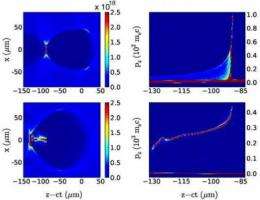
This photo shows electron self-injection and acceleration in an expanding plasma bubble. Credit: Serguei Kalmykov, University of Texas at Austin, Arnaud Beck, CEA.

Particle accelerators are among the largest and most expensive scientific instruments. Thirty years ago, theorists John Dawson and Toshiki Tajima proposed an idea for making them thousands of times smaller: surf the particles on plasma waves driven by short intense laser pulses. Since plasmas are free of the damage limits of conventional accelerators, much larger fields can be built up within such waves, enabling much smaller accelerators.

Just five years ago, experimentalists finally demonstrated that such laser-plasma accelerators could produce monoenergetic, collimated electron beams with quality comparable to conventional accelerators. The secret was for the laser to produce a "bubble" almost completely devoid of in its immediate wake that captured electrons from the surrounding and accelerated them in an exceptionally uniform way. Yet the precise mechanism by which the bubble captured these electrons and accelerated them with such uniformity has remained one of the outstanding mysteries of this field.

Now new theoretical work by scientists from the University of Texas and Commissariat à l'Énergie Atomique (CEA, France), to be reported at the 2009 APS Division of Plasma Physics Annual Meeting, has shed light on this mystery. Formation of the exceptional quality is attributed to the evolution of the bubble shape which, in turn, is directly associated with the nonlinear evolution of the driving laser pulse (nonlinear focusing and defocusing).

The basic premise of this work is that the size of the bubble—the cavity of electron density traveling over the positive ion background with nearly the speed of light—is determined by the spot size of the driving laser pulse. Plasma nonlinearities cause the laser to focus and defocus in the course of propagation. Once the laser diffracts, the bubble expands. Electrons that constitute a dense electron shell surrounding the bubble move with relativistic speeds and thus have high inertia. As a consequence, some of them become too heavy to follow the expanding shell; they fall inside the bubble, stay inside till the end of the plasma (i.e. get trapped) and finally gain multi-GeV energy.

The trapped charge is proportional to the bubble growth rate. Once the laser becomes self-guided, and the spot size oscillations saturate, the injection process clamps. Simultaneously, longitudinal non-uniformity of the accelerating gradient equalizes the trapped electron energy. This scenario of self-injection and monoenergetic bunch formation is discovered and explored in fine detail in the 3-D particle-in-cell simulations. This is fundamentally different from the previous work which concentrated on either one-dimensional models of electron trapping or on the reduced description of transverse plasma wave breaking in planar 2-D geometry.

The discussed mechanism of electron self-injection is very robust in experiments with the high-power laser (tens of terawatts to petawatt). In addition, an appropriate modification of the plasma density (e.g. using a thin dense slab as a nonlinear lens for the laser) may cause the laser to self-focus and defocus faster, which results in a single self-injection event. This kind of laser beam manipulation may lead to the generation of a 2.5 GeV mono-energetic (~1% energy spread) electron bunch containing ~1010 electrons in a future experiment with the recently commissioned Texas Petawatt (TPW) laser - the most powerful in the world. Electrons with 2.5 GeV of energy are traveling at 99.999998% of the speed of light. Electron beams with such unique properties are clearly beneficial for medical applications, radiation physics, material science, and homeland security.

Source: American Physical Society


print this article email this article download pdf blog this article bookmark this article     Stumble it Digg this share on Facebook retweet share on Reddit add to delicious
Rate this story - 4.8 /5 (4 votes)

Rank Filter

Move the slider to adjust rank threshold, so that you can hide some of the comments.


Display comments: newest first


November 2, 2009 all stories

Comments: 1

4.8 /5 (4 votes)
  • Stumble this up

  • Digg this

  • share this

  • hide
  • Related Stories

  • Scientists tame electron beams, bringing 'table top' particle accelerators a step closer
    created Sep 29, 2004 | popularity not rated yet | comments 0
  • Fastest waves ever photographed
    created Oct 27, 2006 | popularity not rated yet | comments 0
  • First demonstration of new laser-driven accelerator technology
    created Sep 30, 2004 | popularity not rated yet | comments 0
  • Laser-plasma accelerators ride on Einstein's shoulders
    created Nov 02, 2009 | popularity not rated yet | comments 0
  • From zero to a billion electron volts in 3.3 centimeters
    created Sep 24, 2006 | popularity not rated yet | comments 0


  • hide
  • Relevant PhysicsForums posts

  • Physicists in survival situation
    created 1hour ago
  • Magnetic Oscillation Equations
    created 2 hours ago
  • US Physics Test Eligibility
    created 3 hours ago
  • Are Active Noise Control Stereo Possible?
    created 8 hours ago
  • More from Physics Forums - General Physics

Other News

A view of a superconducting solenoid magnet at the European Organization for Nuclear Research (CERN) near Geneva

CERN atom-smasher restarts after 14-month hiatus: official

Physics / General Physics

created 14 hours ago | popularity 4.5 / 5 (15) | comments 0

The world's biggest atom-smasher, shut down after its inauguration in September 2008 amid technical faults, restarted on Friday, a spokesman for the European Organisation for Nuclear Research said.


The LHC promises to unlock scientific mysteries about the creation of the Universe and the fundamental nature of matter

Giant atom-smasher set to restart this weekend: CERN

Physics / General Physics

created 22 hours ago | popularity 4.2 / 5 (5) | comments 7

The world's biggest atom-smasher, which was shut down soon after its inauguration amid technical faults, is set to restart this weekend, the European Organisation for Nuclear Research said on Friday.


Tapering a Free-Electron Laser to Extract More Juice

Tapering a Free-Electron Laser to Extract More Juice

Physics / General Physics

created 14 hours ago | popularity not rated yet | comments 0

(PhysOrg.com) -- Researchers from the NSLS and Science Applications International Corporation (SAIC) have demonstrated a technique that could be used to significantly improve the quantity and quality of light ...


Ultra-Powerful Laser Reproduces How Star's Jets Travel through Interstellar Space

Ultra-Powerful Laser Reproduces How Star's Jets Travel through Interstellar Space

Physics / General Physics

created 15 hours ago | popularity 4.3 / 5 (6) | comments 0

(PhysOrg.com) -- A multi-trillion-watt laser at the University of Rochester has simulated a stellar jet -- an outpouring of matter from a fledgling star -- with unprecedented realism.


UCSB physicists move one step closer to quantum computing

UCSB physicists move one step closer to quantum computing

Physics / Quantum Physics

created 18 hours ago | popularity 5 / 5 (6) | comments 0

Physicists at UC Santa Barbara have made an important advance in electrically controlling quantum states of electrons, a step that could help in the development of quantum computing. The work is published ...