Upping the power triggers an ordered helical plasma
November 2, 2009 Upping the power triggers an ordered helical plasma

Enlarge

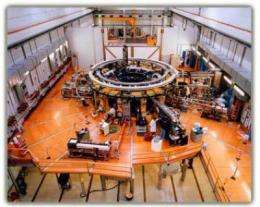
The RFX-mod Reversed Field Pinch (RFP) experiment has shown that higher currents lead to self-organized helical plasmas. Credit: Piero Martin, Padova, Italy

If you keep twisting a straight elastic string, at some moment it starts kinking in a wild way. Something similar occurs when one increases the electrical current flowing in a magnetized plasma doughnut: it takes on a wild helical shape, which spoils its performance. This phenomenon concerns scientists exploring fusion power, who use powerful magnetic fields to confine plasma during their experiments.

But a discovery made in the RFX-mod Reversed Field Pinch (RFP) fusion device demonstrated that if one keeps on increasing the current, above 1.5 million amperes, the helix becomes very smooth, the trapping of the plasma in the magnetic fields improves and the plasma gets hotter. Moreover, the helical state appears to be the preferred one at high current and is spontaneously chosen, or self-organized, by the plasma. RFX is a large RFP device (ten cubic meter plasma) located in Padova, Italy.

In the past, RFP experiments suffered from poor stability, which reduced confinement performance due to magnetic turbulence. But as a result of increased order in the self-organized helical state, magnetic confinement improves and a broad zone of the plasma becomes hot. This renews the fusion prospects of the RFP device, a magnetic confinement configuration germane to the (which uses a magnetic torus for plasma confinement) because a current flows in the plasma doughnut, and to the stellarator (which uses a magnetic helix) because the plasma takes on a helical shape.

An attractive feature of the RFP fusion device is that most of its is produced by the current flowing in the plasma. This eliminates many of the costs and technical difficulties associated with producing strong magnetic fields using high-tech superconducting coils, such as those used in tokamak and stellarator fusion containment designs. The helical shape of the plasma comes with an additional bonus: the current lines are also helical. This greatly increases the length of the electrical circuit with respect to the tokamak. This could make reaching thermonuclear temperatures possible with only the electric power dissipated in the plasma. In principle, no additional heating is necessary—an additional positive economic and technical feature.

The remarkable helical shape of the plasma doughnut is the signature of self-organization dynamics. Similar helical structures may be found in astrophysical objects as well as living things, where self-organization provides stability and resilience against external perturbations. This should lead the RFP to be free of the disruptions that threaten tokamak discharges, where the plasma ring suddenly becomes a wild helix that damages the confinement vessel with heat fluxes and electromagnetic forces.

To confirm their relevance for thermonuclear fusion, RFX helical plasmas should be further improved, especially in two important respects. First, their density should be increased; this is presently being sought using fuel pellet injection. Second, the helical shape should be further optimized to improve confinement. Progress in magnetic control, a further increase of current, and use of modern wall-conditioning techniques might accomplish this.

Source: American Physical Society


print this article email this article download pdf blog this article bookmark this article     Stumble it Digg this share on Facebook retweet share on Reddit add to delicious
Rate this story - 5 /5 (4 votes)


November 2, 2009 all stories

Comments: 0

5 /5 (4 votes)
  • Stumble this up

  • Digg this

  • share this

  • hide
  • Related Stories

  • New stellerator a step forward in plasma research
    created Mar 09, 2007 | popularity not rated yet | comments 0
  • Coil design confines plasma in stellarator fusion reactor
    created Aug 10, 2007 | popularity not rated yet | comments 0
  • Twisted Flux Tubes Expel 'Wrong-Way' Ions
    created Apr 06, 2007 | popularity not rated yet | comments 0
  • Plasma power: Turning fusion into a renewable energy source
    created Sep 14, 2009 | popularity not rated yet | comments 0
  • $12.5 Million in Subcontracts Awarded for Fusion Experiment
    created Oct 06, 2004 | popularity not rated yet | comments 0


  • hide
  • Relevant PhysicsForums posts

  • Can light produce darkness and can noise procude quiteness 4
    created 2 hours ago
  • Magnetic Oscillation Equations
    created 8 hours ago
  • US Physics Test Eligibility
    created 9 hours ago
  • Are Active Noise Control Stereo Possible?
    created 14 hours ago
  • More from Physics Forums - General Physics

Other News

Quick restart of Big Bang machine stuns scientists (AP)

Quick restart of Big Bang machine stuns scientists

Physics / General Physics

created 14 minutes ago | popularity 5 / 5 (1) | comments 0

(AP) -- Scientists moved Saturday to prepare the world's largest atom smasher for exploring the depths of matter after successfully restarting the $10 billion machine following more than a year of repairs.


A view of a superconducting solenoid magnet at the European Organization for Nuclear Research (CERN) near Geneva

CERN atom-smasher restarts after 14-month hiatus: official

Physics / General Physics

created 20 hours ago | popularity 4.6 / 5 (22) | comments 0

The world's biggest atom-smasher, shut down after its inauguration in September 2008 amid technical faults, restarted on Friday, a spokesman for the European Organisation for Nuclear Research said.


Tapering a Free-Electron Laser to Extract More Juice

Tapering a Free-Electron Laser to Extract More Juice

Physics / General Physics

created 20 hours ago | popularity not rated yet | comments 0

(PhysOrg.com) -- Researchers from the NSLS and Science Applications International Corporation (SAIC) have demonstrated a technique that could be used to significantly improve the quantity and quality of light ...


Ultra-Powerful Laser Reproduces How Star's Jets Travel through Interstellar Space

Ultra-Powerful Laser Reproduces How Star's Jets Travel through Interstellar Space

Physics / General Physics

created 21 hours ago | popularity 4.3 / 5 (6) | comments 0

(PhysOrg.com) -- A multi-trillion-watt laser at the University of Rochester has simulated a stellar jet -- an outpouring of matter from a fledgling star -- with unprecedented realism.


nuclear power plant

Doubts raised on nuclear industry viability

Physics / General Physics

created Nov 19, 2009 | popularity 3.2 / 5 (17) | comments 16

(PhysOrg.com) -- The investment in nuclear power has been growing around the world over the last few years, being viewed as a means for countries to control their energy security, avoid the price fluctuations ...