Powerful laser sheds light on fast ignition and high energy density physics
November 2, 2009 Powerful laser sheds light on fast ignition and high energy density physics

Enlarge

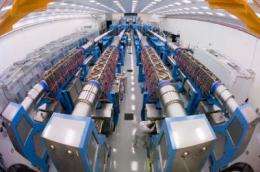
The OMEGA Extended Performance (EP) Laser Facility at the University of Rochester's Laboratory for Laser Energetics conducts ultrahigh-intensity laser-matter interactions research and integrated advanced-ignition experiments. Credit: P.M. Nilson, University of Rochester

A new generation of high-energy (>kJ) petawatt (HEPW) lasers is being constructed worldwide to study high intensity laser matter interactions, including fast ignition. Fast ignition is a laser-based technique for heating and igniting deuterium and tritium fuel to fusion temperatures in a two-step process. In the first phase, laser beams vaporize a fuel pellet and compress it to a thousand times its original density, while in the second phase, electrons accelerated by an intense-laser pulse deposit energy within the fuel assembly, causing rapid heating. This is akin to the way a gasoline engine works with a spark plug.

The OMEGA EP (Extended Performance) laser at the University of Rochester's Laboratory for Laser Energetics is the first of this new generation of HEPW-class lasers to be completed. OMEGA EP delivers multi-kilojoule laser energies in picosecond pulsewidths. Such high energies and short pulse durations allow significant laser powers to be produced with laser-pulse energy approaching the petawatt level - or up to a quadrillion watts.

In work that sheds new light on how to generate the powerful electron source required for fast ignition, LLE researchers have used OMEGA EP to produce intense electrical currents lasting just a few trillionths of a second. In a series of unprecedented experiments, laser energies of up to 2.1kJ were delivered to solid-density targets. These experiments represent a four-fold increase in the on-target laser energy compared to any previous petawatt-class laser system.

The LLE team used an electrostatic technique with thin-foil targets to diagnose the hot-electron source. This technique relies on foils no thicker than a human hair. During laser irradiation, the foils rapidly charge, similar to a capacitor plate. Within picoseconds, the majority of the laser-accelerated electrons transfer their energy to the target material. This occurs during multiple electron transits through the target - a process known as refluxing. Using this mechanism, electrons interact with the target material and generate high-energy x-rays. By diagnosing the x-ray source brightness, the conversion efficiency of laser light into is determined.

Using the OMEGA EP laser, constant laser-energy conversion efficiencies of around 20% and higher into energetic electrons has been demonstrated. These measurements identify what minimum fraction of intense-laser energy is available to heat the target - a critical parameter in determining the energetic and technological feasibility of full-scale fast ignition. These latest observations show that strong laser-energy coupling scales from small university-class laser systems over three orders of magnitude in laser energy to large multi-kilojoule class systems needed for fast ignition.

Achieving high conversion efficiencies with 10 to 20ps pulse durations is also paramount. The laser intensity governs the mean-electron energy. Too intense, and the energetic electrons will pass through the dense fuel and not deposit their energy in the imploded-target core. Too long, and the dense assembled fuel will decompress before it ignites. The key is to generate electrons with optimum energies while maintaining multi kilojoule laser energies to cause strong heating prior to target disassembly. Efficient production of energetic electrons with intense, 15ps long pulses at multi kilojoule laser energies as demonstrated in these experiments will allow an understanding of the requirements for full-scale fast-ignition experiments and will help define the requirements for future fast-ignition facilities.

Source: American Physical Society


print this article email this article download pdf blog this article bookmark this article     Stumble it Digg this share on Facebook retweet share on Reddit add to delicious
Rate this story - 3.8 /5 (5 votes)


November 2, 2009 all stories

Comments: 0

3.8 /5 (5 votes)
  • Stumble this up

  • Digg this

  • share this

  • hide
  • Related Stories

  • Rochester's Omega Laser Receives 50-Fold Power Increase to Become 'Petawatt' Laser
    created May 16, 2008 | popularity not rated yet | comments 0
  • Laser Fusion and Exawatt Lasers
    created Oct 01, 2009 | popularity not rated yet | comments 0
  • The little beam that could
    created Feb 01, 2006 | popularity not rated yet | comments 0
  • Most powerful laser in the world fires up
    created Apr 08, 2008 | popularity not rated yet | comments 0
  • Scientists tame electron beams, bringing 'table top' particle accelerators a step closer
    created Sep 29, 2004 | popularity not rated yet | comments 0


  • hide
  • Relevant PhysicsForums posts

  • Magnetic Oscillation Equations
    created 4 hours ago
  • US Physics Test Eligibility
    created 5 hours ago
  • Are Active Noise Control Stereo Possible?
    created 10 hours ago
  • New Supercomputer at Brown University
    created 20 hours ago
  • More from Physics Forums - General Physics

Other News

A view of a superconducting solenoid magnet at the European Organization for Nuclear Research (CERN) near Geneva

CERN atom-smasher restarts after 14-month hiatus: official

Physics / General Physics

created 16 hours ago | popularity 4.6 / 5 (19) | comments 0

The world's biggest atom-smasher, shut down after its inauguration in September 2008 amid technical faults, restarted on Friday, a spokesman for the European Organisation for Nuclear Research said.


UCSB physicists move one step closer to quantum computing

UCSB physicists move one step closer to quantum computing

Physics / Quantum Physics

created 20 hours ago | popularity 5 / 5 (6) | comments 0

Physicists at UC Santa Barbara have made an important advance in electrically controlling quantum states of electrons, a step that could help in the development of quantum computing. The work is published ...


Tapering a Free-Electron Laser to Extract More Juice

Tapering a Free-Electron Laser to Extract More Juice

Physics / General Physics

created 16 hours ago | popularity not rated yet | comments 0

(PhysOrg.com) -- Researchers from the NSLS and Science Applications International Corporation (SAIC) have demonstrated a technique that could be used to significantly improve the quantity and quality of light ...


Ultra-Powerful Laser Reproduces How Star's Jets Travel through Interstellar Space

Ultra-Powerful Laser Reproduces How Star's Jets Travel through Interstellar Space

Physics / General Physics

created 17 hours ago | popularity 4.3 / 5 (6) | comments 0

(PhysOrg.com) -- A multi-trillion-watt laser at the University of Rochester has simulated a stellar jet -- an outpouring of matter from a fledgling star -- with unprecedented realism.


Researchers Find Innate Correlations Among Different Power Law Phenomena

Researchers Find Innate Correlations Among Different Power Law Phenomena

Physics / General Physics

created Nov 17, 2009 | popularity 4.3 / 5 (15) | comments 12

(PhysOrg.com) -- Studying the patterns that emerge in natural and social phenomena is a popular area of research, although usually individual phenomena are studied separately from each other. In a recent study, ...