Researchers unlock the 'sound of learning' by linking sensory and motor systems
November 2, 2009 Researchers unlock the 'sound of learning' by linking sensory and motor systems

Enlarge

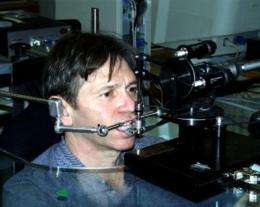
This is a participant in the study using a speech learning robotic device. Credit: David Ostry, Yale University, Haskins Lab

Learning to talk also changes the way speech sounds are heard, according to a new study published in Proceedings of the National Academy of Sciences by scientists at Haskins Laboratories, a Yale-affiliated research laboratory. The findings could have a major impact on improving speech disorders.

"We've found that learning is a two-way street; motor function affects sensory processing and vice-versa," said David J. Ostry, a senior scientist at Haskins Laboratories and professor of psychology at McGill University. "Our results suggest that learning to talk makes it easier to understand the of others."

As a child learns to talk, or an adult learns a new language, Ostry explained, a growing mastery of oral fluency is matched by an increase in the ability to distinguish different speech sounds. While these abilities may develop in isolation, it is possible that learning to talk also changes the way we hear speech sounds.

Ostry and co-author Sazzad M. Nasir tested the notion that speech motor learning alters auditory perceptual processing by evaluating how speakers hear speech sounds following motor learning. They simulated speech learning by using a , which introduced a subtle change in the movement path of the jaw during speech.

To assess speech perception, the participants listened to words one at a time that were taken from a computer-produced continuum between the words "had" and "head." In the speech learning phase of the study, the robot caused the jaw to move in a slightly unusual fashion. The learning is measured by assessing the extent to which participants correct for the unusual movement.

"Its like being handed a two-pound weight for the first time and being asked to make a movement, it's uncomfortable at first, but after a while, the movement becomes natural," said Ostry. "In growing children, the nervous system has to adjust to moving vocal tract structures that are changing in size and weight in order to produce the same words. Participants in our study are learning to return the movement to normal in spite of these changes. Eventually our work could have an impact on deviations to speech caused by disorders such as stroke and Parkinson's disease."

"Our study showed that speech motor learning altered the perception of these . After motor learning, the participants heard the words differently than those in the control group," said Ostry. "One of the striking findings is that the more motor learning we observed, the more their speech perceptual function changed."

Ostry said that future research will focus on the notion that sensory remediation may be a way to jumpstart the motor system.

The team previously found that the movement of facial muscles around the mouth plays an important role not only in the way the sounds of speech are made, but also in the way they are heard.

More information: PNAS: Early Edition November 2, 2009; doi:10.1073/pnas.907032106

Source: Yale University (news : web)


print this article email this article download pdf blog this article bookmark this article     Stumble it Digg this share on Facebook retweet share on Reddit add to delicious
Rate this story - 5 /5 (2 votes)


November 2, 2009 all stories

Comments: 0

5 /5 (2 votes)
  • Stumble this up

  • Digg this

  • share this

  • hide
  • Related Stories

  • Our faces, not just our ears 'hear' speech: study
    created Jan 20, 2009 | popularity not rated yet | comments 0
  • Sensory feedback during speech: The brain attunes to more than just sound
    created Oct 09, 2006 | popularity not rated yet | comments 0
  • Seeing While Hearing Speeds Brain's Processing of Speech
    created Jan 15, 2005 | popularity not rated yet | comments 0
  • Where the brain makes sense of speech
    created Dec 19, 2007 | popularity not rated yet | comments 0
  • When do babies develop a love of speech?
    created Feb 20, 2006 | popularity not rated yet | comments 0


  • hide
  • Relevant PhysicsForums posts

  • Obsessive Compulsive Disorder
    created Nov 20, 2009
  • West's zone 2 starling resistor respiratory physiology
    created Nov 18, 2009
  • 50-0-50 rule
    created Nov 18, 2009
  • What is the evidence in support of the anti-vaccine movement?
    created Nov 17, 2009
  • More from Physics Forums - Medical Sciences

Other News

Swine flu vaccine effective despite mutations: experts

Medicine & Health / Diseases

created 6 hours ago | popularity 1 / 5 (1) | comments 1

Swine flu vaccines are still effective despite reported cases of mutations in the A(H1N1) virus, health experts in Europe and North America said Saturday.


GOP: Health test recommendations could affect care (AP)

GOP: Health test recommendations could affect care

Medicine & Health / Health

created 16 hours ago | popularity not rated yet | comments 0

(AP) -- Republicans are seizing on this week's recommendations for fewer Pap smears and mammograms to fuel concern about government-rationed medical care - and to try to chip away support by women for President ...


Study raises concerns about outdoor second-hand smoke

Medicine & Health / Health

created Nov 18, 2009 | popularity 2 / 5 (4) | comments 21

Indoor smoking bans have forced smokers at bars and restaurants onto outdoor patios, but a new University of Georgia study in collaboration with the Centers for Disease Control and Prevention suggests that these outdoor smoking ...


smoking, cigarette

Vaccine being developed to help smokers quit

Medicine & Health / Medications

created Nov 20, 2009 | popularity 4.3 / 5 (9) | comments 10

(PhysOrg.com) -- Glaxo-SmithKline has joined forces with Nabi Pharmaceuticals to produce a vaccine to help smokers give up their addiction permanently.


Pilot study relates phthalate exposure to less-masculine play by boys

Medicine & Health / Research

created Nov 16, 2009 | popularity 4.8 / 5 (9) | comments 9

A study of 145 preschool children reports, for the first time, that when the concentrations of two common phthalates in mothers' prenatal urine are elevated their sons are less likely to play with male-typical toys and games, ...