Scientists create fruit fly model to help unravel genetics of human diabetes
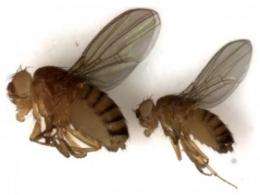
As rates of obesity, diabetes, and related disorders have reached epidemic proportions in the US in recent years, scientists are working from many angles to pinpoint the causes and contributing factors involved in this public health crisis. While sedentary lifestyles and diets high in sugar and fat contribute significantly to the rise in diabetes rates, genetic factors may make some people more vulnerable than others to developing diabetes.
Researchers at the University of Maryland are using the fruit fly, Drosophila melanogaster, as a model system to unravel what genes and gene pathways are involved in the metabolic changes that lead to insulin resistance and full-blown diabetes in humans. In research published in the Proceedings of the National Academy of Sciences (November 2, 2009), Leslie Pick, associate professor, department of entomology, and colleagues describe how they altered genes in fruit flies to model the loss of insulin production, as seen in human Type 1 diabetes.
"These mutant flies show symptoms that look very similar to human diabetes," explains Dr. Pick. "They have the hallmark characteristic which is elevated blood sugar levels. They are also lethargic and appear to be breaking down their fat tissue to get energy, even while they are eating- a situation in which normal animals would be storing fat, not breaking it down."
Pick and her team, which included UM researchers Dr. Hua Zhang, Dr. Jingnan Liu, and Ms. Caroline Li, Associate Professor Bahram Momen (Biostatistics and Environmental Science), and former Johns Hopkins University Associate Professor Dr. Ronald Kohanski, used genetic approaches to delete a cluster of five genes encoding insulin-like peptides (Drosophila insulin-like peptides, DILPs) in the Drosophila melanogaster fruit fly. "When we compare the mutants with a normal fly that has been starved, they look the same in that they are both breaking down their fat to get energy," Pick explains. This mimics a clinical feature of diabetic patients resulting from the fact that nutrients are present but the body cannot utilize them and thus mounts a starvation response, breaking down energy stores to obtain nutrients.
"We can use these genetically manipulated flies as a model to understand defects underlying human diabetes and to identify genes and target points for pharmacological intervention," suggests Dr. Pick, who is also using flies to study Type 2 diabetes and other syndromes of insulin resistance.
Model organisms have proven enormously valuable for studies of human disease mechanisms because regulatory pathways and physiology are so highly conserved throughout the animal kingdom. The relationship between fly and human genes is so close that human genes, including disease genes, can often be matched against their fly counterparts.
"Way more is shared between flies and humans than we ever would have expected before we started identifying the genes," says Pick. Using flies as a model system has advantages over studies in other animals, such as mice, because the experiments can be done quickly in thousands of flies and because scientists can combine different mutations much more easily. This could prove valuable in understanding the genesis of Type 2 diabetes in which scientists believe multiple genes play a role.
"When we made the genetic mutation that deleted these genes, we asked would these flies have any symptoms of human diabetes, and it turns out they do," Pick says. "That tells us that there are some things going on that are very similar. Our hope is that this provides a valuable resource for the scientific community to identify gene targets for diabetes treatment."
Source: University of Maryland (news : web)


