Computer Science Provides a More Sound Way to Test for Sleep Apnea
November 2, 2009
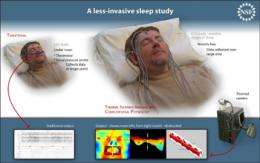
Credit: Zina Deretsky, National Science Foundation; All images in blue band at the bottom (traditional output, Thermal Infrared Imaging output, and thermal camera and computer set-up) courtesy of Computational Physiology Lab, University of Houston.
(PhysOrg.com) -- A computer scientist from the University of Houston and a doctor of sleep medicine at the University of Texas Health Science Center at Houston have teamed up to create a new, less invasive method of diagnosing sleep apnea. Their findings appear in the November issue of the journal Sleep.
Sleep apnea is serious disorder that causes a person to momentarily stop breathing while they sleep. These pauses in breathing can occur many times an hour, and can cause low oxygen levels in the blood and chronic sleepiness, which in turn can lead to deadly accidents. Sleep apnea has also been associated with a range of serious health problems including depression, heart disease and stroke.
Approximately 24 percent of men and 9 percent of women experience sleep apnea, but getting a diagnosis involves a procedure called polysomnography, also known as a sleep study. "It's not as simple as paying a visit to the doctor in the morning for an hour and walking away with a prescription," said Ioannis Pavlidis, Eckhard-Pfeiffer Professor of Computer Science at the University of Houston, and co-investigator of the study. "You have to undergo overnight monitoring in a sleep lab. The subject is wired and sleeps there. Sometimes, the subject has to spend more than one night."
Adding to the difficulty in getting a sleep apnea diagnosis is the invasive nature of current testing methods. "During a sleep study a subject has an average of more than 20 sensors attached to the head and body. It's a very complex procedure where many physiological parameters are simultaneously monitored to help in the diagnosis of sleep disorders. However, these sensors can disturb sleep and contribute to the patient's anxiety," said Jayasimha N. Murthy, assistant professor of medicine from the Division of Pulmonary Critical Care Sleep Medicine at UTHSC at Houston and study co-investigator.
The new diagnostic procedure developed by Pavlidis, Murthy and their collaborators uses a thermal infrared camera to monitor breathing waveforms and airflow as a patient breathes in and out of his or her nose. The measurements are processed using computational algorithms and produce results that have proved to be as accurate as traditional polysomnography. The new method also provides doctors with more information about the patient's breathing.
"In contrast to the traditional one-dimensional methods, this new method is an imaging one and thus, multi-dimensional," said Pavlidis. "We now can see how airflow is distributed locally throughout the extent of the nostril. We get not a single, but multiple values for each nostril at every point in time and this makes a lot of difference when it comes to appreciating subtle pathology."
The researchers believe that this new technology could change the way sleep apnea is diagnosed, potentially helping millions of Americans sleep better and possibly live longer.
Provided by NSF
-
Viagra may aggravate sleep apnea
Sep 25, 2006 |
not rated yet |
0
-
Answering the question: Who should have surgery for sleep apnea?
Sep 23, 2008 |
not rated yet |
0
-
Research underway to give sleep apnea sufferers relief and rest
Sep 26, 2008 |
not rated yet |
0
-
Researchers Identify Connection between Sleep Disruption and Increased Cardiovascular Risk
Mar 30, 2007 |
not rated yet |
0
-
Child sleep breathing problems studied
Oct 09, 2006 |
not rated yet |
0
-
Engineers build first sub-10-nm carbon nanotube transistor
Feb 01, 2012 |
4.9 / 5 (33) |
30
-
Something old, something new: Evolution and the structural divergence of duplicate genes
Jan 31, 2012 |
4.6 / 5 (7) |
1
-
The hidden nanoworld of ice crystals: Revealing the dynamic behavior of quasi-liquid layers
Jan 30, 2012 |
5 / 5 (5) |
1
-
Stock market network reveals investor clustering
Jan 27, 2012 |
3.9 / 5 (23) |
8
-
Of microchemistry and molecules: Electronic microfluidic device synthesizes biocompatible probes
Jan 26, 2012 |
5 / 5 (2) |
0
-
Is Everyday Technology Killing Us?
Feb 08, 2012
-
Exercise and weight loss
Feb 08, 2012
-
Why do we have head aches? Our brains can't feel anything.
Feb 07, 2012
-
"The end of diseases" by David Agus, interview from Daily Show with Jon Stewart
Feb 04, 2012
-
Oncolytic adenovirus
Feb 04, 2012
-
Nutrition label stuffs and diets
Feb 02, 2012
- More from Physics Forums - Medical Sciences
More news stories
Cognitive impairment in older adults often unrecognized in the primary care setting
A new study published in the Journal of the American Geriatrics Society reveals that brief cognitive screenings combined with offering further evaluation increased new diagnoses of cognitive impairment in older veterans two to ...
1 hour ago |
not rated yet |
0
Primary care program helps obese teen girls manage weight, improve body image and behavior
Teenage girls gained less weight, improved their body image, ate less fast food, and had more family meals after participating in a 6- month program that involved weekly peer meetings, consultations with primary care providers ...
1 hour ago |
not rated yet |
0
Botox developer rues missing out on billions
Botox developer Alan Scott says he rues the day he handed over rights to the best-selling wrinkle-smoothing drug to a US company for just $4.5 million, saying he might have become a billionaire.
Medicine & Health / Medications
2 hours ago |
not rated yet |
0
Young adults allowed to stay on parents' health insurance have improved access to care
Researchers from Mount Sinai School of Medicine have found that laws permitting children to stay on their parents' health insurance through age 26 result in improved access to health care compared to states without those ...
1 hour ago |
not rated yet |
0
Cancer rate 4 times higher in children with juvenile arthritis
New research reports that incident malignancy among children with juvenile idiopathic arthritis (JIA) is four times higher than in those without the disease. Findings now available in Arthritis & Rheumatism, a journal publis ...
1 hour ago |
not rated yet |
0
Rapunzel, Leonardo and the physics of the ponytail
(PhysOrg.com) -- New research provides the first mathematical understanding of the shape of a ponytail and could have implications for the textile industry, computer animation and personal care products.
Climate change causes harmful algal blooms in North Atlantic: study
Warming oceans and increases in windiness could be causing of an abundance of harmful algal blooms in the North Atlantic Ocean and North Sea, according to new research.
Hacker claims porn site users compromised
A hacker claims to have compromised the personal information of more than 350,000 users after breaking into a disused website operated by pornography provider Brazzers.
AT&T customers surprised by 'unlimited data' limit
(AP) -- Mike Trang likes to use his iPhone 4 as a GPS device, helping him get around in his job. Now and then, his younger cousins get ahold of it, and play some YouTube videos and games.
Scientists discover molecular secrets of 2,000-year-old Chinese herbal remedy
For roughly two thousand years, Chinese herbalists have treated Malaria using a root extract, commonly known as Chang Shan, from a type of hydrangea that grows in Tibet and Nepal. More recent studies suggest that halofuginone, ...
Integrated pest management recommendations for the southern pine beetle
The southern pine beetle, Dendroctonus frontalis Zimmermann, is a chronic insect pest within pine forests in the southeastern United States. Under favorable environmental and host conditions, it is an agg ...