Catheter-delivered Valve May Help People with Heart Defects Avoid Multiple Surgeries
(PhysOrg.com) -- Children born with certain heart defects have impaired blood flow from the right ventricle to the pulmonary artery leading to the lungs, requiring implanted devices (known as right-ventricular outflow tract conduits) to maintain the flow. However, these conduits fail over time, and children typically face multiple open-heart operations during their lives to reopen the passage.
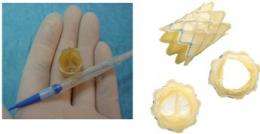
Now, a prospective multicenter study in the October 27 issue of the Journal of the American College of Cardiology, led by Children's Hospital Boston cardiologist Doff McElhinney, MD, finds good preliminary outcomes with a valve that can be delivered non-surgically--threaded up a leg vein to the heart--potentially avoiding the need for repeated open-heart operations.
The device, known as the Melody transcatheter pulmonary valve (Medtronic, Inc), received backing from an FDA advisory panel in July, suggesting FDA approval may come soon for certain patients. The device is currently approved in Europe and Canada; if approved by the FDA, it could be the first catheter-placed heart valve to be approved in the U.S.
"With a transcatheter valve, you don't have to open the chest and put the patient on heart-lung bypass machine, with all that that entails," says McElhinney. "Patients can come in, have a catheter procedure, stay overnight, then go home the next day."
The study, the first prospective, multicenter study of the device, involved 34 children and young adults at Children's Hospital Boston, Miami Children's Hospital and Morgan Stanley Children's Hospital (New York, NY) whose existing right-ventricular outflow conduits were malfunctioning, causing blood to flow backward from the pulmonary artery into the right ventricle (known as pulmonary regurgitation) or obstruction of blood from the right ventricle to the lungs. They had various forms of congenital heart disease, including tetralogy of Fallot, truncus arteriosus, aortic valve disease and transposition of the great arteries.
All patients underwent cardiac catheterization with the intention of implanting the artificial valve, and 30 of the 34 underwent actual implantation attempts, of which 29 were successful. Three patients (9 percent) had complications during implantation, but all survived.
At follow-up six months later, no patient had more than mild pulmonary regurgitation. Of 24 patients who had Class II or III heart failure (mild to moderate limitation of physical activity) before the procedure, 19 had improved by at least one functional class at six months, and no patient's function had declined.
Eight of the 29 devices developed partial fractures during follow-up, and 3 patients required a second Melody valve (inserted inside the first one) for recurrent blockage. In July, the advisory panel members called for longer-term monitoring of patients, but said the potential benefits outweighed concerns about fractures. Medtronic is now working on an improved version.
"This study shows that the valve can be used safely and effectively in the hands of many different trained cardiologists," says McElhinney. "These are early and short term data, but if the longer-term data are equally encouraging, this technology could have a major impact on the long-term health of our patients and their hearts."
"Currently, when patients have conduits that become dysfunctional, we are faced with the choice of tolerating that dysfunction or sending them back to surgery," McElhinney explains. "Because conduits may develop regurgitation or obstruction relatively quickly, we almost inevitably end up accepting some degree of dysfunction, often for many years, because patients can't keep going for surgery every couple of years."
Chronic conduit dysfunction can cause symptoms and eventually lead to dysfunction of the ventricle. Because the transcatheter valve can be implanted without the risks and morbidity of surgery, the threshold for intervening can be lowered, offering patients a chance at an improved quality of life, preserved heart function and fewer surgeries, McElhinney says.
"Of course, we need to learn more before we know whether the promise of this technology is realized," he adds.
Provided by Children's Hospital Boston


