The 'e-Nose': Scientists try to develop an electronic sniffer
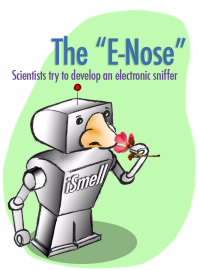
November 2, 2009 The 'e-Nose': Scientists try to develop an electronic sniffer

Credit: American Chemical Society

Sniff, sniff, sniff -- Yum! Sniff, sniff, sniff -- Oh, yuck!!! For almost 25 years, chemists and other scientists have tried to build a machine that can do exactly that.

They want an “electronic nose” that can take a whiff of the air, food or other objects and say whether the odor is nasty or nice. Such a machine could work in factories, and help tell whether food is fresh. An also could sniff for harmful . And unlike people, it could work 24 hours a day and 7 days a week without getting tired.

A German scientist named Udo Weimar and his team decided to check up on how much progress has been made toward an e-nose in those 25 years. It is not an easy task - odors are really complicated!

Next time you eat, notice the aroma arising off your plate. That smell is made up of hundreds or thousands of chemicals that float through the air and into your nose. For example, it takes more than 1,000 chemicals to make up the rich, deep aroma of coffee. Those chemicals land on millions of special cells in your nose. Those cells have the amazing ability to change the chemicals into nerve signals. They send a message to the brain, which figures out whether your food smells fantastic - or funky.

Dr. Weimar found that electronic noses are pretty good at detecting a few odors, including some that people cannot smell. is an important example. Since humans cannot smell this , electronic noses could warn people before they become ill. E-noses could also help sniff out bombs by detecting certain explosive chemicals.

However, present-day e-noses cannot detect nearly as many important smells as humans, dogs, and other animals. So while today’s electronic snouts can’t stop and smell the roses like we do, they may help keep us safer.

This fragrant study appeared in ACS’ Chemical Reviews, a monthly scientific journal.

More information: Listen to the audio version of this story on ACS’ Bytesize Science, an educational, entertaining podcast for young listeners. Click here to listen to Bytesize Science in iTunes.

Provided by American Chemical Society (news : web)


print this article email this article download pdf blog this article bookmark this article     Stumble it Digg this share on Facebook retweet share on Reddit add to delicious
Rate this story - 4 /5 (1 vote)

Rank Filter

Move the slider to adjust rank threshold, so that you can hide some of the comments.


Display comments: newest first

  • nuge - Nov 02, 2009
    • Rank: not rated yet
    I thought they still didn't know whether smells corresponded to the shapes of molecules or the vibrational frequencies the molecules have. Nowhere does it say how this nose supposedly works. This article was a bit heavy on interesting phrasing and a bit light on the underlying science.

November 2, 2009 all stories

Comments: 1

4 /5 (1 vote)
  • Stumble this up

  • Digg this

  • share this

  • hide
  • Related Stories

  • Sniffing out uses for the 'electronic nose'
    created Mar 10, 2008 | popularity not rated yet | comments 0
  • Artificial snot enhances electronic nose
    created Apr 30, 2007 | popularity not rated yet | comments 0
  • Smell something? Ask the rat -- he 'nose'
    created Feb 07, 2006 | popularity not rated yet | comments 0
  • Wake up and smell the sweat
    created Nov 21, 2007 | popularity not rated yet | comments 0
  • Study on olfactory nerve cells shows why we smell better when we sniff
    created Mar 13, 2007 | popularity not rated yet | comments 0


  • hide
  • Relevant PhysicsForums posts

  • Goddard
    created 1hour ago
  • Rate Laws
    created 3 hours ago
  • why oxygen, cannot act as a pi-donor while NO can?
    created 20 hours ago
  • Aspirin
    created Nov 19, 2009
  • More from Physics Forums - Chemistry

Other News

Accidental discovery produces durable new blue pigment for multiple applications

Accidental discovery produces durable new blue pigment for multiple applications

Chemistry / Biochemistry

created Nov 16, 2009 | popularity 4.5 / 5 (30) | comments 6

An accidental discovery in a laboratory at Oregon State University has apparently solved a quest that over thousands of years has absorbed the energies of ancient Egyptians, the Han dynasty in China, Mayan ...


One word: bioplastics

One word: bioplastics

Chemistry / Materials Science

created Nov 17, 2009 | popularity 4.5 / 5 (11) | comments 4

(PhysOrg.com) -- Every year, more than 250 billion pounds of plastic are produced worldwide. Much of it ends up in the world's oceans, a fact that troubles MIT biology professor Anthony Sinskey.


New on-off 'switch' triggers and reverses paralysis in animals with a beam of light

New on-off 'switch' triggers and reverses paralysis in animals with a beam of light (w/ Video)

Chemistry / Biochemistry

created Nov 18, 2009 | popularity 5 / 5 (4) | comments 3

In an advance with overtones of Star Trek phasers and other sci-fi ray guns, scientists in Canada are reporting development of an internal on-off "switch" that paralyzes animals when exposed to a beam of ultraviolet ...


Ethanol

Microbes to Take Over Ethanol Production?

Chemistry / Biochemistry

created Nov 20, 2009 | popularity 3.8 / 5 (5) | comments 0

(PhysOrg.com) -- Not too long ago, it seemed that ethanol production was the wave of the future. The use of trash, wood chips or different types of plants -- usually grass or corn -- to make ethanol was considered ...


New research provides blueprint for molecular basis of global warming

New research provides blueprint for molecular basis of global warming

Chemistry / Materials Science

created Nov 17, 2009 | popularity 4 / 5 (4) | comments 3

A new study indicates that major chemicals most often cited as leading causes of climate change, such as carbon dioxide and methane, are outclassed in their warming potential by compounds receiving less attention.