Hybrid composite for root canal treatment
November 3, 2009
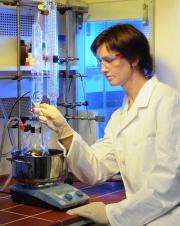
A researcher produces laboratory samples based on the new material. (© Fraunhofer ISC)
(PhysOrg.com) -- A dentist carrying out root canal treatment will need to use a variety of compounds. These do not always bond together properly and sometimes expensive follow-up treatment has to be performed. But a new class of material meets the requirements and solves the problem.
Unrelenting toothache means a visit to the dentist is inevitable, and if the tooth decay is really bad root canal treatment is often the only option. The dentist first removes the nerve completely and then closes the ensuing canal with a filler. This must be airtight to prevent bacteria from entering and causing renewed inflammation. On the other hand, the material must also be removable. If the natural crown is severely damaged, the dentist will anchor a root post in the previously filled canal using dental cement.
The post provides an anchor for the composite material used to rebuild the remaining part of the tooth, the core, which serves as the base for the core build-up material and the prosthetik treatment e.g. a crown. In root canal procedures, therefore, various materials are combined, each fulfilling different requirements. The problem is that the materials are not always compatible with each other or do not bond properly with the hard dental tissue. As a result, the post may break, the core and the crown may not adhere to the post properly, and the expensive crown may need replacing. Such faults are not rare and generally occur in the single-digit percent range.
Researchers at the Fraunhofer Institute for Silicate Research ISC in Würzburg working in collaboration with their research partners at VOCO GmbH have now developed a material that can be used for all the components used in root canal treatment.
“The basis of this material is provided by ORMOCER®s,” explains Dr. Herbert Wolter, group manager at the ISC. “We have combined these ORMOCER®s with various nano- and microparticles to achieve the highly diverse properties needed.” Materials used in filling the root canal, for instance, should not shrink as they harden, should form an airtight bond with the dental material and be visible in x-rays. The material used to rebuild the tooth, on the other hand, should have the same properties as the tooth itself. “Hybrid materials are well suited to these requirements. For instance, they only shrink by about 1.3 percent as they harden, while standard materials generally shrink by 2 to 4 percent. ORMOCER®s can also be adapted to adhere to the different parts of the tooth,” says Wolter. VOCO GmbH is already producing dental preparations and product development is making good progress. Market launch could therefore be just a few years away.
Provided by Fraunhofer-Gesellschaft
-
Dental fillings without gaps
Sep 05, 2008 |
not rated yet |
0
-
Laser used to help fight root canal bacteria
Jul 12, 2007 |
not rated yet |
0
-
Making crowns stick to teeth more effectively
Jul 20, 2009 |
not rated yet |
0
-
How effective are dental referrals by primary care physicians?
Jul 04, 2008 |
not rated yet |
0
-
Simple push filling wins crown in battle against tooth decay
Dec 20, 2007 |
not rated yet |
0
-
Engineers build first sub-10-nm carbon nanotube transistor
Feb 01, 2012 |
4.9 / 5 (33) |
30
-
Something old, something new: Evolution and the structural divergence of duplicate genes
Jan 31, 2012 |
4.6 / 5 (7) |
1
-
The hidden nanoworld of ice crystals: Revealing the dynamic behavior of quasi-liquid layers
Jan 30, 2012 |
5 / 5 (5) |
1
-
Stock market network reveals investor clustering
Jan 27, 2012 |
3.9 / 5 (23) |
8
-
Of microchemistry and molecules: Electronic microfluidic device synthesizes biocompatible probes
Jan 26, 2012 |
5 / 5 (2) |
0
-
How to tell if ionic compound has a higher melting point?
4 hours ago
-
How to determine zinc in a plant.
Feb 11, 2012
-
Boiling and melting point of impure substances
Feb 10, 2012
-
Safe nitrogen compound to decompose a 500 deg C in a furnace?
Feb 09, 2012
-
[ask]electron inside drinking water
Feb 08, 2012
-
How to avoid formation of Lithium Chromate ???
Feb 08, 2012
- More from Physics Forums - Chemistry
More news stories
Scientists discover molecular secrets of 2,000-year-old Chinese herbal remedy
For roughly two thousand years, Chinese herbalists have treated Malaria using a root extract, commonly known as Chang Shan, from a type of hydrangea that grows in Tibet and Nepal. More recent studies suggest that halofuginone, ...
17 hours ago |
4.5 / 5 (19) |
17
|
Ordered planar polymers created for the first time
(PhysOrg.com) -- Scientists under the direction of ETH Zurich have created a minor sensation in synthetic chemistry. They succeeded for the first time in producing regularly ordered planar polymers that form ...
54 minutes ago |
not rated yet |
0
|
New method to examine batteries -- MRI from the inside
There is an ever-increasing need for advanced batteries for portable electronics, such as phones, cameras, and music players, but also to power electric vehicles and to facilitate the distribution and storage of energy derived ...
Chemistry / Analytical Chemistry
17 hours ago |
5 / 5 (7) |
0
|
Hydrogen from acidic water: Researchers develop potential low cost alternative to platinum for splitting water
A technique for creating a new molecule that structurally and chemically replicates the active part of the widely used industrial catalyst molybdenite has been developed by researchers with the Lawrence Berkeley ...
Feb 09, 2012 |
4.8 / 5 (16) |
21
|
Fool's gold may prove an unlikely alternative to overexploited catalytic materials
Catalytic materials, which lower the energy barriers for chemical reactions, are used in everything from the commercial production of chemicals to catalytic converters in car engines. However, with current catalytic materials ...
Feb 10, 2012 |
4.4 / 5 (8) |
9
|
New molecule has potential to help treat genetic diseases and HIV
(PhysOrg.com) -- Chemists at The University of Texas at Austin have created a molecule that's so good at tangling itself inside the double helix of a DNA sequence that it can stay there for up to 16 days before ...
Social psychologist: Lust makes you smarter and evidence that seven deadly sins are good for you
(Medical Xpress) -- Good news for lovers on Valentine’s Day - the seven deadly sins, including Lust, are good for you. University of Melbourne social psychologist Dr Simon Laham uses modern research to make a compelling ...
Research finds injuries to professional athletes from routine play or practice often reported as 'freak accidents' in me
(Medical Xpress) -- A new report from the Johns Hopkins Center for Injury Research and Policy finds injuries to professional athletes from routine play or practice are often characterized as freak accidents in ...
Researchers' paper wins Best Paper Award for 2011
A paper written by Dr. Paul Gratz and his graduate student, Reena Panda, from the Department of Electrical and Computer Engineering at Texas A&M University was selected as one of the best papers from IEEE Computer Architecture ...
Low levels of amplitude-modulated electromagnetic fields elicit therapeutic responses cancer patients
Ryne Ramaker, a senior UALR Donaghey Scholar and University Science Scholar with a double major in biology and chemistry, is a co-author of a cancer research paper creating excitement among other researchers. The article ...
Rapunzel, Leonardo and the physics of the ponytail
(PhysOrg.com) -- New research provides the first mathematical understanding of the shape of a ponytail and could have implications for the textile industry, computer animation and personal care products.