Timber harvest impacts amphibians differently during life stages
November 3, 2009 Timber harvest impacts amphibians differently during life stages

Enlarge

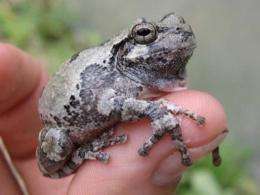
University of Missouri researchers found that removing all of the trees from a section of the forest had a negative effect on amphibians during their later life cycles, but had some positive effects during amphibians' aquatic larva stages at the beginning of their lives. Credit: Photo courtesy of Dr. Semlitsch.

Frogs are croaking in clear-cut forests, but not exactly in their traditional manner. University of Missouri researchers found that removing all of the trees from a section of the forest had a negative effect on amphibians during their later life cycles, but had some positive effects during amphibians' aquatic larva stages at the beginning of their lives. To lessen the negative effects during the later life stage, Semlitsch recommends partial or selection cuts to forests rather than completely removing trees from an area. Removing only a portion of trees and canopy allows amphibians to persist better.

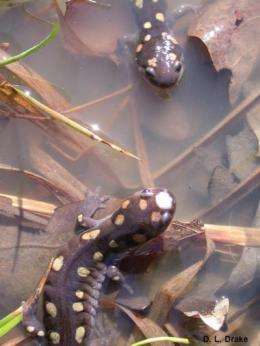
The ultimate goal is not to stop the harvest of trees, but to find techniques that can sustain economically valuable timber harvests and protect , including many species of amphibians, said Ray Semlitsch, Curators' Professor of Biological Science in the College of Arts and Science. Amphibians may be critical for the transfer of nutrients, such as nitrogen from ponds and streams into the uplands for consumption by plants and other forest creatures.
Timber harvest impacts amphibians differently during life stages
Enlarge

Amphibians may be critical for the transfer of nutrients, such as nitrogen from ponds and streams into the uplands for consumption by plants and other forest creatures. Credit: Photo courtesy of Dr. Semlitsch.

"Amphibians are good bio-indicators of the health of an environment," Semlitsch said. "When amphibians aren't doing well, it's a warning that the rest of the ecosystem isn't doing well. They are sensitive to temperature and water loss and take on the same temperature as the area around them. Because of their sensitivity, amphibians are the most endangered of the vertebrates. About one-third of the species world-wide are in danger of extinction. "

In the study, researchers examined how clear-cutting and timber harvest techniques affect amphibians during different life stages. Surprisingly, researchers found that timber harvest has a positive effect on the aquatic stage of the amphibian's life. Without shade over the pond, algae grew faster in direct sunlight and productivity in the pond increased. The larval amphibians ate the increased algae and grew larger and faster. However, this benefit was temporary; when amphibians left the pond, they were more likely to die.

"The trouble starts for amphibians the moment they walk out of the pond," Semlitsch said. "When you remove all the trees from the forest, it has devastating effects on the population. Without a canopy above, open areas basically cook amphibians."

The study was a coordinated effort during a five-year period in three different locations in Maine, South Carolina and Missouri. Researchers were able to cross reference what was happening to the same types of frogs and salamanders in the three locations. Prior studies have been conducted on amphibians in clear-cut environments, but this was the first to compare data during different stages of life across multiple regions.

Source: University of Missouri-Columbia (news : web)


print this article email this article download pdf blog this article bookmark this article     Stumble it Digg this share on Facebook retweet share on Reddit add to delicious
Rate this story - 2.5 /5 (2 votes)


November 3, 2009 all stories

Comments: 0

2.5 /5 (2 votes)
  • Stumble this up

  • Digg this

  • share this

  • hide
  • Related Stories

  • Amphibians respond behaviorally to impact of clear cutting
    created Mar 11, 2008 | popularity not rated yet | comments 0
  • The new wildlife refuge -- Golf courses?
    created Jul 11, 2007 | popularity not rated yet | comments 0
  • New frog center planned at the London Zoo
    created Oct 05, 2005 | popularity not rated yet | comments 0
  • Parasites might spur evolution of strange amphibian breeding habits
    created Nov 14, 2007 | popularity not rated yet | comments 0
  • Pesticides place amphibians in danger
    created Jan 25, 2006 | popularity not rated yet | comments 0


  • hide
  • Relevant PhysicsForums posts

  • Breeding program
    created 16 hours ago
  • How does a concentration gradient provide energy?
    created 19 hours ago
  • Eyesight and Neural Damage from Electronics
    created Nov 19, 2009
  • Quick question about the Golgi Apparatus?
    created Nov 19, 2009
  • More from Physics Forums - Biology

Other News

Atomic-level Snapshot Catches Protein Motor in Action (w/ Video)

Atomic-level Snapshot Catches Protein Motor in Action (w/ Video)

Biology / Cell & Microbiology

created 16 hours ago | popularity 4.5 / 5 (2) | comments 1

(PhysOrg.com) -- The atomic-level action of a remarkable class of ring-shaped protein motors has been uncovered by researchers with the Lawrence Berkeley National Laboratory using a state-of-the-art protein ...


Termite creates sustainable monoculture fungus-farming

Termite creates sustainable monoculture fungus-farming

Biology / Plants & Animals

created 16 hours ago | popularity 5 / 5 (1) | comments 0

(PhysOrg.com) -- Food production of modern human societies is mostly based on large-scale monoculture crops, but it now appears that advanced insect societies have the same practice. Our societies took just ...


Sponges against cancer

Biology / Cell & Microbiology

created 18 hours ago | popularity 5 / 5 (1) | comments 0

Deep under the sea, there's a battle of life and death going on, with no holds barred. Sponges and other marine animals which cannot move around might seem to be defenceless against predators. Yet nothing is further from ...


We're off then: the evolution of bat migration

We're off then: The evolution of bat migration

Biology / Plants & Animals

created 18 hours ago | popularity not rated yet | comments 0

(PhysOrg.com) -- Not just birds, but also a few species of bats face a long journey every year. Researchers at Princeton University in the U.S. and at the Max Planck Institute for Ornithology in Radolfzell, ...


Dutch researchers make breakthrough in bioethanol production from agricultural waste

Biology / Cell & Microbiology

created 19 hours ago | popularity 3.7 / 5 (3) | comments 0

With the introduction of a single bacterial gene into yeast, researchers from Delft University of Technology in the Netherlands achieved three improvements in bioethanol production from agricultural waste material: 'More ...