NRL sensor provides critical space weather observations
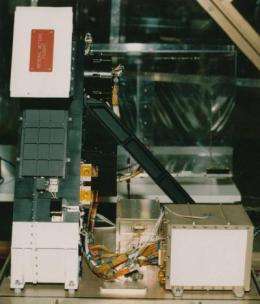
Launched from Vandenberg Air Force Base, Calif., aboard an United Launch Alliance Atlas V launch vehicle, Oct. 18, 2009, the Special Sensor Ultraviolet Limb Imager (SSULI) developed by NRL's Space Science Division and Spacecraft Engineering Department offers a first of its kind technique for remote sensing of the ionosphere and thermosphere from space.
Flying on-orbit the U.S. Air Force Defense Meteorological Satellite Program (DMSP) F18 (flight 18) satellite, SSULI's characterization of the Earth's upper atmosphere and ionosphere provide the necessary scientific data to support military and civil systems. The upper atmosphere affects many systems from global to tactical scales including GPS positioning, High-Frequency (HF) radio communications, satellite drag and orbit determination, and over the horizon radar.
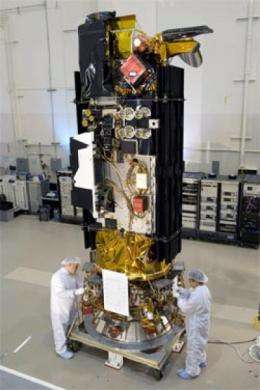
"Space Weather can impact systems in both the military and civilian sectors," said Sean Lynch, program manager, NRL Spacecraft Engineering Department. "Observations acquired by SSULI will be processed at the Air Force Weather Agency to generate products to provide a more accurate representation of the atmosphere at a level that can directly affect civilian and military assets."
Offering global observations, that yield near real-time altitude profiles of the ionosphere and neutral atmosphere, over an extended period of time, SSULI makes measurements from the extreme ultraviolet (EUV) to the far ultraviolet (FUV) over the wavelength range of 80 nanometers (nm) to 170 nm with 2.4 nm resolution.
Building on the successes of the NRL High Resolution Airglow/Aurora Spectroscopy (HIRAAS) experiment flown aboard the Space Test Program (STP) Advanced Research and Global Observations Satellite (ARGOS), SSULI also measures the electron density and neutral density profiles of the emitting atmospheric constituents. SSULI uses a spectrograph with a mirror capable of scanning below the satellite horizon from 10 degrees to 27 degrees every 90 seconds. These observations represent a vertical slice of the Earth's atmosphere from 750 kilometers (km) to 50 km in depth.
"The performance characteristics of this sensor are outstanding," said Andrew Nicholas, SSULI principal investigator, NRL Space Science Division. "SSULI measures vertical profiles of the natural airglow radiation from atoms, molecules and ions in the upper atmosphere and ionosphere and enables the development of new techniques for global ionospheric remote sensing and new models of global electron density variation."
Models being developed include the Global Assimilation of Ionospheric Measurements. GAIM applies novel and sophisticated data assimilation techniques to space weather forecasting and will become an operational ionospheric model providing real-time ionospheric specification and forecasts for Department of Defense (DoD) and civilian customers.
An extensive data processing suite was developed to support on-orbit observations and flight operations. It includes data reduction software using unique science algorithms developed at NRL and comprehensive data validation techniques. After launch, the SSULI sensor, software, and derived atmospheric specification will undergo an extensive validation. After validation, SSULI products will be distributed by AFWA to support operational DoD systems.
Source: Naval Research Laboratory (news : web)


