Reflective film can boost profits for apple growers
November 3, 2009 Reflective film can boost profits for apple growers

Enlarge

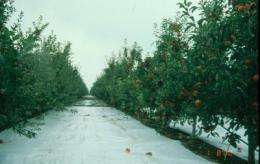
Solar films shown applied to the orchard floor improved fruit size and color in Gala apples. Credit: Photo by Ignasi Iglesias

In a research report published in a recent issue of HortTechnology, scientists Ignasi Iglesias and Simó Alegre examined the effects of covering orchard floors with reflective films on fruit color, fruit quality, canopy light distribution, orchard temperature, and profitability. The experiments were performed using Extenday™ and Solarmate™ films installed 5 weeks before commercial harvest in orchards of 'Mondial Gala' apples. The research showed that the use of both films increased fruit size and color and can result in increased profits for apple growers.

It's long been known that consumers choose apples based on fruit color. Although color does not affect the flavor, taste, and texture of apples, color influences consumer buying decisions and, in turn, growers' bottom lines. For many red and bicolored apple cultivars, including Gala, Delicious, and Fuji, red color (the intensity and quality of red skin) and fruit size are also important characteristics for fruit grading standards. Even when apples are of adequate size, poor fruit color can result in lower-grade fruit and decreased consumer approval.

Apple producers recognize that clear days with temperatures of around 25 °C and cool nights below 15 °C are ideal growing conditions for apples to develop bright red colors. Under these conditions, apples are capable of increasing canopy photosynthesis, and respiration rates decrease at night. Commercial apple growers in southern regions can be challenged by warm, dry summers that are not favorable to apple fruit color development; these warmer climates can have a definite negative effect on production and profits.

'Gala' apples have become very popular in Europe, where the high quality of this fruit is increasingly appreciated by consumers. To meet consumer demand, apple growers in southern Europe (mainly Spain and Italy) are looking for ways to turn out high-quality, cost-effective apple crops despite a climate that is not particularly conducive to apple production.

To address producers' issues of warmer climates, increased consumer demand, and high apple quality, Iglesias and Alegre designed a 3-year experiment using 'Mondial Gala' apples grown in orchards in northeastern Spain. Their objective was to determine how different types of reflective film affect orchard temperature, skin-color development, fruit quality, light canopy distribution, and, ultimately, apple crop profitability.

Based on the fruit size and color required to meet European Union grade standards, the use of Extenday™ or Solarmate™ films resulted in an increase of 26% and 17%, respectively, when compared with the control, for the number of fruit picked at first harvest.

The researchers concluded that "season clearly affected fruit color development, whereas harvest date, fruit firmness, fruit size, soluble solid concentration, titratable acidity, and maturity were not consistently affected by the use of reflective film." According to Iglesias, the study results are promising, but long-term benefits of the technique will largely depend on fruit prices.

Source: American Society for Horticultural Science


print this article email this article download pdf blog this article bookmark this article     Stumble it Digg this share on Facebook retweet share on Reddit add to delicious
Rate this story - 4 /5 (2 votes)


November 3, 2009 all stories

Comments: 0

4 /5 (2 votes)
  • Stumble this up

  • Digg this

  • share this

  • hide
  • Related Stories

  • Apple peel appeal: Using software to measure variances in 'honeycrisp' apple peels
    created Feb 17, 2009 | popularity not rated yet | comments 0
  • Found - the apple gene for red
    created Nov 30, 2006 | popularity not rated yet | comments 0
  • One bad apple: Consumers prefer perfect produce
    created Dec 03, 2007 | popularity not rated yet | comments 0
  • Laser Shows if Fruit's Beauty is Only Skin Deep
    created May 08, 2005 | popularity not rated yet | comments 0
  • Apples, apple juice shown to prevent early atherosclerosis
    created May 03, 2008 | popularity not rated yet | comments 0


  • hide
  • Relevant PhysicsForums posts

  • Human Leukocyte Antigen (HLA) typing
    created 3 hours ago
  • Breeding program
    created Nov 20, 2009
  • How does a concentration gradient provide energy?
    created Nov 20, 2009
  • Eyesight and Neural Damage from Electronics
    created Nov 19, 2009
  • More from Physics Forums - Biology

Other News

The Monarchs' annual migration ritual has yet to be scientifically explained

Tree-eating bugs threaten Monarch butterfly in Mexico

Biology / Ecology

created 5 hours ago | popularity 4 / 5 (1) | comments 0

The mysterious Monarch butterfly, which migrates en masse annually between Canada and Mexico, is now facing a new peril: another insect thriving in Western Mexican forests.


Extinct goat Myotragus balearicus

Extinct goat was cold-blooded

Biology / Plants & Animals

created Nov 18, 2009 | popularity 4.9 / 5 (32) | comments 10

(PhysOrg.com) -- An extinct goat that lived on a barren Mediterranean island survived for millions of years by reducing in size and by becoming cold-blooded, which has never before been discovered in mammals.


Bigger not necessarily better, when it comes to brains

Bigger not necessarily better, when it comes to brains

Biology / Plants & Animals

created Nov 17, 2009 | popularity 4.5 / 5 (17) | comments 11

(PhysOrg.com) -- Tiny insects could be as intelligent as much bigger animals, despite only having a brain the size of a pinhead, say scientists at Queen Mary, University of London.


Right-handed chimpanzees provide clues to the origin of human language

Biology / Plants & Animals

created Nov 16, 2009 | popularity 3 / 5 (1) | comments 7

Most of the linguistic functions in humans are controlled by the left cerebral hemisphere. A study of captive chimpanzees at the Yerkes National Primate Research Center (Atlanta, Georgia), reported in the January 2010 issue ...


The creature was found at a depth of 161 metres

Japanese researchers film rare baby fish 'fossil'

Biology / Plants & Animals

created Nov 17, 2009 | popularity 4.7 / 5 (7) | comments 4

Japanese marine researchers said Tuesday they had found and successfully filmed a young coelacanth -- a rare type of fish known as "a living fossil" -- in deep water off Indonesia.