Laser etching safe alternative for labeling grapefruit
November 3, 2009 Laser etching safe alternative for labeling grapefruit

Enlarge

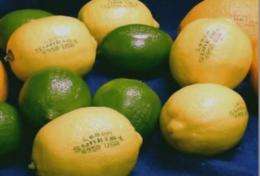
This image shows laser etching on lemons and limes. Credit: Photo courtesy of Sunkist

Laser labeling of fruit and vegetables is a new, patented technology in which a low-energy carbon dioxide laser beam is used to label, or "etch" information on produce, thereby eliminating the need for common sticker-type labels. The technology has been licensed for use on a variety of fruits and vegetables and is being used in New Zealand, Australia, and Pacific Rim countries. It has been been approved in Asia, South Africa, Central and South America, Canada, and the European Union. The U.S. Food and Drug Administration (FDA) is in the final stages of approving the use of laser etching in the United States.

A research study aimed at investigating water loss, peel appearance, and potential decay in laser-labeled grapefruit was published recently in HortTechnology. "Little information is available on the impact of this new technology on the overall quality of labeled produce, especially its effect on water loss and decay during prolonged storage", said Dr. Ed Etxeberria, who headed the research team comprised of scientists from the University of Florida and the USDA Agricultural Research Service (USDA-ARS).

"In Florida, grapefruit represents 43% of the citrus fresh market. Grapefruit require extended storage, especially when transported to international destinations. This study determined the effects of laser labeling on water loss and decay susceptibility during prolonged storage", Etxeberria explained.

During commercial production, citrus is waxed before being labeled, packed, stored, and transported. Whereas common sticker-type labels do not deteriorate during storage, researchers postulated that water loss resulting from laser etching may distort the physical appearance of the fruit's surface, making it less effective and appealing. "The pinhole depressions applied after washing and waxing disrupt the natural cuticular barrier and the protective commercial wax cover, seemingly creating open cavities that would allow for increased water loss and facilitating the entrance of decay organisms. These etched surfaces can promote water loss and may increase the number of entry sites for decay-promoting organisms", the researchers said.

'Red Ruby' grapefruit that had been washed and waxed with carnuba containing 15 ppm thiabendazole (following established commercial practices) was used in the study. Water loss from etched surfaces was measured, and the effect of waxing on reducing water loss from etched fruit surfaces was investigated using nine different waxes. Laser-labeled fruit stored at 10 °C and two relative humidities (95% and 65%) for 5 weeks showed no increase in decay compared with nonetched control fruit, suggesting that laser labeling does not facilitate decay. This was confirmed by experiments where Penicillium digitatum spores were coated on fruit surfaces before and after etching. In either case, no decay was observed.

The researchers concluded that, when compared with sticker-labeled fruit, laser etching provides a relatively tamper-free labeling method, while "the fruit quality remains high as the invasion of the epidermis does not incite decay, provide an avenue for food pathogens, and water loss is easily controlled. The technology will offer the grapefruit industry a safe alternative to adhesive sticker labeling without enhancing decay susceptibility."

Source: American Society for Horticultural Science


print this article email this article download pdf blog this article bookmark this article     Stumble it Digg this share on Facebook retweet share on Reddit add to delicious
Rate this story - 4.4 /5 (14 votes)

Rank Filter

Move the slider to adjust rank threshold, so that you can hide some of the comments.


Display comments: newest first

  • ealex - Nov 03, 2009
    • Rank: not rated yet
    I have always failed to understand why someone would want or need their fruit production to be labeled. What possible good can it achieve, the labels contain no real information of value other than a logo or brand name and branding fruit seems to go to the edge of consumer advertising stupidity.

    Why not just include a cartboard cutout that can be posted up by the retailer, or whatever other form that is far less expensive or material and energy-consuming.
  • El_Nose - Nov 03, 2009
    • Rank: 5 / 5 (1)
    the final piece of informaiton on a friut label is a 4 to 6 digit code. I have no idea what the code signifies but it may trace the fuit back to a region or specific farm in which case that knowledge would help in food bourne pathogen outbreaks.
  • ealex - Nov 03, 2009
    • Rank: not rated yet
    hmm never seen fruit labels that have a code on them, it's they seem pretty pointless to me, but I'll give you that, could be useful in tracking down fpos.
  • nkalanaga - Nov 03, 2009
    • Rank: 4 / 5 (1)
    The numeric code also identifies the type of produce, which helps the checkout clerk find the price. It's hard to barcode and scan a grape, even in bunches, and many small retailers still don't use electronic scanners anyway. Rather than having to know all of the types of produce by sight, or have a name on it in who-knows-how-many languages, a standard number lets the clerk look up the store's price on a printed sheet.
  • snivvy - Nov 04, 2009
    • Rank: not rated yet
    The purpose of the labels on the fruit is so the grocery chains can hire the lowest of the low to work at the checkout registers. These people, generally, don't speak English very well and have no clue what the heck they're selling. Then you have organic vs. good fruit and vegetables. You can always recognize the organic fruit because it full of bug bites and bruises vs. the beautiful good fruit.
  • nkalanaga - Nov 04, 2009
    • Rank: not rated yet
    It also helps when the store sells 37 varieties of apples, half of which look alike. It doesn't matter what language one speaks, that requires some type of label.
  • Cellar - Nov 05, 2009
    • Rank: not rated yet
    Now what I'd like to know is what happens when you etch before waxing instead of after.
  • nkalanaga - Nov 05, 2009
    • Rank: not rated yet
    That would seem to be ideal. The wax would seal the etching, which was the only apparent issue in the tests.

November 3, 2009 all stories

Comments: 8

4.4 /5 (14 votes)
  • Stumble this up

  • Digg this

  • share this

  • hide
  • Related Stories

  • Food 'Tattoos' an Alternative to Labels for Identifying Fruit
    created Aug 31, 2009 | popularity not rated yet | comments 0
  • Comparing apples and pears: Scientists see health-determining air paths in fruit
    created Jul 10, 2008 | popularity not rated yet | comments 0
  • Laser Shows if Fruit's Beauty is Only Skin Deep
    created May 08, 2005 | popularity not rated yet | comments 0
  • New reasons to avoid grapefruit and other juices when taking certain drugs
    created Aug 19, 2008 | popularity not rated yet | comments 0
  • Seeing through tooth decay
    created Aug 22, 2008 | popularity not rated yet | comments 0


  • hide
  • Relevant PhysicsForums posts

  • Selenocysteine in pH=7
    created Nov 26, 2009
  • What is the formula for calculating the speed of thought?
    created Nov 26, 2009
  • What does word "absorption" mean in the intestine?
    created Nov 26, 2009
  • What is transpulmonary pressure?
    created Nov 24, 2009
  • More from Physics Forums - Biology

Other News

Hammerhead shark

Wide heads give hammerheads exceptional stereo view

Biology / Plants & Animals

created 7 hours ago | popularity 4.3 / 5 (4) | comments 4

Hammerhead sharks are some of the Ocean's most distinctive residents. 'Everyone wants to understand why they have this strange head shape,' says Michelle McComb from Florida Atlantic University. One possible ...


Tough yet stiff deer antler is materials scientist's dream

Biology / Plants & Animals

created 7 hours ago | popularity not rated yet | comments 2

Prized for their impressive antlers, red deer have been caught in the hunters' sights for generations. But a deer's antlers are much more than decorative. They are lethal weapons that stags crash together when duelling. John ...


Indonesia rejects Bali plan for turtle sacrifices (AP)

Indonesia rejects Bali plan for turtle sacrifices

Biology / Ecology

created 5 hours ago | popularity not rated yet | comments 0

(AP) -- Indonesia has rejected a push by the resort island of Bali for rare turtles to be legally slain in Hindu ceremonies, siding with conservationists of the protected reptiles against religious advocates, ...


Ecologists sound out new solution for monitoring cryptic species

Biology / Ecology

created 7 hours ago | popularity not rated yet | comments 0

Ecologists have at last worked out a way of using recordings of birdsong to accurately measure the size of bird populations. This is the first time sound recordings from a microphone array have been translated into accurate ...


The six elephants in Sierra Leone were shot and "crudely butchered"

S.Leone elephants 'wiped out' by poachers: official

Biology / Ecology

created Nov 26, 2009 | popularity 5 / 5 (5) | comments 6

Poachers "wiped out" the entire elephant herd in Sierra Leone's only wildlife park, wildlife managers said Thursday after police said they had arrested a gang of 10 poachers.