Sustainably grown garlic
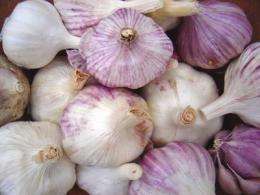
Consumer interest in new and diverse types of garlic is on the rise. Fueled by factors including the growth of the "local foods" movement, interest in world cuisines, and widespread reports touting its numerous health benefits, demand for high-quality, locally grown garlic is increasing throughout the U.S.
While most grocery stores in carry the familiar white, "softneck" garlic (which is most often imported), varieties of "hardneck" garlic in colorful hues of purple, magenta, pink, and white are becoming more available at local vegetable stands and through direct-marketing programs. The results of a recent study of 10 garlic cultivars can help farmers identify niche regional markets and offer new, in-demand garlic varieties to consumers.
Hundreds of garlic (Allium sativum L.) cultivars are available from seed companies, retailers, and germplasm collections. Increasingly, growers purchase bulbs from nonlocal sources and are often disappointed by unpredictable yields. Garlic bulbs resulting from seed stock purchased in other regions may not display the characteristics—such as bulb size, shape, and color—featured in the catalogs.
Gayle M. Volk of the National Center for Genetic Resources Preservation, U.S. Department of Agriculture's Agricultural Research Service in Fort Collins, and David Stern of the Garlic Seed Foundation authored a study designed to determine which garlic traits are stable and which traits vary depending on where the garlic is grown. According to the study published in a recent issue of HortScience and funded primarily by the Northeast Sustainable Agricultural Research and Education program, prior research has shown that traits such as clove number, clove skin coloration, and topset number are representative of cultivar type across growth locations, whereas "phenotypic" traits such as bulb wrapper color, bulb size, and bulb elemental composition are specific to sites.
Ten diverse garlic cultivars ('Ajo Rojo', 'Chesnok', 'German White', 'Inchelium', 'Purple Glazer', 'Red Janice', 'Sakura', 'Siberian', 'Silverwhite', and 'Spanish Roja') were grown at 12 locations in the United States and Canada for the study. One cultivar representing each of the 10 garlic types was selected to best capture the genetic diversity available within Allium sativum.
In 2005, garlic bulbs obtained from producers in Washington were distributed to 10 garlic growers who practiced sustainable production methods with minimal or no chemical inputs. Small-scale garlic farmers were provided with planting stocks from the same original sources and were asked to grow them on their farms for two consecutive years using their best practices.
At each location, 16 cloves per cultivar were planted in each of three replicate plots. Bulbs were harvested when the lower one-third to one-half of the leaves on the plants had dried. Six to eight bulbs of each cultivar grown in each plot were sent to Fort Collins for data collection and analysis. In Fall 2006, bulbs produced at each farm were replanted and grown for a second season at the same farm (except for a change in the Colorado farm and the addition of a farm in Ontario, Canada). Quality of planting stock, bulb characteristics, bulb wrapper color, bulb yield, clove characteristics and bulb elemental composition were analyzed. Growers also provided feedback for the study using digital documentation, surveys, planting notes, and harvest notes.
Among the significant findings: bulb wrapper color and bulb size were determined to be "highly dependent" on location and cultivar. "It was not surprising to find that bulb size and circumference were highly site-dependent and correlated. Bulb wrapper color is also highly site-specific, supporting evidence reported by marketers that bulb color is more determined by growth environment than cultivar types", Volk stated.
The research offers promise for savvy consumers interested in more locally grown, fresh garlic varieties. "As consumers start to recognize and request garlic types by name, information about which traits define specific cultivars and which traits are highly variable will be valuable for successful marketing of new garlic cultivars", explained Volk.
Source: American Society for Horticultural Science


