Volcanic eruptions may split Africa: scientists
November 3, 2009
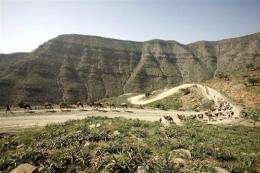
Camels carry salt in the Ethiopia's Afar Region

Enlarge

Camels carry salt in the Ethiopia's Afar Region in 2007. Volcanic activity may split the African continent in two owing to a recent geological crack in northeastern Ethiopia, researchers said on Tuesday.

Volcanic activity may split the African continent in two owing to a recent geological crack in northeastern Ethiopia, researchers said on Tuesday.

The 60-kilometre (35-mile) split in the desolate Afar region, which was the result of two in September 2005, has enabled scientists to further examine the earth's tectonic movements, said a report published in the Geophysical Research Letters.

"The significance of the finding is that a huge magnetic deformation can happen within a few days like in oceans," Atalay Arefe, an Ethiopia-based university professor who was part of the study, told AFP in an interview.

Researchers say faults and fissures, which normally occur deep down on the , are the main processes by which continents gradually break off from each other.

They cite Africa, which underwent a similar phase when it split from America millions of years ago.

"Normally, such phenomena happens beneath the ocean, which is inaccessible, expensive and very difficult to make experiments. But in Afar, it's quite a natural laboratory for us to carry those out," Atalay explained.

Atalay, who was part of an international group of scientists who have been undertaking studies since the eruptions, said the event indicated what was likely to happen in the mainland.

"The ocean's formation is happening slowly, likely to take a few million years. It will stretch from the Afar depression (straddling Ethiopia, Eritrea and Djibouti) down to Mozambique," he said.

The Afar region, known for its salt mines and active volcanoes, is one of the lowest and hottest places on the planet.

(c) 2009 AFP

4.4 /5 (10 votes)  

Filter


Move the slider to adjust rank threshold, so that you can hide some of the comments.


Display comments: newest first

Omnitheo
Nov 03, 2009

Rank: 5 / 5 (3)
The topic title is misleading. We've known for several years about Africa being split apart by tectonic movement.

What this article is about is how the fact that this rift is on land rather than underwater makes it much easier for them to study
Rank 4.4 /5 (10 votes)
Related Stories
Relevant PhysicsForums posts
  • Do some geologists actually act a lot like Randy Marsh?
    createdFeb 11, 2012
  • Discrepancy between oxygen and carbon-dioxide levels
    createdFeb 09, 2012
  • where gems are found in the world
    createdFeb 09, 2012
  • Wind Waves in Reservoir ~ Wind run-up and Wind set-up
    createdFeb 08, 2012
  • Balance of oxygen in the atmosphere
    createdFeb 01, 2012
  • The case for a methanol-based economy
    createdJan 30, 2012
  • More from Physics Forums - Earth

More news stories

With climate change, today's '100-year floods' may happen every three to 20 years: research

Last August, Hurricane Irene spun through the Caribbean and parts of the eastern United States, leaving widespread wreckage in its wake. The Category 3 storm whipped up water levels, generating storm surges ...

Space & Earth / Environment

created 34 minutes ago | popularity 2.3 / 5 (3) | comments 0 | with audio podcast

China's pollution puts a dent in its economy

Although China has made substantial progress in cleaning up its air pollution,a new MIT study shows that the economic impact from ozone and particulates in its air has increased dramatically. ...

Space & Earth / Environment

created 11 minutes ago | popularity not rated yet | comments 0

New European rocket lifts off on maiden flight

A lightweight rocket aimed at securing Europe a stake in the market to launch small satellites lifted off from Kourou space base on its maiden flight on Monday.

Space & Earth / Space Exploration

created 1 hour ago | popularity 5 / 5 (4) | comments 1

Climate change causes harmful algal blooms in North Atlantic: study

Warming oceans and increases in windiness could be causing of an abundance of harmful algal blooms in the North Atlantic Ocean and North Sea, according to new research.

Space & Earth / Environment

created 3 hours ago | popularity not rated yet | comments 0

NASA budget will axe Mars deal with Europe: scientists

US President Barack Obama's budget proposal to be submitted next week for 2013 will cut NASA's budget by 20 percent and eliminate a major partnership with Europe on Mars exploration, scientists said Thursday.

Space & Earth / Space Exploration

created Feb 10, 2012 | popularity 5 / 5 (4) | comments 59


Researchers make better heat sensor based on butterfly wings

(PhysOrg.com) -- Scientists have long known that butterfly wings produce their iridescent colors by bouncing light around and between tiny ridges in structures made of chitin. More recently they’ve discovered ...

Manipulating genes with hidden TALENs

(PhysOrg.com) -- A better understanding of gene function in model plant and animal systems could be used to develop useful traits in livestock and crop plants, and might someday lead to developments in stem ...

The joy of cheques

An electronic cheque which eliminates the need for costly processing by banks but preserves the simplicity and ease of a traditional cheque book has been designed by a team of academics in the UK.

Research shows promise in converting camelina oil into jet fuel

(PhysOrg.com) -- Researchers at Montana State University-Northern have developed a process to convert camelina oil to jet fuel and other high-value chemicals. MSU has applied for a U.S. patent and research is ongoing.

Couples in the same place emotionally stay together, study says

(Medical Xpress) -- Despite life’s ups and downs, couples whose feelings are in sync consistently over time are more likely to stay together, says a University of California, Davis, study.

Researchers make breakthrough in stem cell research

(Medical Xpress) -- University of Queensland scientists have developed a world-first method for producing adult stem cells that will substantially impact patients who have a range of serious diseases.