Will Europe Be Powered by the Sahara

November 4, 2009 by Miranda Marquit weblog
Sahara

Enlarge

Image source: U.S. government via Wikimedia Commons

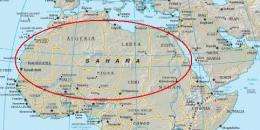
(PhysOrg.com) -- Europe has long been interested in developing alternative energy sources. And, one of the more interesting places that some Europeans are looking for solar power is the Sahara. With the vast amounts of sun beating down on the Saharan desert, it seems an ideal place for solar panels. The Desertec Industrial Initiative, a consortium of 12 companies, including Siemens and Deutsche Bank, aims to make Saharan solar power for Europe a reality. But it won't exactly be easy.

First of all, there is the fact that Africa is not exactly connected by land to Europe. The Initiative has a plan for that, though. The Guardian reports that power lines will stretch across the Mediterranean to provide as much as 15% of Europe's electric power by 2050. Another issue is the fact that there are some, er, less than stable countries involved.

Just as energy from oil can be disrupted by conflict and political turmoil in African nations, in the Sahara could be impacted by problems in the region. And, of course, if Saharan countries agree to allow such farms on their land, it is likely that some of the power will have to go to African cities, and that there will be leases to pay and perhaps royalties. It is likely that some sort of financial arrangement will have to be made, and could affect the project's profitability.

The technology to be used for the solar farms is described by The Guardian:

The involved is known as concentrated (CSP) which uses mirrors to concentrate the sun's rays on a fluid container. The super-heated liquid then drives turbines to generate electricity. The advantage over solar photovoltaic panels, which convert sunlight directly to electricity, is that if sufficient hot fluid is stored in containers, the generators can run all night.

The technology has been around for years, but never used on this scale. There are hopes that, if everything goes well, the first power station of the project could be build by 2015.

© 2009 PhysOrg.com

4.1 /5 (23 votes)  

Filter


Move the slider to adjust rank threshold, so that you can hide some of the comments.


Display comments: newest first

nuge
Nov 04, 2009

Rank: 4.1 / 5 (8)
You have to wonder if it would mean Europe would held to ransom by Saharan Solar nations controlling energy prices if they did this.
frajo
Nov 04, 2009

Rank: 3.5 / 5 (8)
This project has advantages for all. The African countries will get wealthier and therefore more stable. The Europeans will have an additional energy source besides coal, oil, gas, fission, wind, water. Finally some African countries will want to join the EU. It's a matter of time only. It's wise to diversify your energy sources.
DozerIAm
Nov 04, 2009

Rank: 2.8 / 5 (4)
Nuge, you mean as is the situation now with with Europe and oil producing countries? More options for buyers means less problems if one energy delivery source (or even several) falls thru.

Frajo, you got it - economic wealth will promote political stability (of some sort - we may not like it but it will be stable).
danman5000
Nov 04, 2009

Rank: 4.8 / 5 (4)
There's also the inconvience that Africa isn't in Europe. There's going to have to be a lot of careful negotiating to get a stable arrangement going.

Also power lines seem like an extremely easy target for terrorism. It would be impractical to patrol the entire length to kepe it safe, and it would be all too easy to cut power to a large portion of Europe by simply cutting a few cables.
finitesolutions
Nov 04, 2009

Rank: 2 / 5 (6)
As always the europeans have to do all the work because Algeria, Tunisia and Libya do not have the will, money and technology to build the solar power plants. We have to think for them. But trade benefits both ways. With the money they gain they will be able to buy food, water etc. from Europe.
USA can destroy a city by nuclear bombing it. You never know!
ThomasS
Nov 04, 2009

Rank: 4.3 / 5 (6)
Article is really short, and its not exactly news. And
some, er, less than stable countries involved
what kind of language is that?
Nederluv
Nov 04, 2009

Rank: 3.8 / 5 (4)
This project has advantages for all. The African countries will get wealthier and therefore more stable. The Europeans will have an additional energy source besides coal, oil, gas, fission, wind, water. Finally some African countries will want to join the EU. It's a matter of time only. It's wise to diversify your energy sources.

It doesn't have advantages for Europe, we will still be dependant on the Arabic world regarding our energy needs. We should become able to suffice in our own energy needs. Electricity has become a primary need in modern society.
African countries can't join the EU, because they don't lie in Europe.
ArtflDgr
Nov 04, 2009

Rank: 3.5 / 5 (4)
only people who have a childs concept of a desert would think yes.

how would europe like to have a black out for weeks when a sand storm reduced output and teams of people have to go out to scrub 100,000 panels.
antialias_physorg
Nov 04, 2009

Rank: 3.7 / 5 (3)
ArtflDgr:
how would europe like to have a black out for
Weeks when a sand storm reduced output and teams of people have to go out to scrub 100,000 panels.


Since the power plants would be distributed along the entire northern part of Africa a sand storm would only affect a miniscule portion of them at a time. Africa is BIG. Look at a map. When there is a dust-bowl event in the mid-west you don't notice it in California or New York, do you? (And sand storms of the intensity that could black out a single power plant don't last for weeks but 1-2 days at most. Check out the sand storm entry on wikipedia)

With good design you would also not need to scrub anything. Picture something like cling-wrap over the mirrors. Once the storm passes you just tear it off and put on a new layer. Alternatively you could have a simple shutter mechanism that closes over each mirror if a sand storm threatens. These storms are pretty predictable.
antialias_physorg
Nov 04, 2009

Rank: 4.2 / 5 (5)
finitesolutions:
As always the europeans have to do all the work because Algeria, Tunisia and Libya do not have the will, money and technology to build the solar power plants.

They have cheap oil. They don't NEED solar. If they had no oil they'd have long ago built solar powerplants. These plants aren't exactly rocket science.

nuge:
You have to wonder if it would mean Europe would held to ransom by Saharan Solar nations

Since these nations are not politically aligned with each other there is little chance of that. Since any of them would be gladly incorporated into the EU they'd think twice before threatening to cut off the energy supply to it (in effect strengthening the position of their neighbors for such a bid)

Nederluv:
African countries can't join the EU

The EU is not so short sighted as to bar a country from joining just because it is not geographically located in Europe. Already there are such territories (e.g. Azores, Canary Island, Martinique, ... )
Duude
Nov 04, 2009

Rank: 1 / 5 (4)
While the Sahara has the sun, we're still a decade away from solar panels that could efficiently produce electricity considering the cost of the additional infrastructure needed to connect (its a huge expense), and dealing with African countries which are far, far less than a reliable partner. These countries would make the list of the most likely to screw you after billions have been poured into the build out. But I hope they do it. I love watching Europe suffer when they trust the wrong people. This will make Russia's gas supply look incredibly reliable.
nuge
Nov 04, 2009

Rank: 3 / 5 (1)
Okay, well I won't claim to be a political expert, if you guys think its a good idea to be reliant on these countries I'll take your word for it. That business aside, I think artflDgr makes a good point - are you aware of how difficult it would be to build lasting structures in the Sahara? Whole towns are wiped out by advancing sand dunes. Yes, the whole desert can be covered by dust storms. What's more, the desert is vast, there would be very long power lines, a lot of distance to monitor. You would need a big work crew to look after it all, and the logisitics of people living out there are not excellent. I guess the real point is that this is not as ideal and problem free as it sounds.
zuggerjack
Nov 05, 2009

Rank: 1.5 / 5 (2)
The Sahara does indeed receive tremendous amounts of sunlight that falls on Earth, but it may be better suited for situating huge receiving antennas that collect microwave energy from power-beaming satellites in geosynch orbit as described in the book Sunstroke by David Kagan. Passive solar energy has its drawbacks due to lack of sunlight at night, and on cloudy days. But satellites can harness the Sun 24/7.

antialias_physorg
Nov 05, 2009

Rank: 3.6 / 5 (5)
are you aware of how difficult it would be to build lasting structures in the Sahara?


I think people need to look at a map. Africa is far more than 'the Sahara' and not all of that is desert. Cities exist there and have existed there for thousands of years without being 'wiped out by sand storms'. Algiers, Tunis, Tripolis, Cairo, Rabat, ... (people, you have GOT to stop watching 'The Mummy' and think that this is what Africa looks like!)

The solar power generation plants will likely be situated close to the coast so that cables can be stung under the mediterraneon or accross Gibraltar.

Africa is not a homogeneous political entity. It's unlikely that such countries would decide 'in unison' to screw over Europe (what for? And since the aim is 15% energy dependedance even a single country turning away won't matter much)

There have been a lot of stable buiness partnerships between the EU and countries in that region. No reason to suspect this would go any other way.
nuge
Nov 05, 2009

Rank: 4 / 5 (1)
I think people need to look at a map. Africa is far more than 'the Sahara'


I think you need to look at the title of the article. I am aware that Africa is not all desert.
DGBEACH
Nov 05, 2009

Rank: not rated yet
In my humble opinion the ample sunlight in that part of the world should be used to desalinate ocean water instead, which would be much easier to transport by ship anywhere around the world...including the rest of Africa. Our basic need for drinkable water FAR outweighs the "need" for more electricity.

Improving the efficiency of electrical appliances would solve the supply short-comings in the near future, until we finally move towards a Hydrogen-based society. By then, we should be able to extract it straight from seawater, using the sun.
antialias
Nov 05, 2009

Rank: 1 / 5 (2)
Why not combine the two? Since these nations would want to get something out of the bargain have a sizeable portion of the energy diverted to associated desalination plants.

This way everyone gets what they want: The EU a stable business partner and the north African nations a free supply of clean water (I strongly suspect something along that line of thought will be implemented)

nuge:
I think you need to look at the title of the article. I am aware that Africa is not all desert.

Then why do you make such inane comments about the 'difficulty of building stuff inthe Sahara'?
nuge
Nov 05, 2009

Rank: 4 / 5 (1)
Because, this article is about building stuff in the Sahara.
Lord_jag
Nov 06, 2009

Rank: not rated yet
I think they are underestimating the destructive power of a sandstorm. That sand is already very fine, and a good storm would be able to blast though an inch thick piece of steel in about a day, especially if it is exposed like a water tower for mirrors to shine on.

And the sand will blast though and cellophane layer you want to put over your mirrors, then go through the glass very easily.

I have no idea how they are going to make this happen. I think you'll have to find a way to stop/slow the sandstorms first. Maybe huge holding ponds of water?
Aesop73
Nov 07, 2009

Rank: not rated yet
One problem not adressed in the article is the need for water for cooling. The sites indicated already have very little water and using ground water is not a good idea since it is not renewable.

Air cooling is of course possible, but this lowers efficiency thus making the projects costlier. This is often ignored in price per kW calculations when this project is presented.
Velanarris
Nov 07, 2009

Rank: 1 / 5 (1)
You have to wonder if it would mean Europe would held to ransom by Saharan Solar nations controlling energy prices if they did this.

You mean as opposed to Europe and the US being held ransom at the whim of desert oil nations in the middle east controlling energy prices?
antialias
Nov 07, 2009

Rank: 1 / 5 (1)
That sand is already very fine, and a good storm would be able to blast though an inch thick piece of steel in about a day


Funny how all those cities over there have survived all these thousands of years without being blasted away.
(I think you've been reading too much 'Dune'.)

You can sit in a sandstorm with nothing more than a heavy cloak and ride it out without your cloak even being 'worn away'. Cars, which have notably less than 'inch thick steel' come through sandstorms without their PAINTJOBS being unduly damaged.

And the solar power plants would be close to the coast where there are no big sandstorms, anyways.

One problem not adressed in the article is the need for water for cooling.

Interesting. What exactly do you need to cool in a solar power plant?
CyberRat
Nov 07, 2009

Rank: 1 / 5 (1)
Article is really short, and its not exactly news. And
some, er, less than stable countries involved
what kind of language is that?


You don't have to read it, go use your time on something else.

On topic: We have lots of technology to improve the world for every one, politics and hunger for power slows everything down.

As far as solar power goes, we already CAN get enough cheap green clean energy for everyone, we just lack the willpower to do good.

nuge
Nov 07, 2009

Rank: 5 / 5 (1)
You have to wonder if it would mean Europe would held to ransom by Saharan Solar nations controlling energy prices if they did this.

You mean as opposed to Europe and the US being held ransom at the whim of desert oil nations in the middle east controlling energy prices?


No, I mean in the exact same way.
antialias_physorg
Nov 08, 2009

Rank: 1 / 5 (1)
The point of the statement is that when you get part of your energy from solar, part from oil and part from gas (each being supplied by a (near) monopolist) then it's harder for them to hold you ransom than if you are dependent on only one monopolist.

In this case it`s easy to play one against the other in order to prevent a ransom situation.

Energy in the EU is organized differently than in the US. We aim to always have a surplus of available energy. That case, if one source 'fails', there is still no shortage and no powerplay possible.
jerryd
Nov 09, 2009

Rank: not rated yet

The problem is this would cost far more than using Europe's best RE resource, the kinetic tidal/river power without dams. There is enough to power Europe without coal or nuke.

But for some reason the 'engineers' can't seem to build a decent one. I built a series of small ones it the 80's and they worked fine. So good in fact they had to be turned of most of the time from too much power. Back then we were not allowed to sell it to the grid.

Doing this would cost about 1/4 the desert scheme which is more for corporate welfare than cost effective power.
DozerIAm
Nov 09, 2009

Rank: not rated yet
I like the desalinization idea - in fact I can see a country providing the infrastructure at no cost to the hosting country in order to get a steady supply of a percentage of the resultant desalinized water. This is a win/win. The European country gets a long term supply of desalinized water and the hosting country gets jobs, a steady supply of some of the desalinized water, and an industrial "leg up" on their neighbors, which is in and of itself an economic boost.

Also, the same win/win benefits of building a desalinization plant likewise applies to building an electrolysis plant - a steady supply of hydrogen and oxygen would have polenty of industrial applications for both African hosting nations and their European partners.

Best - both of these examples don't need pipelines farther than from the sea to the plant and back, as opposed to a electricity production model which would require transmission lines that would span hundreds or thousands of kilometers.
Rank 4.1 /5 (23 votes)
Related Stories
Relevant PhysicsForums posts
  • feed hold button on CNC lathe
    created18 hours ago
  • Mechanics of Solids ( Final exam question) please help!
    created20 hours ago
  • RFAC in Fortran
    created23 hours ago
  • dynamics 2/32
    createdFeb 08, 2012
  • dynamics
    createdFeb 08, 2012
  • Vibration Absorbtion Problem
    createdFeb 08, 2012
  • More from Physics Forums - General Engineering

More news stories

Soraa LED light may dim 50-watt halogen rivals

(PhysOrg.com) -- Soraa, a Fremont, California company founded in 2008, this week launched its first product, a light that uses LEDS (light emitting diodes). The "Soraa LED MR16 lamp" is the "perfect" replacement ...

Technology / Semiconductors

created 19 hours ago | popularity 4.3 / 5 (17) | comments 15 | with audio podcast report

First Google hire leaving for online academy

The first person hired by Google's founders is leaving the Internet giant to devote himself to an innovative online education website called Khan Academy.

Technology / Internet

created 7 hours ago | popularity 5 / 5 (1) | comments 0

FBI file: Steve Jobs was considered for govt post

(AP) -- FBI background interviews of some people who knew Apple co-founder Steve Jobs reveal a man driven by power and alienating some of the people who worked with him.

Technology / Business

created 7 hours ago | popularity 3.4 / 5 (5) | comments 0

New integrated building model may improve fish farming operations

Today's "locavore" movement with its emphasis on eating more locally-produced food is a natural fit for fruits and vegetables in nearly every region, but few entrepreneurs have dared to apply the concept to ...

Technology / Engineering

created 7 hours ago | popularity not rated yet | comments 0

Samsung can continue selling Galaxy tabs in Germany: court

South Korea's Samsung Electronics can continue to sell its Galaxy Tab 10.1N tablet computer in Germany, a German court ruled Thursday, rejecting a bid by arch-rival Apple to have them banned.

Technology / Business

created 17 hours ago | popularity 3.7 / 5 (3) | comments 3


'Dark plasmons' transmit energy

Microscopic channels of gold nanoparticles have the ability to transmit electromagnetic energy that starts as light and propagates via "dark plasmons," according to researchers at Rice University.

FDA-approved drug rapidly clears amyloid from the brain, reverses Alzheimer's symptoms in mice

Neuroscientists at Case Western Reserve University School of Medicine have made a dramatic breakthrough in their efforts to find a cure for Alzheimer's disease. The researchers' findings, published in the journal Science, show t ...

Hydrogen from acidic water: Researchers develop potential low cost alternative to platinum for splitting water

A technique for creating a new molecule that structurally and chemically replicates the active part of the widely used industrial catalyst molybdenite has been developed by researchers with the Lawrence Berkeley ...

Ultraviolet protection molecule in plants yields its secrets

Lying around in the sun all day is hazardous not just for humans but also for plants, which have no means of escape. Ultraviolet (UV) radiation from the sun can damage proteins and DNA inside cells, leading ...

Anyone can learn to be more inventive, cognitive researcher says

There will always be a wild and unpredictable quality to creativity and invention, says Anthony McCaffrey, a cognitive psychology researcher at the University of Massachusetts Amherst, because an "Aha moment" is rare and ...

New method makes culture of complex tissue possible in any lab

Scientists at the University of California, San Diego have developed a new method for making scaffolds for culturing tissue in three-dimensional arrangements that mimic those in the body. This advance, published online in ...