Tiny Music Player Made from Wire Bridge (w/ Video)
November 4, 2009 By Lisa Zyga Tiny Music Player Made from Wire Bridge

Enlarge

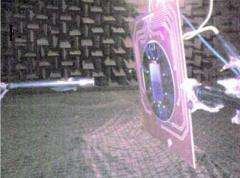
Photograph of the measurement arrangement inside an anechoic chamber for sound testing. The wire loudspeakers are held on the round 150-mm silicon wafer, which is in the middle attached to the circuit board. Image copyright: Niskanen, et al.

(PhysOrg.com) -- In 2008, scientists built a loudspeaker made of carbon nanotubes that produced sound and music based on the thermoacoustic effect. Now, a different team of scientists has built a loudspeaker made of tiny aluminum wires suspended like a bridge between two supports, producing sound in a similar way. The new wire bridge also has the advantage of being much easier to fabricate than the nanotube device, offering the potential for a wide range of audio applications.

A. O. Niskanen, et al., from the VTT Technical Research Center of Finland and the Helsinki University of Technology, have published their study on the sound-producing wire bridge in a recent issue of . In experiments, the scientists constructed several versions of the wire bridge, using between 6,000 and 233,000 wires. Each wire was about 200 micrometers long, 3 micrometers wide, and 30 nanometers thick. The ends of the wires were clamped to supports to form “air bridges,” hovering a few microns above the substrate underneath.

Like the nanotube loudspeaker, the wire arrays also use the thermoacoustic effect to produce . When a voltage is applied to the conductive aluminum wires, it creates temperature variations in the wires proportional to the voltage. In turn, these temperature variations create pressure variations in the air, which are sound waves. By adding a dc bias, the scientists could enable the loudspeakers to produce speech and music.

FLV player

“The thermoacoustic effect utilizes the fact that sound, i.e. adiabatic pressure fluctuation of air, is accompanied by fluctuation in air temperature,” coauthor Juha Hassel of the VTT Technical Research Center of Finland told PhysOrg.com. “Conversely, it is possible to generate sound thermally, by varying rapidly the air temperature. This is how our sound generator works. Electrical heating power on the device surface is converted to a corresponding acoustic pressure. To linearize the acoustic response to voltage or current, a dc bias is superposed on the speech or music signal.”

Audio measurements showed that the loudspeakers could generate high-pressure sound waves up to 110 decibels at a distance of 8 cm. The thermoacoustic effect is more suitable for producing higher frequency sounds, such as ultrasound, and the scientists found that the device could produce sounds with frequencies up to 40,000 Hz, well beyond the normal human hearing range of 20 - 20,000 Hz.

The scientists predict that the thermoacoustic speakers could be used in ultrasound applications, such as SONARs ("sound radars"), gas sensors, and distance sensors. The simplicity of the basic structure could also be used to create phased array ultrasound sources. Phased arrays are used for constructing an ultrasound beam of a desired shape by driving different loudspeakers (or wires) at different phases. As the scientists explain, the fabrication process is very simple compared to other microelectronics processes, and could easily be incorporated into a more complicated process.

“The method allows development of applications even on the industrial scale,” said Hassel. “We believe that such simple technology could be especially useful in ultrasound applications, possibly replacing the conventional piezoelectric actuators in some cases. Our ongoing experimental and theoretical work aims towards a better understanding of the properties of the technology to be able to evaluate its full potential.”

FLV player

Video credit: Niskanen, et al.

More information: A. O. Niskanen, J. Hassel, M. Tikander, P. Maijala, L. Grönberg, and P. Helistö. “Suspended metal wire array as a thermoacoustic sound source.” Applied Physics Letters 95, 163102 (2009)

Copyright 2009 PhysOrg.com.
All rights reserved. This material may not be published, broadcast, rewritten or redistributed in whole or part without the express written permission of PhysOrg.com.


print this article email this article download pdf blog this article bookmark this article     Stumble it Digg this share on Facebook retweet share on Reddit add to delicious
Rate this story - 4.2 /5 (17 votes)

Rank Filter

Move the slider to adjust rank threshold, so that you can hide some of the comments.


Display comments: newest first

  • Mr_Man - Nov 06, 2009
    • Rank: not rated yet
    I would like to know if the nanotube speaker could either now or after further development output a higher quality audio signal with less distortion. I would imagine there would be more control over the specific frequencies being outputted compared to a standard speaker that is just a woofer and tweeter. You wouldn't really have to worry about the dampening effect with the speaker..

    Actually - the signal would probably be nice and clear for higher frequencies but I bet it would actually be harder for it to output lower frequencies.

    As an audio engineer, I find this extremely interesting.

November 4, 2009 all stories

Comments: 1

4.2 /5 (17 votes)
  • Stumble this up

  • Digg this

  • share this

  • hide
  • Related Stories

  • Carbon nanotubes could act as an efficient music speaker
    created Nov 03, 2008 | popularity not rated yet | comments 0
  • A sound way to turn heat into electricity
    created Jun 04, 2007 | popularity not rated yet | comments 0
  • Panasonic Develops Advanced Low-Range Sound Reproduction Technology for Compact Speakers
    created Jul 30, 2007 | popularity not rated yet | comments 0
  • A traveling-wave engine to power deep space travel
    created Sep 17, 2004 | popularity not rated yet | comments 0
  • Surround sound via headphones
    created Sep 06, 2005 | popularity not rated yet | comments 0


  • hide
  • Relevant PhysicsForums posts

  • New Supercomputer at Brown University
    created 6 hours ago
  • Difference between Magnus effect and Bernoulli
    created 9 hours ago
  • Equations
    created 11 hours ago
  • Force Vectors and Dot Products
    created 12 hours ago
  • More from Physics Forums - General Physics

Other News

A view of a superconducting solenoid magnet at the European Organization for Nuclear Research (CERN) near Geneva

CERN atom-smasher restarts after 14-month hiatus: official

Physics / General Physics

created 2 hours ago | popularity 4.5 / 5 (2) | comments 0

The world's biggest atom-smasher, shut down after its inauguration in September 2008 amid technical faults, restarted on Friday, a spokesman for the European Organisation for Nuclear Research said.


Tapering a Free-Electron Laser to Extract More Juice

Tapering a Free-Electron Laser to Extract More Juice

Physics / General Physics

created 1hour ago | popularity not rated yet | comments 0

(PhysOrg.com) -- Researchers from the NSLS and Science Applications International Corporation (SAIC) have demonstrated a technique that could be used to significantly improve the quantity and quality of light ...


UCSB physicists move one step closer to quantum computing

UCSB physicists move one step closer to quantum computing

Physics / Quantum Physics

created 6 hours ago | popularity 5 / 5 (5) | comments 0

Physicists at UC Santa Barbara have made an important advance in electrically controlling quantum states of electrons, a step that could help in the development of quantum computing. The work is published ...


Ultra-Powerful Laser Reproduces How Star's Jets Travel through Interstellar Space

Ultra-Powerful Laser Reproduces How Star's Jets Travel through Interstellar Space

Physics / General Physics

created 2 hours ago | popularity 4.3 / 5 (4) | comments 0

(PhysOrg.com) -- A multi-trillion-watt laser at the University of Rochester has simulated a stellar jet -- an outpouring of matter from a fledgling star -- with unprecedented realism.


The LHC promises to unlock scientific mysteries about the creation of the Universe and the fundamental nature of matter

Giant atom-smasher set to restart this weekend: CERN

Physics / General Physics

created 10 hours ago | popularity 5 / 5 (1) | comments 6

The world's biggest atom-smasher, which was shut down soon after its inauguration amid technical faults, is set to restart this weekend, the European Organisation for Nuclear Research said on Friday.