Success in 'space elevator' competition (Update 3)
November 5, 2009
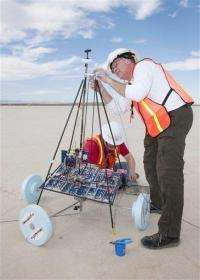
This handout photo from NASA shows David Bashford, right, lead of the LaserMotive team, preparing their robotic climber entry in the $2 million Space Elevator Games at the NASA Dryden Flight Research Center at Edwards Air Force Base, Calif., Wednesday, Nov. 4, 2009. In a the test of the concept, robotic machines powered by laser beams will try to climb a cable suspended from a helicopter, on a course 900 meters (2,953 feet) high. (AP Photo/NASA, Tom Tschida)
(AP) -- A robot powered by a ground-based laser beam climbed a long cable dangling from a helicopter on Wednesday to qualify for prize money in a $2 million competition to test the potential reality of the science fiction concept of space elevators.
The highly technical contest brought teams from Missouri, Alaska and Seattle to Rogers Dry Lake in the Mojave Desert, most familiar to the public as a space shuttle landing site.
The contest requires their machines to climb 2,953 feet (nearly 1 kilometer) up a cable slung beneath a helicopter hovering nearly a mile high.
LaserMotive's vehicle zipped up to the top in just over four minutes and immediately repeated the feat, qualifying for at least a $900,000 second-place prize.
You need Flash installed to watch this ideo
Video: In their first run today and their first ever successful run in any of the NASA sponsored Power Beaming Challenge events, Team Lasermotive qualified for at least a share of the 1st level prize money of $900,000.
More information: http://www.spaceel … orgames.org/
©2009 The Associated Press. All rights reserved. This material may not be published, broadcast, rewritten or redistributed.


The concept is to launch a satellite with a light and thin cable or ribbon which it spools down to the ground. Then a very light climber ascends the cable or ribbon and lays down another one, increasing the strength. This is done until the cable or ribbon is strong enough to support the heavy climbers.
I mean even if the space anchor is in geosynchronous orbit, the cable will not be. The gravitational pull on the cable will pull the orbiting anchor down, won't it?
In this scenario I'm not taking into account the air resistance of the cable, which will induce some more pulling which won't be downwards-only.
We need to mine the universe. Find a few big asteroids full of Rhodium and Platinum as well as other useful space material like deuterium. Then you can reverse the problem. It then becomes...
How do we counter weight a big ol rock falling thru space onto the earth? With a 26000km long rope with a bucket full of people and supplies on the other side. And because the cold vacuum of space, the pully shouldnt be a problem to engineering.
Or if you dont like that one...
Collect lots of fusion feedstocks, have a reactor floating around @ 26000km. Have a mega cable shooting KWH's down to earth. And the way up will just pilfering KWH's charging the on board batteries. We could have them all over the planet serving multi functions of power generation and space travel. Again, space makes fusion easier.
As for the weight of the cable, it would cost big bucks to get an optimally thin cable in orbit. But then making the cable thicker would be as cheap as driving a progressively larger car a couple hundred miles and dropping more cable down. In the long run the initial costs will be offset by cheap access to space. People smarter than me have done the math and see the concept as feasible and profitable once the technology is there for it.
This will be an interesting story in about 15-20 years....
A lot of research has been done on this over the years.
Why not search the internet to find out why:
1: A 26km falling thread/ribbon/ whatever can be easily designed to be fall safely even if it did break. No more dangerous than any other falling lightweight ribbon.
2: The tensile stress is not a problem.
3: The whole construction could be achieved for a fraction of the cost of establishing alternative (eg chemical rocket) infrastructures for getting stuff to geosynchronous orbit...
... The list goes on.... Have fun.
The prospect of reducing costs to orbit from $10,000 / lb to $10 / lb is enough to invest heavily in this dream.
These types of cables need to be fairly thin in order to not collapse under their own weight. But once they are set up you can't move them out of the way of hazards:
- Thunderstorms. These cables are glorified lightning rods. Carbon nanotubes are especially bad at not melting when lightning strikes them. NO place on the equator does not experience a thunderstorm every once in a while.
- Hurricanes. Wind force could cut them. If the wind doesn't do it then the debris will. Again: the equator has lots of those kinds of storms.
- Space-junk. We have gazillions of tiny, sharp and incredibly fast particles flying around in earth orbit. Not to mention all the rocky stuff the universe constantly throws at us. Notice how they move the ISS out of the way every time something gets close? Well, you can't do that with a tether.
- Terrorism. Can you say "perfect and easy target"? You could sabotage them with a ground based laser or a model airplane.
Another issue I just thought of:
How about the weight of ice forming at high altitudes on such cables? Apart from stopping all the nifty elevators robots it might be enough to tear the whole structure down.
a) They don't leave the surface dry (not DURING a thunderstorm)
b) they make the surface slippery (which you definitely don't want since it would make your robots slip off the surface, too)
The energy content of a lightning strike is very low (an average bolt of lightning has enough to power a lightbulb for a year). Only the POWER of a lightning bolt (energy/time) is high.
Burning a piece of wood in your back yard every day would be a more efficient (not to say less expensive) power plant than an entire space cable used to harvest lightning strikes.
No that's not a problem, its the centre of mass of the anchor and cable that is in geosynchronous orbit, not the anchor. The anchor is even further out.
Let's start by assuming that the issues the arm-chair engineers are bringing up have been thought through and there are solutions at least in the concept stage. Next, lets get out of the box and look at some great applications for a space elevator outside of Earth. Having one on the moon would be much easier than on Earth. Mars is also a good place for one. So, why would we want to build a space elevator on Mars and the moon? Because moving raw materials from Mars to the moon is cheaper than from Earth to the moon (i.e., we'll feed our moon station from Mars). What moon station? The one we build there that is sending resources back to Earth and being fed from supplies from Mars. I realize this sounds bit strange, but it's all pretty well documented. Earth is the worse case use for a space elevator, but even here it's a better long term solution than rockets.
In terms of space debris, it turns out that carbon nanotubes are among the strongest things we've ever dealt with. What makes anyone think that with enough nanotubes stronger than diamonds, there are still enough floating screws orbiting the earth to chip away at it? I challenge anyone to put a chip in a diamond with a steel screw.
If they can get this to work, it would be a massive leap for energy and space exploration. I would definitely like to see this, even if they use Kevlar.
As the platform rises or lowers, the electrical potential will change proportionally. This thought inspired the power cable experiment that destroyed itself when reeled out from the shuttle. The power generated melted the cable at the reel. More reliable data about the power generated would allow engineers to take this into account. Then we wouldn't need lasers at all.
True enough nanotube composite diamonds are +10 on mohs hardness scale, but a hammer will crush them all. Increadibly hard, not so tough.
The ribbon though, yes it will be under tension, but it will still be flexible. trying to crack a ribbon is a different matter. More likely it will catch anything hitting it.
Micron texturing only beads up the water preventing whetting no slippery surface.
As mentioned earlier, the upper atmosphere and ground act as capacitor plates, the ribbon would ground that. The resistance of the ribbon would limit the current.
I think the moon would be a problem. The moon rotates once in about 28 days right? Where would the geostationary satellite be? On the Earth?
http://en.wikiped...elevator
No. Let's just do something more sensible like a launch loop or a mass driver
http://en.wikiped...t_launch
Exactly, the earth is at the stationary orbit of the moon, if you neglect the gravity of the earth.
Space junk is a huge problem. The recent tests of space tethers were "cut short" due to space junk severing the tether (sorry for the obvious pun).
My own view is that the space elevator be self supporting/thrusting and be remotely powered by ground and space based lasers. Perhaps it uses a fuel pellet that is vaporized by the laser for thrust. That means no cable is needed, only powerful lasers.
And people who think a space tether would be too heavy, think about this. If you attach a tether to the moon, would the moon fall? No. It's just a matter of getting something big high up in the sky, and it has to be just big enough to work. After that, you can use the smaller space elevator to build some really big ones by piecing them together in space.
I hate you, all who just declare this as impossible. You know, never say never.
It is understandable to have doubts about the concept, especially if you're not an expert on all aspects involved. But instead of just declaring it impossible, you can do some research or even ask some questions and maybe you will see there is a chance for this idea.
Vlasev, yes the cable that is below geostationary orbit will be pulling the station down. But the idea is to also have a counter-weight mass on a cable above geostationary orbit, that will pull it up, and both should balance.
Everything that skeptics point out has a solution, it is just a matter of time and money. Eventually we will get it working.
IMHO this is purely a structural engineering and materials science excercise. Clearly it obeys the laws of physics.
For the record -
1) just because someone isn't a true believer in "space elevators, now" doesn't necessarily mean they are ignorant, it means they've read the available info and came to a conclusion different than the one you came to
2) there is rain in desert (almost spit my coffee onto my keyboard on that one, thanks)
3) the technology doesn't exist to mass produce carbon nanotube cables or ribbons in quantities necessary to build a space elevator
4) the technology doesn't exist to build a long term and survivable mars base or moon base
The contest was about beaming power, not space elevators. And in that context, its really, really cool. Just accept the technological victory for what it is, we don't need fantasy to make this a great moment in engineering!
But today skeptics are worst because today we live surrounded by the advances those visionaries brought to us.
Maybe you folks should consider the possibility that dissent from the groupthink mindset needn't be quashed, but instead should be evaluated outside of internal biases, prejudices, and wishful fantasies.
Riiiiight, that'll happen.