NIST test proves 'the eyes have it' for ID verification
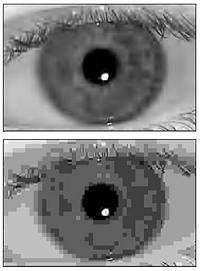
The eyes may be the mirror to the soul, but the iris reveals a person's true identity—its intricate structure constitutes a powerful biometric. A new report by computer scientists at the National Institute of Standards and Technology demonstrates that iris recognition algorithms can maintain their accuracy and interoperability with compact images, affirming their potential for large-scale identity management applications such as the federal Personal Identity Verification program, cyber security and counterterrorism.
After fingerprints, iris recognition has emerged in recent years as the second most widely supported biometric characteristic. This marketplace rests, in large part, on the ability of recognition algorithms to process standard images from the many cameras now available. This requires images to be captured in a standard format and prepared so that they are compact enough for a smart card and for transmission across global networks. The images also have to be identifiable by computer algorithms and interoperable with any iris-matcher product regardless of the manufacturer.
NIST scientists are working with the international biometrics community to revise iris recognition standards and to advance iris images as the global interchange medium in this rapidly evolving field.
NIST established the Iris Exchange IREX program as a NIST-industry collaboration to encourage development of iris recognition algorithms operating on images conforming to the new ISO-IEC 19794-6 standard. The first IREX project, IREX I, provided quantitative support to the standard by conducting the largest independently administered test of iris recognition technology to date. The test attracted 19 recognition technologies from 10 different providers. This represents an order of magnitude expansion of the industry over the past five years.
The international standard, now under revision, defined three competing image formats and three compression methods: the IREX I test narrowed the field by determining which ones performed consistently at a high level and are included in the IREX report. The image format test showed that two of the three formats performed well: these center and crop the iris, or center, crop and mask eyelids and eyelashes. The study also determined that two compression standards were found to squeeze the images to a size small enough for storage and transmission while retaining the necessary quality level. One is the JPEG2000 which gives better recognition accuracy than the more commonly used JPEG, and the other is PNG format that employs lossless compression to completely preserve the iris information.
The IREX I tests also looked at technical factors affecting users. These include speed-accuracy tradeoffs, threshold calibration, storage requirements, image quality assessment, and the effects of iris size, eyelid occlusion and pupil dilation. The test result shows that forensic applications, where image quality is sometimes degraded, can benefit from slower but more powerful algorithms.
Recommendations based on the NIST results have been adopted by the standards committees. The report, IREX I: Performance of Iris Recognition Algorithms on Standard Images, can be downloaded from http://iris.nist.gov/irex. Since its inception in 2007, IREX has helped advance iris recognition toward the level of technical maturity and interoperability of fingerprint biometrics and has affirmed the potential for using iris biometrics as a second modality for large-scale identity management applications.
Meanwhile, plans for IREX II are under way to calibrate and evaluate the effectiveness and efficiency of iris image quality assessment algorithms. This study will support a new international iris image quality standard by identifying specific iris image properties that are influential on recognition accuracy. The second draft of the IREX II research plan—available online at http://iris.nist.gov/irexII—is open for comments until Nov. 15, 2009.
Source: National Institute of Standards and Technology (news : web)


