NIST quantifies low levels of 'heart attack risk' protein
November 4, 2009
NIST quantifies low levels of 'heart attack risk' protein

Enlarge

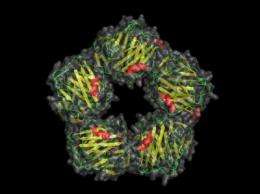
This is a computer-generated image of the structure for C-reactive protein. Credit: S. Kolstoe, Center for Amyloidosis, University College, London, UK

Searching for a needle in a haystack may seem futile, but it's worth it if the needle is a hard-to-detect protein that may identify a person at high risk of a heart attack circulating within a haystack of human serum (liquid component of blood).

C-reactive protein (CRP), a molecule produced by the liver in response to inflammation, normally accounts for less than 1/60,000 of a person's total serum protein, or about 1 milligram per liter (mg/L) of serum. Recent evidence suggests that a CRP level between 1 and 3 mg/L indicates a moderate risk of while a level greater than 3 mg/L predicts a high risk. A clinical diagnostic procedure known as the high-sensitivity CRP (hsCRP) test has been used to detect higher-than-normal levels of the protein and warn a patient about elevated risk for cardiovascular disease.

However, there is no certified reference material—in this case, a sample of human serum with accurately determined amounts of the CRP for various risk levels—against which the accuracy of methods for measuring CRP can be evaluated. The problem: normal, low-risk of cardiovascular disease CRP levels are so low that even mass spectrometry (a very sensitive technique for separating and identifying molecules based on mass) cannot easily quantify them.

In a recent paper in Analytical Chemistry, NIST researchers Eric Kilpatrick and David Bunk describe the first steps toward development of a certified reference material that can be used to assess the accuracy of routine clinical laboratory tests for CRP. The researchers accomplished this by isolating the minute amounts (less than 1 mg/L) of CRP circulating at normal levels in serum prior to measurement. Using a protein isolation technique called affinity purification, Kilpatrick and Bunk added polystyrene beads coated with anti-CRP antibodies to normal human serum. The antibodies bind tightly to any circulating CRP, allowing it to be easily removed from solution. The researchers then cleave the purified protein they isolated into its component parts, known as peptides, using enzyme digestion. The peptides are more readily measured by the mass spectrometer, resulting in a very precise determination of the total CRP.

To see if their purification method yields CRP that can serve as a reference material, Kilpatrick and Bunk will next mix purified CRP with genetically engineered CRP containing a heavy isotope of nitrogen (nitrogen 15) and then run the combined pool through affinity purification, enzyme digestion and mass spectrometry. The peptides with the heavy nitrogen 15 atoms will be easily detected and precisely quantified by the mass spectrometer. If the measurements for the nitrogen 15-tagged peptides compare favorably to those made for the purified serum CRP, then that will validate the use of the affinity purification method for quantifying extremely low levels of the protein. In turn, this validation will clear the way for purified serum CRP derived by the NIST method to be eventually used as a quality control and calibration tool by manufacturers for the hsCRP test.

More information: E.L. Kilpatrick and D.M. Bunk. Reference measurement procedure development for C-reactive protein in human serum. , Vol. 81, No. 20, pages 8610-8616. Oct. 15, 2009

Source: National Institute of Standards and Technology (news : web)


Rank 5 /5 (1 vote)
Relevant PhysicsForums posts
  • How to tell if ionic compound has a higher melting point?
    created4 hours ago
  • How to determine zinc in a plant.
    createdFeb 11, 2012
  • Boiling and melting point of impure substances
    createdFeb 10, 2012
  • Safe nitrogen compound to decompose a 500 deg C in a furnace?
    createdFeb 09, 2012
  • [ask]electron inside drinking water
    createdFeb 08, 2012
  • How to avoid formation of Lithium Chromate ???
    createdFeb 08, 2012
  • More from Physics Forums - Chemistry

More news stories

Manipulating genes with hidden TALENs

(PhysOrg.com) -- A better understanding of gene function in model plant and animal systems could be used to develop useful traits in livestock and crop plants, and might someday lead to developments in stem ...

Chemistry / Biochemistry

created just added | popularity not rated yet | comments 0 | with audio podcast

Ordered planar polymers created for the first time

(PhysOrg.com) -- Scientists under the direction of ETH Zurich have created a minor sensation in synthetic chemistry. They succeeded for the first time in producing regularly ordered planar polymers that form ...

Chemistry / Polymers

created 1 hour ago | popularity 5 / 5 (2) | comments 1 | with audio podcast

Scientists discover molecular secrets of 2,000-year-old Chinese herbal remedy

For roughly two thousand years, Chinese herbalists have treated Malaria using a root extract, commonly known as Chang Shan, from a type of hydrangea that grows in Tibet and Nepal. More recent studies suggest that halofuginone, ...

Chemistry / Biochemistry

created 18 hours ago | popularity 4.5 / 5 (19) | comments 18 | with audio podcast

New method to examine batteries -- MRI from the inside

There is an ever-increasing need for advanced batteries for portable electronics, such as phones, cameras, and music players, but also to power electric vehicles and to facilitate the distribution and storage of energy derived ...

Chemistry / Analytical Chemistry

created 18 hours ago | popularity 5 / 5 (7) | comments 0 | with audio podcast

Hydrogen from acidic water: Researchers develop potential low cost alternative to platinum for splitting water

A technique for creating a new molecule that structurally and chemically replicates the active part of the widely used industrial catalyst molybdenite has been developed by researchers with the Lawrence Berkeley ...

Chemistry / Materials Science

created Feb 09, 2012 | popularity 4.8 / 5 (16) | comments 21 | with audio podcast


With climate change, today's '100-year floods' may happen every three to 20 years: research

Last August, Hurricane Irene spun through the Caribbean and parts of the eastern United States, leaving widespread wreckage in its wake. The Category 3 storm whipped up water levels, generating storm surges ...

Researchers make better heat sensor based on butterfly wings

(PhysOrg.com) -- Scientists have long known that butterfly wings produce their iridescent colors by bouncing light around and between tiny ridges in structures made of chitin. More recently they’ve discovered ...

The joy of cheques

An electronic cheque which eliminates the need for costly processing by banks but preserves the simplicity and ease of a traditional cheque book has been designed by a team of academics in the UK.

Research shows promise in converting camelina oil into jet fuel

(PhysOrg.com) -- Researchers at Montana State University-Northern have developed a process to convert camelina oil to jet fuel and other high-value chemicals. MSU has applied for a U.S. patent and research is ongoing.

Couples in the same place emotionally stay together, study says

(Medical Xpress) -- Despite life’s ups and downs, couples whose feelings are in sync consistently over time are more likely to stay together, says a University of California, Davis, study.

Researchers make breakthrough in stem cell research

(Medical Xpress) -- University of Queensland scientists have developed a world-first method for producing adult stem cells that will substantially impact patients who have a range of serious diseases.