Clean algae biofuel project leads world in productivity

November 4, 2009 Clean algae biofuel project leads world in productivity

Enlarge

Murdoch University Professor Michael Borowitzka holds clean biofuel produced from algae. Credit: Murdoch University.

Australian scientists are achieving the world's best production rates of oil from algae grown in open saline ponds, taking them a step closer to creating commercial quantities of clean biofuel for the future.

A joint $3.3 million project led by Murdoch University in Perth, Western Australia, and involving the University of Adelaide in South Australia, now leads world research after more than 12 months of consistent results at both universities.

"It was previously believed impossible to grow large quantities of algae for biofuel in open ponds consistently and without contamination, but we've proven it can be done," says Project Leader Professor Michael Borowitzka from Murdoch University.

The project has received $1.89 million funding from the Australian Government as part of the Asia-Pacific Partnership on Clean Development and Climate.

"This is the only biofuel project in Australia working simultaneously on all steps in the process of microalgal biofuels production, from microalgae culture, harvesting of the algae and extraction of oil suitable for biofuels production," Professor Borowitzka says.

Professor Borowitzka says that due to the project's success, construction of a multi-million dollar pilot plant to test the whole process on a larger scale will now begin in Karratha in the North-West in January and is expected to be operational by July.

"This is another potential growth industry and jobs generator for Western Australia and South Australia aside from mining - using our natural abundance of sunlight and year-round good climate," he says.
Clean algae biofuel project leads world in productivity
Enlarge

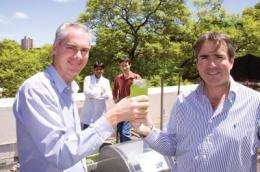
From left: (front) Dr Peter Ashman and Dr David Lewis from the School of Chemical Engineering at the University of Adelaide with a sample of the algae being cultivated at Adelaide; (rear) Chemical Engineering postgraduate student Suraj Sathe and postdoctoral research associate Stephen Pahl. Credit: University of Adelaide.

"We have achieved production rates of 50 tonnes per hectare per year, over half of which is converted to oil. These high production rates are expected to increase at the new pilot plant due to the even better climatic conditions in Karratha."

The first stage is costing $1.5 million and further funding is being sought for future stages estimated to cost between $5-10 million.

Professor Borowitzka says the cost of producing biofuel from algae has already dropped from $12 a kilo to below $4 in the past year, but the aim is to get it down to less than $1 a kilo.

Dr David Lewis from the University of Adelaide's School of Chemical Engineering says a key aspect of the project is to show that commercial levels of algae can be grown without competing for resources with food crops.

"The algae will grow on non-arable - even arid - land without any need for freshwater in cultivation," Dr Lewis says.

"By contrast, crops such as canola need a lot of freshwater and good-quality farming land. Growing algae at an industrial scale also takes up significantly less land than that required by canola crops to produce the same amount of biofuel."

In addition to producing clean fuel, Professor Borowitzka from Murdoch says that during the growth of the algae, 60 tonnes of CO2 are fixed per hectare of algae each year.

One of the project's international partners, major algae producer Parry Nutraceuticals in India, has also achieved high rates of carbon fixation. (South China University of Technology is the project's other international partner.)

Source: University of Adelaide (news : web)


print this article email this article download pdf blog this article bookmark this article     Stumble it Digg this share on Facebook retweet share on Reddit add to delicious
Rate this story - 4 /5 (4 votes)


November 4, 2009 all stories

Comments: 0

4 /5 (4 votes)
  • Stumble this up

  • Digg this

  • share this

  • hide
  • Related Stories

  • Montana researchers to study algae as a source of biofuel
    created Nov 13, 2008 | popularity not rated yet | comments 0
  • Algae-Based Biofuel From Fish
    created Sep 01, 2009 | popularity not rated yet | comments 0
  • Success for first outdoor, large-scale algae-to-biofuel research project in Nevada
    created Jan 29, 2009 | popularity not rated yet | comments 0
  • New sources of biofuel to take pressure off traditional crops
    created Sep 10, 2009 | popularity not rated yet | comments 0
  • Algae: Biofuel of the future?
    created Aug 19, 2008 | popularity not rated yet | comments 0


  • hide
  • Relevant PhysicsForums posts

  • Goddard
    created 5 hours ago
  • Rate Laws
    created 7 hours ago
  • why oxygen, cannot act as a pi-donor while NO can?
    created Nov 20, 2009
  • Aspirin
    created Nov 19, 2009
  • antibonding orbitals
    created Nov 19, 2009
  • Affect of adjacent amino acids on pKa values
    created Nov 19, 2009
  • More from Physics Forums - Chemistry

Other News

Accidental discovery produces durable new blue pigment for multiple applications

Accidental discovery produces durable new blue pigment for multiple applications

Chemistry / Biochemistry

created Nov 16, 2009 | popularity 4.5 / 5 (30) | comments 6

An accidental discovery in a laboratory at Oregon State University has apparently solved a quest that over thousands of years has absorbed the energies of ancient Egyptians, the Han dynasty in China, Mayan ...


One word: bioplastics

One word: bioplastics

Chemistry / Materials Science

created Nov 17, 2009 | popularity 4.5 / 5 (11) | comments 4

(PhysOrg.com) -- Every year, more than 250 billion pounds of plastic are produced worldwide. Much of it ends up in the world's oceans, a fact that troubles MIT biology professor Anthony Sinskey.


New on-off 'switch' triggers and reverses paralysis in animals with a beam of light

New on-off 'switch' triggers and reverses paralysis in animals with a beam of light (w/ Video)

Chemistry / Biochemistry

created Nov 18, 2009 | popularity 4.8 / 5 (5) | comments 3

In an advance with overtones of Star Trek phasers and other sci-fi ray guns, scientists in Canada are reporting development of an internal on-off "switch" that paralyzes animals when exposed to a beam of ultraviolet ...


New research provides blueprint for molecular basis of global warming

New research provides blueprint for molecular basis of global warming

Chemistry / Materials Science

created Nov 17, 2009 | popularity 4 / 5 (4) | comments 3

A new study indicates that major chemicals most often cited as leading causes of climate change, such as carbon dioxide and methane, are outclassed in their warming potential by compounds receiving less attention.


Ethanol

Microbes to Take Over Ethanol Production?

Chemistry / Biochemistry

created Nov 20, 2009 | popularity 3.5 / 5 (6) | comments 0

(PhysOrg.com) -- Not too long ago, it seemed that ethanol production was the wave of the future. The use of trash, wood chips or different types of plants -- usually grass or corn -- to make ethanol was considered ...