Conserving historic apple trees
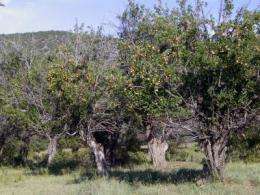
The apple trees of yesteryear are slowly disappearing. Many apple varieties common in the United States a century ago can no longer be found in today's orchards and nurseries. But some historic apple trees still survive in abandoned farmsteads and historic orchards throughout the U.S. Now, scientists interested in conserving these horticultural treasures have set out to identify and catalogue them, working to discover if the last remnants of historical trees may still be alive in American landscapes.
American horticulturalists and historians often refer to the late 19th century as the "golden years of apple growing", when scores of apple and other fruit trees were planted in farmstead and kitchen orchards. Their ability to ''keep'' all winter in cold cellars, produce flavorful ciders, and their versatility for cooking and baking made apples a staple in American homes. This period of American horticultural history was preceded by an era of fruit diversification that lasted into the early nineteenth century. In 1905, the popular manual The Nomenclature of the Apple by W.H. Ragan listed 6,654 unique apple varieties referenced in U.S. literature between the years 1804 and 1904. A new book by Dan Bussey, The Apple in North America (in press), lists more than 14,000 named apple cultivars introduced to or selected in North America.
Market pressures on commercial apple growers have reduced the diversity of apple trees once grown in small family orchards to only a handful of commonly marketed apple varieties. Currently, a mere 11 apple varieties account for more than 90% of the apples sold in the United States, with 'Red Delicious' making up 41% of this figure.
Have historic and heirloom apple trees succumbed to their more popular commercially produced relatives? Apple trees can live to remarkably old ages; single apple trees have been known to live 150 years or longer. In many areas, it is still possible to find trees of ''heirloom'' cultivars once abundant at the beginning of the 20th century. Remnant orchards planted before the modern era of fruit production hang on tenaciously around abandoned farmsteads and historic orchards.
Kanin J. Routson of the University of Arizona and colleagues at the U.S. Department of Agriculture's National Center for Genetic Resources Preservation published a study in the journal HortScience that assessed the genetic diversity of 280 apple trees growing in 43 historic farmstead and orchard sites in Arizona, Utah, and New Mexico. The study took place from June through September 2007 and focused sampling efforts primarily on sites dating back to the 1930s and earlier, with priority given to trees planted before 1920.
Using seven microsatellite markers, the researchers compared the samples to 109 cultivars likely introduced into the southwest in the late 19th and early 20th centuries. Genetic analysis revealed 144 genotypes represented in the 280 field samples. According to Routson, the study identified 34 of these 144 genotypes as cultivars brought to the region by Stark Brothers Nursery and by USDA agricultural experiment stations. One-hundred-twenty of the total samples (43%) had DNA "fingerprints" that suggested they were representative of these 34 cultivars. "The remaining 160 samples, representing 110 genotypes, had unique fingerprints that did not match any of the fingerprinted cultivars. The results of this study confirm for the first time that a high diversity of historic apple genotypes remain in homestead orchards in the U.S. southwest", the study explained.
The research team noted that additional genetic fingerprinting of apple cultivars will enable researchers to identify the unknown genotypes from the study. "Until further research is done, these unknown genotypes should be conserved and analyzed for useful traits. Future efforts targeting orchards in the southwest should focus on conservation for all unique genotypes as a means to sustain both cultural heritage and biological genetic diversity", Routson added.
More information: The complete study and abstract are available on the ASHS HortScience electronic journal web site: hortsci.ashspublications.org/c … nt/abstract/44/3/589
Source: American Society for Horticultural Science


