Orphan army ants join nearby colonies
November 4, 2009 Orphan army ants join nearby colonies

Enlarge

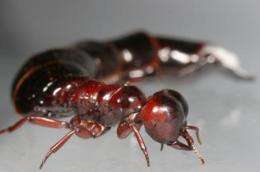
The queens of African Dorylus army ants are with over 5cm body length the largest ants on Earth, and hold the world record in egg laying. The picture shows a queen of Dorylus molestus. Credit: Daniel Kronauer/Harvard University

(PhysOrg.com) -- Colonies of army ants, whose long columns and marauding habits are the stuff of natural-history legend, are usually antagonistic to each other, attacking soldiers from rival colonies in border disputes that keep the colonies separate. But new work by a researcher at the Harvard Museum of Comparative Zoology and colleagues at the University of Copenhagen shows that in some cases the colonies can be cooperative instead of combative.

In those cases, when an army ant colony loses its queen, its workers are absorbed, not killed, by neighboring colonies, and within days are treated as part of the family.

The research, conducted in an ant-rich area on the slopes of Mount Kenya, is detailed in the journal .

Army ant colonies are dominated by a single, large queen who produces the eggs that give rise to all of the colony's individuals, which can number millions of workers. When she dies, colonies quickly disappear, raising the question of what happens to the many individuals.
Orphan army ants join nearby colonies
Enlarge

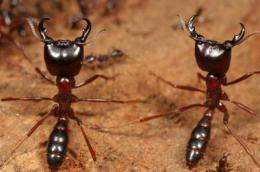
Army ants are nomadic and colonies emigrate frequently. Here, two soldiers of the army ant Dorylus molestus guard a colony emigration at Mt Kenya. Credit: Daniel Kronauer/Harvard University

The work was conducted by Daniel Kronauer, a junior fellow in Harvard's Society of Fellows, over two field seasons in Kenya. Kronauer and his colleagues followed the fates of 10 army ant colonies whose queens they had removed. The researchers lost track of two of the colonies but observed two distinct strategies used by the remaining eight.

Most of the queenless colonies, seven out of 10, simply joined a neighboring colony -- determined by -- with the new workers slowly losing their distinct colony odor, and within days becoming fully integrated.

The last queenless colony stayed on its own, with workers employing a strategy of producing a small brood of winged males. Though these males were removed for analysis, in an undisturbed colony the males would fly off looking for young unmated queens. Though this strategy does provide some chance of passing along the colony's genes, the small number of males produced -- just 31 in this case compared with 3,000 in a fully functioning colony -- illustrates that this strategy may not be efficient.

"It is a last option to get some fitness returns before they die," Kronauer said.
Orphan army ants join nearby colonies
Enlarge

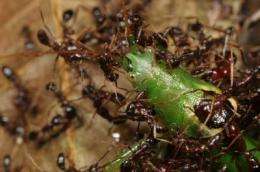
Army ants are group predators that overwhelm large arthropods and other social insect colonies. Here, a raiding swarm of Dorylus molestus is attacking a grasshopper at Mt Kenya. Credit: Daniel Kronauer/Harvard University

Though the work illuminates where most of the go, it doesn't entirely settle the question of why. Though it makes sense that the accepting colony would want to increase its size and competitiveness by gaining many new workers, the evolutionary drivers behind the queenless colony's workers absorbing into the new colony are more vague.

Since workers are normally kept from reproducing, Kronauer and his co-authors found, there doesn't seem to be a direct fitness benefit. Instead, the authors suggested that the fusing colonies are driven by indirect fitness benefits gained because of distant relationships between colonies, and they called for more fieldwork to explore the issue further.

Source: Harvard University (news : web)


print this article email this article download pdf blog this article bookmark this article     Stumble it Digg this share on Facebook retweet share on Reddit add to delicious
Rate this story - 4.9 /5 (7 votes)


November 4, 2009 all stories

Comments: 0

4.9 /5 (7 votes)
  • Stumble this up

  • Digg this

  • share this

  • hide
  • Related Stories

  • Royal corruption is rife in the ant world
    created Mar 11, 2008 | popularity not rated yet | comments 0
  • Flexible genes allow ants to change destiny
    created May 24, 2007 | popularity not rated yet | comments 0
  • Wood ant queen has no egg-laying monopoly
    created Jun 28, 2007 | popularity not rated yet | comments 0
  • Playing dead is no game for ant survival
    created Apr 08, 2008 | popularity not rated yet | comments 0
  • Worker Ants Store Fat To Share With Colony Members During Times Of Need
    created Aug 14, 2006 | popularity not rated yet | comments 0


  • hide
  • Relevant PhysicsForums posts

  • Breeding program
    created 22 hours ago
  • How does a concentration gradient provide energy?
    created Nov 20, 2009
  • Eyesight and Neural Damage from Electronics
    created Nov 19, 2009
  • Quick question about the Golgi Apparatus?
    created Nov 19, 2009
  • The beginning of humans
    created Nov 18, 2009
  • Omega 3 questions
    created Nov 18, 2009
  • More from Physics Forums - Biology

Other News

Atomic-level Snapshot Catches Protein Motor in Action (w/ Video)

Atomic-level Snapshot Catches Protein Motor in Action (w/ Video)

Biology / Cell & Microbiology

created 23 hours ago | popularity 4.5 / 5 (2) | comments 1

(PhysOrg.com) -- The atomic-level action of a remarkable class of ring-shaped protein motors has been uncovered by researchers with the Lawrence Berkeley National Laboratory using a state-of-the-art protein ...


Termite creates sustainable monoculture fungus-farming

Termite creates sustainable monoculture fungus-farming

Biology / Plants & Animals

created 23 hours ago | popularity 5 / 5 (1) | comments 0

(PhysOrg.com) -- Food production of modern human societies is mostly based on large-scale monoculture crops, but it now appears that advanced insect societies have the same practice. Our societies took just ...


Extinct goat Myotragus balearicus

Extinct goat was cold-blooded

Biology / Plants & Animals

created Nov 18, 2009 | popularity 4.9 / 5 (29) | comments 10

(PhysOrg.com) -- An extinct goat that lived on a barren Mediterranean island survived for millions of years by reducing in size and by becoming cold-blooded, which has never before been discovered in mammals.


Bigger not necessarily better, when it comes to brains

Bigger not necessarily better, when it comes to brains

Biology / Plants & Animals

created Nov 17, 2009 | popularity 4.4 / 5 (14) | comments 10

(PhysOrg.com) -- Tiny insects could be as intelligent as much bigger animals, despite only having a brain the size of a pinhead, say scientists at Queen Mary, University of London.


Right-handed chimpanzees provide clues to the origin of human language

Biology / Plants & Animals

created Nov 16, 2009 | popularity 3 / 5 (1) | comments 7

Most of the linguistic functions in humans are controlled by the left cerebral hemisphere. A study of captive chimpanzees at the Yerkes National Primate Research Center (Atlanta, Georgia), reported in the January 2010 issue ...