Mimicking nature, scientists can now extend redox potentials
November 4, 2009
Mimicking nature, scientists can now extend redox potentials

Enlarge

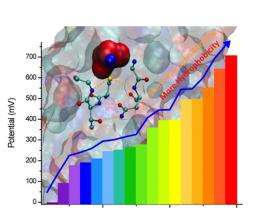
Tuning redox potentials of a protein for energy conversions. A combination of water-repelling hydrophobicity (shown in red sphere) and hydrogen bonding interactions (shown in dotted orange lines) can fine-tune the redox potential of copper ion (shown in blue) in azurin in a wide range. Graphic courtes Yi Lu

(PhysOrg.com) -- New insight into how nature handles some fundamental processes is guiding researchers in the design of tailor-made proteins for applications such as artificial photosynthetic centers, long-range electron transfers, and fuel-cell catalysts for energy conversion.

From rusting iron to forest fires to the beating of a human heart, oxidation-reduction reactions, which transfer electrons from one atom to another, are at the heart of many chemical and biological processes. Each process requires a particular redox potential, just as different electronic devices can require their own special battery.

How nature fine-tunes these potentials over a broad range with little change to the protein's electron-transfer properties or efficiency has largely remained a mystery.

Now, a team led by University of Illinois chemistry professor Yi Lu has unearthed nature's secret, and has utilized it to their advantage. The researchers describe their work in a paper to appear in the Nov. 5 issue of the journal Nature.

"We show that two important interactions, hydrophobicity (water repelling) and hydrogen bonding, are capable of fine-tuning the reduction potential of a particular class of copper-containing proteins called cupredoxins," Lu said. "We extended the range both above and below what had previously been found in nature."

Lu, graduate student and lead author Nicholas M. Marshall, and their collaborators also show that the effects of hydrophobicity and hydrogen bonding are additive, which offers additional control and extends the range of redox (short for oxidation-reduction reaction) potentials beyond what nature, by itself, provides.

Previously, to cover a wide potential range, scientists had to use several different redox agents in conjunction. This made it difficult, if not impossible, to tune the redox potentials without changing other electron transfer properties or the efficiency.

Also, stable, water-soluble redox agents are rare, Lu said, and those that are available have a limited potential range. "Consequently, there is a huge demand for efficient, water-soluble redox agents with a wide potential range for environmentally friendly aqueous or biochemical studies," he said.

To unlock nature's secret, Lu's team studied the behavior of the cupredoxin, azurin. Cupredoxins are redox-active copper proteins that play crucial roles in many important processes, such as photosynthesis and cell signaling. Cupredoxins use a single redox-active center, whose reduction potential is tunable without compromising the structure and electron transfer properties of the protein.

The researchers found that two interactions - hydrophobicity and hydrogen bonding - can selectively raise or lower azurin's redox potential. The interactions occur not in the metalloprotein's innermost, primary core, but in a secondary sphere that surrounds the primary core.

Increasing the hydrophobicity in the secondary sphere can significantly increase the redox potential, the researchers report. The more this secondary region repels water, the more the overall charge on the copper ion becomes destabilized and the higher the potential becomes.

The effect of the hydrogen bonding interaction is subtler than the effect of hydrophobicity, Lu said. Hydrogen bonding can either increase or decrease electron densities around a residue that binds the copper ion in azurin, making the copper ion either easier or harder to reduce and thus slightly changing the redox potential.

"This was nature's secret," Lu said. "That by adjusting the hydrophobicity and the hydrogen bonding, we can raise or lower the redox potential, without changing the protein's electron-transfer properties or decreasing the protein's efficiency."

The result is a tailor-made redox agent that can be set with a very high potential, a very low potential, or with a potential somewhere in between.

"This unprecedented level of control over an protein was achieved by mapping out the major interactions," Lu said, "an approach that may apply to other redox proteins of interest, as well."

Source: University of Illinois at Urbana-Champaign (news : web)

4.8 /5 (5 votes)  

Rank 4.8 /5 (5 votes)
Relevant PhysicsForums posts
  • AAS or Colorimeter method to determine zinc in a plant.
    created20 hours ago
  • Stoichiometry
    createdFeb 10, 2012
  • Boiling and melting point of impure substances
    createdFeb 10, 2012
  • Safe nitrogen compound to decompose a 500 deg C in a furnace?
    createdFeb 09, 2012
  • [ask]electron inside drinking water
    createdFeb 08, 2012
  • How to avoid formation of Lithium Chromate ???
    createdFeb 08, 2012
  • More from Physics Forums - Chemistry

More news stories

Hydrogen from acidic water: Researchers develop potential low cost alternative to platinum for splitting water

A technique for creating a new molecule that structurally and chemically replicates the active part of the widely used industrial catalyst molybdenite has been developed by researchers with the Lawrence Berkeley ...

Chemistry / Materials Science

created Feb 09, 2012 | popularity 4.8 / 5 (15) | comments 21 | with audio podcast

Fool's gold may prove an unlikely alternative to overexploited catalytic materials

Catalytic materials, which lower the energy barriers for chemical reactions, are used in everything from the commercial production of chemicals to catalytic converters in car engines. However, with current catalytic materials ...

Chemistry / Materials Science

created Feb 10, 2012 | popularity 4.4 / 5 (8) | comments 8 | with audio podcast

Research provides octagonal window of opportunity for carbon capture

(PhysOrg.com) -- Filtering carbon dioxide, a greenhouse gas, from factory smokestacks is a necessary, but expensive part of many manufacturing processes. However, a collaborative research team from the National ...

Chemistry / Materials Science

created Feb 08, 2012 | popularity 5 / 5 (1) | comments 5 | with audio podcast

Flexible paper robots

(PhysOrg.com) -- These inexpensive robots can stretch, bend and twist under control, and lift objects up to 120 times their own weight. Being soft, they can apply gentle and even pressure, and adapt to varied ...

Chemistry / Materials Science

created Feb 09, 2012 | popularity 5 / 5 (5) | comments 4 | with audio podcast

New form of hafnium oxide developed

(PhysOrg.com) -- A novel material developed by researchers at the University of Cambridge is opening up new possibilities for next generation electronic and optoelectronic devices, and paving the way for further ...

Chemistry / Materials Science

created Feb 07, 2012 | popularity 4.6 / 5 (5) | comments 4 | with audio podcast


Walney offshore wind farm is world's biggest (for now)

(PhysOrg.com) -- The Walney wind farm on the Irish Sea--characterized by high tides, waves and windy weather--officially opened this week. The farm is treated in the press as a very big deal as the Walney ...

GPS court ruling leaves US phone tracking unclear

A US Supreme Court decision requiring a warrant to place a GPS device on the car of a criminal suspect leaves unresolved the bigger issue of police tracking using mobile phones, legal experts say.

Europeans protest controversial Internet pact

Tens of thousands of people marched in protests in more than a dozen European cities Saturday against a controversial anti-online piracy pact that critics say could curtail Internet freedom.

Europe stakes billion-dollar bet on new rocket

A pencil-slim rocket is scheduled to lift into space from South America on Monday, carrying a billion-dollar bet that Europe can grab a juicy slice of the market to place satellites in low orbit.

Study finds that anti-diabetic medication can prevent the long-term effects of maternal obesity

In a study to be presented today at the Society for Maternal-Fetal Medicine's annual meeting, The Pregnancy Meeting, in Dallas, Texas, researchers will report findings that show that short therapy with the anti-diabetic medication ...

Netflix settlement trims 14 pct off 4Q earnings

(AP) -- Netflix pressed the rewind button on its fourth-quarter earnings after settling allegations that the video subscription service violated a consumer-privacy law.