Applause for the SmartHand
November 4, 2009 Applause for the SmartHand

Enlarge

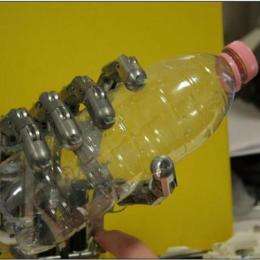
The SmartHand device developed by Professor Yosi Shacham-Diamand and a team of European Union scientists. Credit: AFTAU

In one sense, our hands define our humanity. Our opposable thumbs and our hands' unique structure allow us to write, paint, and play the piano. Those who lose their hands as a result of accident, conflict or disease often feel they've lost more than mere utility.

A new invention from Tel Aviv University researchers may change that. Prof. Yosi Shacham-Diamand of TAU's Department of Engineering, working with a team of European Union scientists, has successfully wired a state-of-the-art artificial hand to existing nerve endings in the stump of a severed arm. The device, called "SmartHand," resembles ― in function, sensitivity and appearance ― a real hand.

Robin af Ekenstam of Sweden, the project's first human subject, has not only been able to complete extremely complicated tasks like eating and writing, he reports he is also able to "feel" his fingers once again.

In short, Prof. Shacham-Diamand and his team have seamlessly rewired Ekenstam's mind to his SmartHand.

Linking mind and machine

Prof. Shacham-Diamand's contribution to the project, on which TAU collaborated with Sweden's Lund University, is the interface between the body's nerves and the device's electronics. "Perfectly good remain at the stem of a severed limb," the researcher says. "Our team is building the interface between the device and the nerves in the arm, connecting cognitive neuroscience with state-of-the-art information technologies."

Prof. Shacham-Diamand runs one of the top labs in the world for nano-bio-interfacing science: the Department of Electrical Engineering ― Physical Electronics Lab under the Bernard L. Schwartz Chair for Nano-scale Information Technologies. "Our challenge," remarks Prof. Shacham-Diamand, "was to make an electrode that was not only flexible, but could be implanted in the human body and function properly for at least 20 years."

The artificial SmartHand, built by a team of top European Union scientists, will belong to Ekenstam, the test subject, as long as he wishes. "After only a few training sessions, he is operating the artificial hand as though it's his own," says Prof. Shacham-Diamand. "We've built in tactile sensors too, so the information transfer goes two ways. These allow Ekenstam to do difficult tasks like eating and writing."

Complexity of a challenging magnitude

Ekenstam told a television interviewer, "I am using muscles which I haven't used for years. I grab something hard, and then I can feel it in the fingertips, which is strange, as I don't have them anymore. It's amazing."

This particular multi-million dollar project focused on hands, but the TAU/EU team could also have built bionic legs to be wired to the brain. The team first chose to build a hand, however, because of its unique challenges. "The fingers in the hand are the most complex appendages we have," Prof. Shacham-Diamand observes. "The brain needs to synchronise the movement of each digit in a very complicated way."

With the help of the TAU team, the SmartHand project was able to integrate recent advances in today's "intelligent" prosthetic hands with all the basic features of a flesh-and-blood hand. Four electric motors and 40 sensors are activated when the SmartHand touches an object, not only replicating the movement of a human hand, but also providing the wearer with a sensation of feeling and touch.

While the prototype looks very "bionic" now, in the future SmartHand scientists plan to equip it with artificial skin that will give the brain even more tactile feedback. The researchers will also study amputees equipped with the SmartHand to understand how to improve the device over time.

Source: Tel Aviv University (news : web)


print this article email this article download pdf blog this article bookmark this article     Stumble it Digg this share on Facebook retweet share on Reddit add to delicious
Rate this story - 5 /5 (12 votes)

Rank Filter

Move the slider to adjust rank threshold, so that you can hide some of the comments.


Display comments: newest first

  • visual - Nov 05, 2009
    • Rank: 5 / 5 (1)
    I am a bit confused about the extent of the machine-nerve interactions in this case.

    This article makes it sound like there is a bi-directional interface, that the subject can both control and feel the hand. But details are disappointingly scarce.
    Does this use targeted muscle re-innervation for controlling the motors, or does it interface directly with the nerves? If the latter, then this is an extremely important break-through by itself... at least I don't think that it's been done before.

    But I guess if it were the case, it would have gotten more hype and given out more details. As it is now, the articles that I found about this focus primarily on the reverse interface - from artificial sensors to nerves. And even the details on that aspect are too limited. I am really curious about the extent of this - how many sensors have been used and how well does the subject distinguish them, what levels of sensitivity does he have, and many other questions.

    This has huge potential.

November 4, 2009 all stories

Comments: 1

5 /5 (12 votes)
  • Stumble this up

  • Digg this

  • share this

  • hide
  • Related Stories

  • Tiny 'lab-on-a-chip' detects pollutants, disease and biological weapons
    created Feb 17, 2009 | popularity not rated yet | comments 0
  • Robotic Hand That Senses Touch (w/ Video)
    created Oct 21, 2009 | popularity not rated yet | comments 0
  • University of Utah to help build bionic arm
    created Apr 24, 2006 | popularity not rated yet | comments 0
  • Scientists develop 'clever' artificial hand
    created Sep 07, 2005 | popularity not rated yet | comments 0
  • Amputees can experience prosthetic hand as their own
    created Dec 11, 2008 | popularity not rated yet | comments 0


  • hide
  • Relevant PhysicsForums posts

  • Aspiring Engineering major looking for general answers
    created Nov 19, 2009
  • Calculating max load of square tube (steel)
    created Nov 19, 2009
  • Passive Chemical Heating
    created Nov 19, 2009
  • Shortening Boat Trailer
    created Nov 18, 2009
  • More from Physics Forums - General Engineering

Other News

plug-in hybrid electric vehicle

Pulling the plug on hybrid myths

Technology / Energy

created Nov 19, 2009 | popularity 3.8 / 5 (12) | comments 16

(PhysOrg.com) -- Whether you call them myths, urban legends, fables or old wives' tales, there's a lot of misinformation out there about plug-in electric hybrid vehicles. These vehicles, abbreviated PHEVs, ...


UK police make 2 Trojan computer virus arrests

Technology / Internet

created Nov 18, 2009 | popularity 5 / 5 (1) | comments 10

(AP) -- A couple suspected of helping spread some of the Internet's most aggressive computer viruses has been arrested in the English city of Manchester, police said Wednesday.


A sign marks the entrance to IBM Corporate Headquarters

IBM makes Big Blue cloud

Technology / Software

created Nov 16, 2009 | popularity 2.9 / 5 (8) | comments 8

IBM on Monday announced it has created the world's largest business computing "cloud" capable of holding an amount of digital data on a par with 250 billion iTunes songs.


Google SPDY

Google's SPDY will speed up downloads

Technology / Internet

created Nov 16, 2009 | popularity 4.4 / 5 (15) | comments 7

(PhysOrg.com) -- As part of its effort to speed up the Web, Google is experimenting with SPDY, a new application layer protocol, that it hopes will speed up the conversation between browsers and Web servers ...


Battery Research Aims To Store Renewable Energy

Battery Research Aims To Store Renewable Energy

Technology / Energy

created Nov 19, 2009 | popularity 3.9 / 5 (11) | comments 5

The biggest chemical battery in the United States is located near Interstate 90 in the small town of Luverne, Minn. The 80 ton device -- the size of two tractor-trailers stacked on top of each other -- stores ...