Earthquakes actually aftershocks of 19th century quakes
November 4, 2009 earthquake

Enlarge

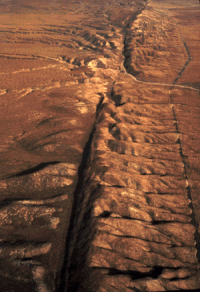
An aerial view of the San Andreas fault in the Carrizo Plain, Central California. Image: USGS, Wikimedia Commons.

(PhysOrg.com) -- When small earthquakes shake the central U.S., citizens often fear the rumbles are signs a big earthquake is coming. Fortunately, new research instead shows that most of these earthquakes are aftershocks of big earthquakes (magnitude 7) in the New Madrid seismic zone that struck the Midwest almost 200 years ago.

The study, conducted by researchers from Northwestern University and the University of Missouri-Columbia, will be published in the Nov. 5 issue of the journal Nature.

"This sounds strange at first," said the study's lead author, Seth Stein, the William Deering Professor of Geological Sciences in the Weinberg College of Arts and Sciences at Northwestern. "On the San Andreas fault in California, aftershocks only continue for about 10 years. But in the middle of a continent, they go on much longer."

There is a good reason, explains co-investigator Mian Liu, professor of geological sciences at Missouri. "Aftershocks happen after a big because the movement on the fault changed the forces in the earth that act on the fault itself and nearby. Aftershocks go on until the fault recovers, which takes much longer in the middle of a continent."

The difference, Stein explains, is that the two sides of the move past each other at a speed of about one and a half inches in a year -- which is fast on a geologic time scale. This motion "reloads" the fault by swamping the small changes caused by the last big earthquake, so aftershocks are suppressed after about 10 years. The New Madrid faults, however, move more than 100 times more slowly, so it takes hundreds of years to swamp the effects of a big earthquake.

"A number of us had suspected this," Liu said, "because many of the earthquakes we see today in the Midwest have patterns that look like aftershocks. They happen on the faults we think caused the big earthquakes in 1811 and 1812, and they've been getting smaller with time."

To test this idea, Stein and Liu used results from lab experiments on how faults in rocks work to predict that aftershocks would extend much longer on slower moving faults. They then looked at data from faults around the world and found the expected pattern. For example, aftershocks continue today from the magnitude 7.2 Hebgen Lake earthquake that shook Montana, Idaho and Wyoming 50 years ago.

"This makes sense because the Hebgen Lake fault moves faster than the New Madrid faults but slower than the San Andreas," Stein noted. "The observations and theory came together the way we like but don't always get."

Aftershocks go on for long times in other places inside continents, Stein said. It even looks like we see small earthquakes today in the area along Canada's Saint Lawrence valley where a large earthquake occurred in 1663.

The new results will help investigators in both understanding earthquakes in continents and trying to assess earthquake hazards there. "Until now," Liu observed, "we've mostly tried to tell where large earthquakes will happen by looking at where small ones do." That's why many scientists were surprised by the disastrous May 2008 magnitude 7.9 earthquake in Sichuan, China -- a place where there hadn't been many earthquakes in the past few hundred years.

"Predicting big quakes based on small quakes is like the 'Whack-a-mole' game -- you wait for the mole to come up where it went down," Stein said. "But we now know the big earthquakes can pop up somewhere else. Instead of just focusing on where small earthquakes happen, we need to use methods like GPS satellites and computer modeling to look for places where the earth is storing up energy for a large future earthquake. We don't see that in the Midwest today, but we want to keep looking."

More information: The Nature paper is titled "Long Aftershock Sequences within Continents and Implications for Earthquake Hazard Assessment."

Source: Northwestern University (news : web)


print this article email this article download pdf blog this article bookmark this article     Stumble it Digg this share on Facebook retweet share on Reddit add to delicious
Rate this story - 4.4 /5 (19 votes)

Rank Filter

Move the slider to adjust rank threshold, so that you can hide some of the comments.


Display comments: newest first

  • Gravity2 - Nov 04, 2009
    • Rank: 2.3 / 5 (3)
    Earthquakes occur along expansion joints. All rivers are expansion fault lines. The Mississippi and the Colorado Rivers quake constantly. The San Andreas is constantly quaking from the mouth of the Colorado up through southern California to Arcarta where it dives into the Pacific and emerges again in Alaska. Alaska also experiences intense earthquake activity contineously. Then there is the Aleutian archipeligo which never stops quaking as Russia separates from Alaska. See my Web page at www.widemargin2000.com to read more about what is happening "as the world quakes"
  • Gravity2 - Nov 04, 2009
    • Rank: 2.3 / 5 (3)
    There is a lot of Media Hypertension about rising sea levels ostensibly as aresult of melting icecaps. Lowlying states like Bangledash will be inundated by twenty feet of rising sea. Nothing of the sort is going to happen. It is all figmental.
    If all the Icecaps melt, and they certainly will not, sea level will not rise. The perennial decline in sea level due to expansion of our planet will effectively negate any rise.
  • vidar_lund - Nov 04, 2009
    • Rank: 3 / 5 (2)
    There is a lot of Media Hypertension about rising sea levels ostensibly as aresult of melting icecaps. Lowlying states like Bangledash will be inundated by twenty feet of rising sea. Nothing of the sort is going to happen. It is all figmental.
    If all the Icecaps melt, and they certainly will not, sea level will not rise. The perennial decline in sea level due to expansion of our planet will effectively negate any rise.

    Excuse me, but how exactly does the earth expand, is it the yeast?
  • StillWind - Nov 05, 2009
    • Rank: 3 / 5 (2)
    The expanding Earth Theory isn't new. In fact it is older than the bogus Plate Tectonic Theory that is currently in vogue.
    One has to wonder how such a ridiculous theory was ever taken seriously, except that many scientists are extremely ignorant of anything but their specific area of study.
    All our current theories are being proven wrong, one by one.
    How can anyone take seriously our cosmology when it relies on a fudge factor of greater than 90%, which is currently being covered up by silly ideas of Dark Matter and Dark energy.
    Anything else that needed such an enormous "fix" would be easily forgotten.
    Science is simply another religion that is protected by priests that hope to preserve their places of power.
  • StillWind - Nov 05, 2009
    • Rank: 1 / 5 (1)
    BTW, Neal Adams explains the mechanism behind the expanding Earth.
  • frajo - Nov 05, 2009
    • Rank: 3 / 5 (2)
    Expanding planet lifts land but not sea?
    Fascinating. None of my 300 SF books told me that story.
  • vidar_lund - Nov 05, 2009
    • Rank: 3 / 5 (2)
    The expanding Earth Theory isn't new. In fact it is older than the bogus Plate Tectonic Theory that is currently in vogue.

    It hasn't occurred to you that any significant expansion of the earths diameter would have been discovered long time ago by the precise measurements done by satellites orbiting the earth? Have you heard about GPS?

    Plate tectonics is not a theory anymore, it is a proven fact that is observed all over the world and the measurement of the movement of the continents is becoming very precise. Again I suggest you google GPS. But I guess the guys that designed the GPS system have conspired with the plate techtonic guys to produce fake measurements.
  • StillWind - Nov 07, 2009
    • Rank: not rated yet
    Plate Tectonics is completely false and easily proven to be so. In fact, I can't think of a more ridiculous idea, but then again I'm just basing my position on physics, paleontology, and observation.
    GPS is irrelevant, as it has only been in use for a short time, and isn't sensitive enough to measurer the small amount of expansion that we've seen since it was put into service..
  • LuckyBrandon - Nov 07, 2009
    • Rank: not rated yet
    plate tectonics makes perfect sense. if you wre to take a super hot ass ball of iron or something, then put a nice thick layer of dense mud around it...what would happen...
    the mud would dry up, then begin to fracture, and as more drying occurred, those fractures would move...
    ..just a simple example there, as to make it more realistic, you would have to have something essentially with currents running through it to simulate magma...but the concept seems sound...

November 4, 2009 all stories

Comments: 9

4.4 /5 (19 votes)
  • Stumble this up

  • Digg this

  • share this

  • hide
  • Related Stories

  • New Madrid fault system may be shutting down
    created Mar 13, 2009 | popularity not rated yet | comments 0
  • Loma Prieta fault not so weak?
    created Dec 19, 2007 | popularity not rated yet | comments 0
  • Geologists study China earthquake for glimpse into future
    created Jul 06, 2008 | popularity not rated yet | comments 0
  • Earthquake in Illinois could portend an emerging threat
    created Apr 24, 2008 | popularity not rated yet | comments 0
  • Scientists explore Sichuan fault
    created Aug 14, 2008 | popularity not rated yet | comments 0


  • hide
  • Relevant PhysicsForums posts

  • HadleyCru data hacked
    created Nov 20, 2009
  • Younger Dryas Caused by Ice Dam Collapse?
    created Nov 17, 2009
  • Modeling rainfall and flooding
    created Nov 15, 2009
  • Is there any scientific explanation for increasingly violent natural disasters?
    created Nov 14, 2009
  • Rocks
    created Nov 11, 2009
  • Himalayan glaciers
    created Nov 11, 2009
  • More from Physics Forums - Earth

Other News

Cassini's Big Sky: The View from the Center of Our Solar System

Cassini's Big Sky: The View from the Center of Our Solar System

Space & Earth / Space Exploration

created 20 hours ago | popularity 4.7 / 5 (10) | comments 1

(PhysOrg.com) -- When NASA's Cassini spacecraft began orbiting Saturn five years ago, a dozen highly-tuned science instruments set to work surveying, sniffing, analyzing and scrutinizing the Saturnian system.


Some 6,000 families were affected by the drought in the Chaco region of Paraguay, particularly indigenous populations

El Nino intensifies Latin America drought

Space & Earth / Earth Sciences

created 22 hours ago | popularity 5 / 5 (2) | comments 0

From a devastating food crisis in Guatemala to water cuts in Venezuela, El Nino has compounded drought damage across Latin America this year.


More than 18 million cubic metres of sand are set to be poured onto the new coastal band of dunes until 2011

Dutch build more dunes against rising seas

Space & Earth / Environment

created 15 hours ago | popularity 4 / 5 (4) | comments 0

On the beach at Monster, bulldozers painstakingly turn sand dredged from the bottom of the North Sea bed into dunes in an ambitious effort to safeguard the Netherlands from flooding.


New Method to Measure Snow, Soil Moisture With GPS May Benefit Meteorologists, Farmers

Space & Earth / Earth Sciences

created 15 hours ago | popularity not rated yet | comments 1

(PhysOrg.com) -- A research team led by the University of Colorado at Boulder has found a clever way to use traditional GPS satellite signals to measure snow depth as well as soil and vegetation moisture, a technique expected ...


Astronauts await word of baby girl on Earth (AP)

Astronauts await word of baby girl on Earth

Space & Earth / Space Exploration

created 16 hours ago | popularity 5 / 5 (1) | comments 0

(AP) -- Atlantis' astronauts anxiously awaited word on the birth of one crewman's daughter Friday, as they moved more supplies into the International Space Station and geared up for another spacewalk.