Organic weed control options for highbush blueberry
November 4, 2009
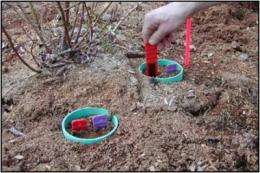
Researchers study mulching options for weed control at Blueberry Acres in Nova Scotia. Credit: Photo courtesy of Derek Lynch
Research scientists at Nova Scotia Agricultural College have been working steadily to find effective organic methods to control weeds in cultivated blueberry crops. One resulting study, published in a recent issue of the ASHS journal HortScience, reported on the efficacy of three organic mulches used on highbush blueberry (HBB) produced under organic production practices. The research team determined that the major factor influencing weed suppression by compost mulches (for certain weed species) was likely mulch thickness and bulk density, which provide a barrier to weed growth and prevents light penetration to the soil surface.
Weeds are a widespread problem for the blueberry industry. North American commercial blueberry producers who took part in a recent survey indicated that weed problems were a concern in almost all production areas, particularly in young plantings when bushes are not fully established and most susceptible to competition. Weed control is even more of a challenge for growers of organic products, including organic highbush blueberry (Vaccinium corymbosum L.). The current study was initiated as an attempt to find feasible, effective organic weed control methods to sustain Nova Scotia's growing blueberry industry.
A two-year field study was conducted in 2005 and 2006 in an established field of 5-year-old northern highbush blueberry at Blueberry Acres, a commercial blueberry operation in the Annapolis Valley of Nova Scotia. Mulches, applied in-row at a 20-cm depth, included pine needles, manure-sawdust compost, and seafood waste compost.
Dr. Derek Lynch, of the Department of Plant and Animal Science at NSAC, headed the research team. According to Lynch, organic materials such as pine bark, peat, and sawdust are commonly used as a preplant soil amendment to increase the organic matter content of mineral soils, but heavy applications of organic mulch can result in high soil salinity and impact plant yield and growth, even resulting in environmental impacts. "Alternately", noted Lynch, "thickly applied organic mulches may be an effective weed management option. Mulch thickness is an important consideration because the emergence of weed seedlings is inversely related to seed depth, meaning the efficacy of weed control tends to increase with mulch thickness."
The study reported that pine needles (PN) were the most effective mulch in suppressing weed growth, with 55% less and 73% less aboveground weed biomass compared with the control in 2005 and 2006, respectively. Pine needle productivity effects were much more modest, however. One year after application, pine needles lost some efficacy at suppressing weeds but the treatment was still superior to both composts. The researchers recommend continuing to topdress PN or similar mulches on a yearly basis to maintain mulch thickness.
Lynch summarized; "This approach can be cost-effective depending on local availability of mulch materials. However, precautions should be taken to avoid excess nutrients from heavy application of nutrient-rich mulches and weed-seed contamination of these types of mulch." He added that more research is needed to evaluate the long-term effects of different mulches on productivity and nutrient availability in these systems.
More information: The complete study and abstract are available on the ASHS HortScience electronic journal web site: http://hortsci.ash … act/44/3/688
Source: American Society for Horticultural Science
-
Biodegradable mulch films on the horizon
Feb 26, 2009 |
not rated yet |
0
-
Organic apple orchard floor maintenance techniques
Sep 04, 2009 |
not rated yet |
0
-
Organic weed control for dandelions
Sep 08, 2009 |
not rated yet |
0
-
Ethanol byproduct produces green results
Jul 02, 2008 |
not rated yet |
0
-
Organic corn: Increasing rotation complexity increases yields
May 28, 2008 |
not rated yet |
0
-
Engineers build first sub-10-nm carbon nanotube transistor
Feb 01, 2012 |
4.9 / 5 (31) |
30
-
Something old, something new: Evolution and the structural divergence of duplicate genes
Jan 31, 2012 |
4.6 / 5 (7) |
1
-
The hidden nanoworld of ice crystals: Revealing the dynamic behavior of quasi-liquid layers
Jan 30, 2012 |
5 / 5 (3) |
1
-
Stock market network reveals investor clustering
Jan 27, 2012 |
3.9 / 5 (23) |
8
-
Of microchemistry and molecules: Electronic microfluidic device synthesizes biocompatible probes
Jan 26, 2012 |
5 / 5 (1) |
0
-
Stem cell question.
Feb 10, 2012
-
Protease cleavage
Feb 10, 2012
-
Pertubance in a model
Feb 10, 2012
-
Cancer drugs and Alzheimer's, Oh my!
Feb 09, 2012
-
Squishing cells
Feb 09, 2012
-
Any books/articles for evolutionary stable strategy models in humans?
Feb 09, 2012
- More from Physics Forums - Biology
More news stories
Entire genome of extinct human decoded from fossil
(PhysOrg.com) -- In 2010, Svante Pääbo and his colleagues presented a draft version of the genome from a small fragment of a human finger bone discovered in Denisova Cave in southern Siberia. The ...
Feb 07, 2012 |
4.7 / 5 (58) |
45
|
Why are there so few fish in the Earth's oceans?
(PhysOrg.com) -- A Stony Brook University researcher has found that, contrary to popular belief, there are not plenty of fish in the sea.
Feb 08, 2012 |
4.3 / 5 (17) |
26
|
Miami battling invasion of giant African snails
No one knows how they got there. But an invasion of African giant snails has southern Florida in a panic over potential crop damage, disease and general yuckiness surrounding the slimy gastropods.
Feb 10, 2012 |
4.5 / 5 (2) |
5
Deciding to go left or right: Researchers use device to determine that lower animals can navigate too
For decades, scientists have associated binary decision making opting to go left or right with higher-ranking animals, including humans. A team of Harvard researchers, however, is rewriting that ...
Feb 09, 2012 |
4 / 5 (1) |
4
|
Study shows chimps able to understand needs of others
(PhysOrg.com) -- By setting up a unique experiment, a small team of researchers has found that chimpanzees are able to understand need in other chimps, despite their general disinclination to offer aid when ...
Google might launch Drive for cloud storage soon
(PhysOrg.com) -- Google's next big move, according to the Wall Street Journal, is a cloud storage service called Drive. Hardly first to the plate, Google is simply catching up to introducing its cloud reposi ...
Latin America mining boom clashes with conservation
Latin America is experiencing a mining boom as prices rise fuelled by a hike in global demand, but the region is also being hit by a wave of violent protests, strikes and rallies by environmentalists.
Walney offshore wind farm is world's biggest (for now)
(PhysOrg.com) -- The Walney wind farm on the Irish Sea--characterized by high tides, waves and windy weather--officially opened this week. The farm is treated in the press as a very big deal as the Walney ...
Love a click away in Indonesia's Twitter Republic
He was a geeky kid from Yogyakarta, she a glamorous city girl in Jakarta. In a country with one of the world's most vibrant social networking scenes they fell in love on Twitter.
GPS court ruling leaves US phone tracking unclear
A US Supreme Court decision requiring a warrant to place a GPS device on the car of a criminal suspect leaves unresolved the bigger issue of police tracking using mobile phones, legal experts say.
Europeans protest controversial Internet pact
Tens of thousands of people marched in protests in more than a dozen European cities Saturday against a controversial anti-online piracy pact that critics say could curtail Internet freedom.