Bacteria expect the unexpected: Scientists observe the emergence of a new adaptation strategy
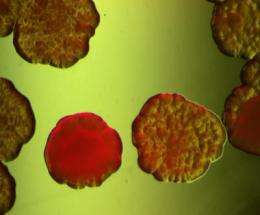
Organisms ensure the survival of their species by genetically adapting to the environment. If environmental conditions change too rapidly, the extinction of a species may be the consequence. A strategy to successfully cope with such a challenge is the generation of variable offspring that can survive in different environments. Even though a portion of the offspring may have a decreased chance to survive, the survival of the species as a whole is guaranteed.
For the first time scientists have now observed the evolution of such a strategy under lab conditions in an experiment with the bacterial species Pseudomonas fluorescens: A bacterial strain exposed to rapidly changing environmental conditions developed the ability to generate variable offspring without additional mutations. This new strategy ensured the survival of the bacterial strain. The results were published in journal Nature, Nov. 5, 2009.
A popular saying already tells an interesting truth, when it recommends "not to put all your eggs in one basket", that is to say spread and hence reduce risks. Also in biology, such strategies are already known and referred to as "bet-hedging". In the process of evolution, bet-hedging is not the usual way of adapting to the environment, in which carriers of advantageous mutations prevail against other individuals that do not show these mutations.
In fact, bet-hedging means that a generation produces offspring that is genetically identical, but differs in the ability to prosper in the current environments: Some offspring is optimally adapted to the current environment, while others thrive under completely different conditions. In case of rapid and drastic changes of the environment, the latter offspring is at an advantage and hence the species survives. The evolutionary advantage of the bet-hedging strategy increases, the more drastically and unpredictably the environmental conditions change. Such risk-spreading mechanisms are, for example, known from bacterial pathogens: By varying their cell surfaces, genetically identical pathogen cells escape the human immune system. Further examples of bet-hedging are known from the animal and plant kingdom.
Christian Kost, scientist at the Max Planck Institute for Chemical Ecology in Jena, Germany, has been working on this topic. Funded by the Alexander von Humboldt Foundation, he studied bacteria of the species Pseudomonas fluorescens at the New Zealand Institute for Advanced Study in Auckland. Due to their short generation time (cells divide every 52 minutes), these bacteria are particularly well suited to study evolution in the test tube. Moreover, the relatively small genome of these organisms facilitates the detection of new mutations.
Advantageous mutations become disadvantages
In their experiments the researchers exposed Pseudomonas strains alternately to unshaken or shaken culture media. Due to beneficial mutations in the genome, new variants emerged in both environments that had an advantage in either the "shaken" or "unshaken" environment. Once emerged, each new variant had to outcompete all other unmutated representatives of the ancestral strain. Under the assumption that one variant that differed in its outer appearance from its parent (for example smooth vs. rough surface) also must have outcompeted the parent strain, the most frequent representative of this new variant was picked and transferred to the respective other environment. Mutations that were advantageous in shaken media became disadvantageous in unshaken environments, and vice versa. As a consequence, new mutations and hence new variants evolved to compensate for this disadvantage. As soon as the bacteria adapted to one environment they were forced to readapt to the second one.
Bet-hedging: One genotype, several variants
The constant changes between shaken and unshaken media soon resulted in the development of types with the same genetic constitution (genotypes), which always produced two different variants. Once emerged, this was the ultimate survival strategy for the bet-hedging pseudomonades, for all other genotypes that produced new variants by mutation only had no chance to prevail against the bet-hedging variants.
Genetic analysis showed that both variants were absolutely identical on a genetic level. Furthermore, the bet-hedging genotype differed by nine mutations from the ancestral strain, with which the experiment had been started. Moreover, the final mutation in the series was causal for bet-hedging. "Our experiments provide evidence that risk-spreading is a very successful strategy to rapidly adapt to changing environments. If the same genotype generates several variants at the same time, it may survive major environmental changes", Christian Kost says. And Paul Rainey, principal investigator of the study at Massey University Auckland, adds: "The rapid and repeatable evolution of bet-hedging during our experiment suggests it may have been one of the earliest evolutionary solutions to life in constantly changing environments".
More information: Hubertus J. E. Beaumont, Jenna Gallie, Christian Kost, Gayle C. Ferguson, Paul B. Rainey: Experimental evolution of bet-hedging. Nature. DOI: 10.1038/nature08504
Source: Max Planck Institute


