Carbon Atmosphere Discovered on Neutron Star
November 4, 2009 Carbon atmosphere discovered on neutron star

Enlarge

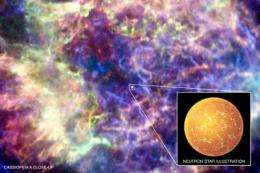
New evidence from Chandra suggests that the neutron star at the center of the Cas A supernova remnant has an ultra-thin carbon atmosphere. This uniform carbon atmosphere would explain the lack of X-ray pulsations from this object because the neutron star would be unlikely to display any changes as it rotates. The absence of pulsations has been a mystery since the neutron star was discovered in Chandra's "First Light" image over a decade ago. The carbon atmosphere is thought to be only about four inches thick, with a density similar to diamond and a pressure more than 10 times that found at the center of the Earth. Credit: X-ray: NASA/CXC/Southampton/W. Ho et al.; Illustration: NASA/CXC/M.Weiss

(PhysOrg.com) -- Evidence for a thin veil of carbon has been found on the neutron star in the Cassiopeia A supernova remnant. This discovery, made with NASA's Chandra X-ray Observatory, resolves a ten-year mystery surrounding this object.

"The compact star at the center of this famous supernova remnant has been an enigma since its discovery," said Wynn Ho of the University of Southampton and lead author of a paper that appears in the latest issue of Nature. "Now we finally understand that it can be produced by a hot neutron star with a carbon ."

By analyzing Chandra's X-ray spectrum - akin to a fingerprint of energy - and applying it to , Ho and his colleague Craig Heinke, from the University of Alberta, determined that the neutron star in A, or Cas A for short, has an ultra-thin coating of carbon. This is the first time the composition of an atmosphere of an isolated neutron star has been confirmed.

The Chandra "First Light" image of Cas A in 1999 revealed a previously undetected point-like source of X-rays at the center. This object was presumed to be a neutron star, the typical remnant of an exploded star, but researchers were unable to understand its properties. Defying astronomers' expectations, this object did not show any X-ray or radio pulsations or any signs of radio pulsar activity.

By applying a model of a neutron star with a carbon atmosphere to this object, Ho and Heinke found that the region emitting would uniformly cover a typical neutron star. This would explain the lack of X-ray pulsations because -- like a lightbulb that shines consistently in all directions -- this neutron star would be unlikely to display any changes in its intensity as it rotates.

Scientists previously have used a neutron star model with a atmosphere giving a much smaller emission area, corresponding to a hot spot on a typical neutron star, which should produce X-ray pulsations as it rotates. Interpreting the hydrogen atmosphere model without pulsations would require a tiny size, consistent only with exotic stars made of strange quark matter.

"Our carbon veil solves one of the big questions about the neutron star in Cas A," said Craig Heinke. "People have been willing to consider some weird explanations, so it's a relief to discover a less peculiar solution."
Carbon atmosphere discovered on neutron star
Enlarge

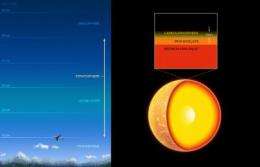
Evidence for a thin carbon atmosphere on a neutron star at the center of Cas A has been found. The properties of the carbon atmosphere are remarkable. It is only about four inches thick, has a density similar to diamond and a pressure more than ten times that found at the center of the Earth. As with the Earth's atmosphere, the extent of an atmosphere on a neutron star is proportional to the atmospheric temperature and inversely proportional to the surface gravity. The temperature is estimated to be almost two million degrees, much hotter than the Earth's atmosphere. However, the surface gravity on Cas A is 100 billion times stronger than on Earth, resulting in an incredibly thin atmosphere. Credit: NASA/CXC/M. Weiss

Unlike most astronomical objects, neutron stars are small enough to understand on a human scale. For example, neutron stars typically have a diameter of about 14 miles, only slightly longer than a half-marathon. The atmosphere of a neutron star is on an even smaller scale. The researchers calculate that the carbon atmosphere is only about 4 inches thick, because it has been compressed by a surface gravity that is 100 billion times stronger than on Earth.

"For people who are used to hearing about immense sizes of things in space, it might be a surprise that we can study something so small," said Ho. "It's also funny to think that such a thin veil over this star played a key role in frustrating researchers."

In Earth's time frame, the estimated age of the neutron star in Cas A is only several hundred years, making it about ten times younger than other neutron stars with detected surface emission. Therefore, the Cas A neutron star gives a unique window into the early life of a cooling neutron star.

The carbon itself comes from a combination of material that has fallen back after the supernova, and nuclear reactions on the hot surface of the neutron star which convert hydrogen and helium into carbon.

The X-ray spectrum and lack of pulsar activity suggest that the magnetic field on the surface of this neutron star is relatively weak. Similarly low magnetic fields are implied for several other young neutron stars by study of their weak X-ray pulsations. It is not known whether these will have low magnetic fields for their entire lives, and never become radio pulsars, or whether processes in their interior will lead to the development of stronger magnetic fields as they age.

Source: Chandra X-ray Center (news : web)


print this article email this article download pdf blog this article bookmark this article     Stumble it Digg this share on Facebook retweet share on Reddit add to delicious
Rate this story - 4.7 /5 (19 votes)

Rank Filter

Move the slider to adjust rank threshold, so that you can hide some of the comments.


Display comments: newest first

  • brant - Nov 04, 2009
    • Rank: not rated yet
    No, it appears there is NO evidence for carbon unless they directly detected it in the spectrum, but it doesnt say that.
    It says "This uniform carbon atmosphere would explain the lack of X-ray pulsations from this object".

    This is a prediction that shows that their model is broken.

    The need for a carbon atmosphere came from the fact that they are using it to fix their broken model.

    ""People have been willing to consider some weird explanations, so it's a relief to discover a less peculiar solution."

    Neutron stars are a weird solution to a simple plasma problem!

November 4, 2009 all stories

Comments: 1

4.7 /5 (19 votes)
  • Stumble this up

  • Digg this

  • share this

  • hide
  • Related Stories

  • Chandra Finds Star With a Mystery Partner
    created Jul 11, 2007 | popularity not rated yet | comments 0
  • The case of the neutron star with a wayward wake
    created Jun 01, 2006 | popularity not rated yet | comments 0
  • Possible closest neutron star to Earth found
    created Aug 20, 2007 | popularity not rated yet | comments 0
  • Neutron stars join the black hole jet set
    created Jun 27, 2007 | popularity not rated yet | comments 0
  • Chandra Spies Cosmic Fireworks
    created Jul 14, 2006 | popularity not rated yet | comments 0


  • hide
  • Relevant PhysicsForums posts

  • basic 'our universe' question..
    created 4 hours ago
  • deriving keplers law
    created Nov 19, 2009
  • rotation of Earth
    created Nov 18, 2009
  • elliptical orbits
    created Nov 18, 2009
  • Apophis
    created Nov 18, 2009
  • Summer Research project
    created Nov 18, 2009
  • More from Physics Forums - General Astronomy

Other News

Cassini's Big Sky: The View from the Center of Our Solar System

Cassini's Big Sky: The View from the Center of Our Solar System

Space & Earth / Space Exploration

created 12 hours ago | popularity 4.7 / 5 (10) | comments 1

(PhysOrg.com) -- When NASA's Cassini spacecraft began orbiting Saturn five years ago, a dozen highly-tuned science instruments set to work surveying, sniffing, analyzing and scrutinizing the Saturnian system.


More than 18 million cubic metres of sand are set to be poured onto the new coastal band of dunes until 2011

Dutch build more dunes against rising seas

Space & Earth / Environment

created 7 hours ago | popularity 3.7 / 5 (3) | comments 0

On the beach at Monster, bulldozers painstakingly turn sand dredged from the bottom of the North Sea bed into dunes in an ambitious effort to safeguard the Netherlands from flooding.


New Method to Measure Snow, Soil Moisture With GPS May Benefit Meteorologists, Farmers

Space & Earth / Earth Sciences

created 7 hours ago | popularity not rated yet | comments 1

(PhysOrg.com) -- A research team led by the University of Colorado at Boulder has found a clever way to use traditional GPS satellite signals to measure snow depth as well as soil and vegetation moisture, a technique expected ...


Some 6,000 families were affected by the drought in the Chaco region of Paraguay, particularly indigenous populations

El Nino intensifies Latin America drought

Space & Earth / Earth Sciences

created 15 hours ago | popularity 5 / 5 (2) | comments 0

From a devastating food crisis in Guatemala to water cuts in Venezuela, El Nino has compounded drought damage across Latin America this year.


NJIT receives funding to improve Big Bear Telescope, study solar energy

NJIT receives funding to improve Big Bear Telescope, study solar energy

Space & Earth / Astronomy

created 5 hours ago | popularity 4 / 5 (2) | comments 0

NJIT researchers are at work on many scientific and technological frontiers. The National Science Foundation has recently provided support that totals nearly $4.3 million for the diverse efforts of the following ...